S. Swann - Prophets
Здесь есть возможность читать онлайн «S. Swann - Prophets» весь текст электронной книги совершенно бесплатно (целиком полную версию без сокращений). В некоторых случаях можно слушать аудио, скачать через торрент в формате fb2 и присутствует краткое содержание. Жанр: Старинная литература, на английском языке. Описание произведения, (предисловие) а так же отзывы посетителей доступны на портале библиотеки ЛибКат.
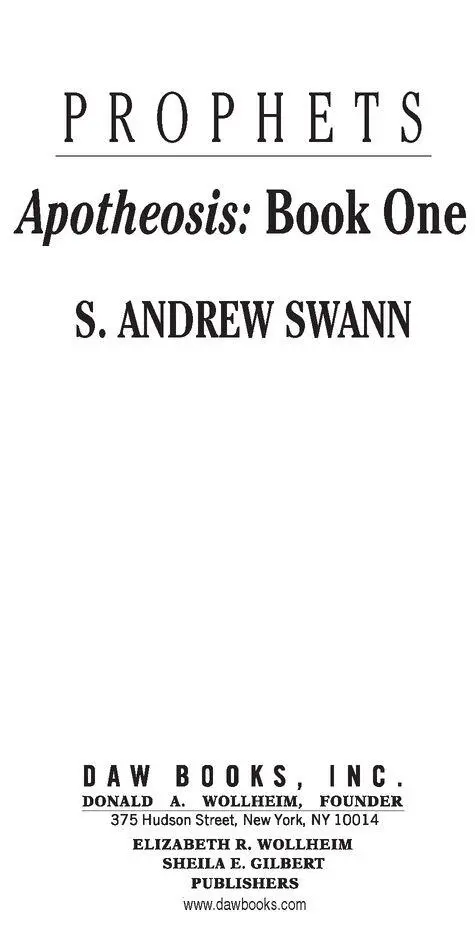
- Название:Prophets
- Автор:
- Жанр:
- Год:неизвестен
- ISBN:нет данных
- Рейтинг книги:3 / 5. Голосов: 1
-
Избранное:Добавить в избранное
- Отзывы:
-
Ваша оценка:
Prophets: краткое содержание, описание и аннотация
Предлагаем к чтению аннотацию, описание, краткое содержание или предисловие (зависит от того, что написал сам автор книги «Prophets»). Если вы не нашли необходимую информацию о книге — напишите в комментариях, мы постараемся отыскать её.
Prophets — читать онлайн бесплатно полную книгу (весь текст) целиком
Ниже представлен текст книги, разбитый по страницам. Система сохранения места последней прочитанной страницы, позволяет с удобством читать онлайн бесплатно книгу «Prophets», без необходимости каждый раз заново искать на чём Вы остановились. Поставьте закладку, и сможете в любой момент перейти на страницу, на которой закончили чтение.
Интервал:
Закладка:
He saw the twist and political outlines of the Alpha Centauri Alliance as well as the plastic cases holding the holo screens mounted on the walls around him. He could feel the proxy tendrils of the Vatican pushing toward the Caliphate as concretely as he felt the engineered leather of the chair he sat on.
And from a dozen different subtle directions, he felt something pressing into fringes of human space. Information was leaking in from outside . . .
Xi Virginis.
Mosasa knew about the colonies in that direction of space. He knew about them since their founding. He was old enough to have personally known some of the people who had founded them.
He had also known that they didn’t interact with the main body of human space. For a decade or so, those colonies’ only impact had been the knowledge of their existence in the upper levels of the Caliphate, the Vatican, and their proxies. Mosasa had seen that knowledge channel human actions on the highest levels, a stalemate where those in power did not act for fear of prompting their rivals to act. It was a stable equilibrium that should have endured for decades more.
Something was tipping the equilibrium. Some unseen stream of data was feeding into the equation. Some unknown was moving the Vatican and the Caliphate. Mosasa saw the resources moving, but not the reason.
But like a black hole moving through a galaxy, he might not see the source of the distortion, though seeing the effects was enough for him to give the location of the unknown.
Xi Virginis.
The unknown drew him, even though he knew that if he moved himself, it would further upset the equilibrium. He told himself that, as long as an unknown this large loomed within these far-flung colonies, the stability he saw was illusory.
It wasn’t even really a decision. As soon as he knew that the unknown existed, there was a hole in the fabric of his universe. He would have to investigate it. The only decision was how he would do so, and what individual threads from the human universe he would pull in behind him to help patch the hole.
Parvi looked at the list of names on the cyberplas sheet in her hand. She read the capsule biographies and shook her head. “Why go to so much trouble? There are plenty of scientists on Bakunin.”
“Perspective,” Mosasa said. His tone was flat, as always, and it irritated Parvi how it never quite became mechanical. He should speak in a synthetic monotone; sounding like a disinterested human being was just wrong .
She knew her irritation was irrational. An artificial voice could sound indistinguishable from human even when not spoken by an illegal self-aware AI. However, most programmers were polite enough to slip in some sort of audible hook, just so you knew there wasn’t a real person behind the speech.
Parvi looked up at Mosasa.
That was the other thing. He looked like a real person. A tall, sculpted man with hairless brown skin covered with photoreactive tattoos and body jewelry. He might have been handsome if it wasn’t for the dragon’s head drawn across the side of his skull and a third of his face. She knew that a long time ago there was a human being named Mosasa, and that man looked pretty much the way Mosasa looked now.
She also knew that man had been dead for at least a couple of centuries.
“What do you mean, ‘perspective’?” Her words echoed in the hangar while Mosasa stood with his back to her. He was doing something inscrutable to the drive section of a Scimitar fighter, an old stealth design from the Caliphate that had somehow ended up in the possession of Mosasa Salvage.
“I am investigating something unknown,” he said without turning around. “An unknown whose shape implies an impact that could involve all of human space. Having a wide section of social and political background in personnel will be an aid to my analysis.”
“I see.”
“After you make contact with the science team and arrange for their arrival here, I will need you to assemble the military team.”
“I don’t see any military personnel here.”
“All in time.” He waved a hand, dismissing her.
She sighed and turned around, walking out of the hangar.
Parvi hated working for Mosasa. It made her skin crawl whenever she was in his presence. It was with a palpable physical relief that she walked out of the hangar and into the desert air on the outskirts of Proudhon. It wasn’t just that he was an AI. That was bad enough. The taboo against Artificial Intelligence devices of any sort were broad and deep in every human culture, dating from the Genocide War with the Race over four hundred years ago. Seeing what the Race-built AIs could do with their social programming was enough to put that tech in a class of evil only shared by self-replicating nanotechnology and the genetic engineering of sapient creatures.
No, Mosasa couldn’t just be an AI, living on the lawless world Bakunin, the only place where he didn’t face summary destruction. No, Mosasa had to be an AI built by the Race itself, a remnant of an old weapon surviving long past the war for which it was built, a weapon that in some sick fashion had learned to mimic a human being.
But Mosasa paid well, and Parvi needed the money.
So she tucked the cyberplas sheet into her pocket, got onto her contragrav bike, and shot back toward Proudhon. She had a bunch of tach-comm calls to make on her boss’ behalf.
CHAPTER NINE
Initiations
The shortest freeway will have the highest toll.
—The Cynic’s Book of Wisdom
If you would win a man to your cause, first convince him that you are his sincere friend.
—ABRAHAM Lincoln (1809-1865)
Date: 2525.11.18 (Standard) Bakunin-BD+50°1725
The whole process of registering as a member of the BMU alternately fascinated and appalled Mallory. The academic in him was fascinated with how the BMU operated and seeing the detailed workings of a society that operated on completely different premises than his own. The Marine in him was offended by the military pretense of an organization that, for the most part, didn’t have a chain of command above the squad level—un-uniformed and mostly unregulated. The Catholic in him kept seeing the implications of a world whose only military was essentially a group of semiorganized thugs for hire.
To which, the academic in him responded, How is that different from most of human history?
The more he saw of the way Bakunin worked, the more he saw parallels to medieval Europe; the social rationalizations and beliefs might be different, but the BMU reminded him of landless knights. All they lacked was dispensation from the pope to go on a crusade and keep them from ravaging the countryside.
One major difference, though, was in the area of skill assessment. Apparently, any idiot with a gun and some money could join the BMU—gun optional. But if you wanted to be a working member, and do more that pay the union protection money, you needed a rating. You could put anything you wanted on your résumé narrative—experience in hand-to-hand combat, fighter pilot, special forces, covert ops—but what mattered was BMU’s own assessment.
In the chaotic economy that was Bakunin, it was worth it to pay for a known quantity. Someone hiring a union mercenary was getting a known skill set. It might be more expensive than hiring random thugs off the street, but it was less prone to surprises. Also attractive to a potential employer, a lot of the BMU’s few regulations were specifically intended to prevent their members from turning on their employers. Hire someone from BMU, and you were assured that the whole weight of the union would fall on a member who double-crossed you. Of course the converse was also true; union members had the muscle of the BMU to back them if their employer ever double-crossed them.
Читать дальшеИнтервал:
Закладка:
Похожие книги на «Prophets»
Представляем Вашему вниманию похожие книги на «Prophets» списком для выбора. Мы отобрали схожую по названию и смыслу литературу в надежде предоставить читателям больше вариантов отыскать новые, интересные, ещё непрочитанные произведения.



Обсуждение, отзывы о книге «Prophets» и просто собственные мнения читателей. Оставьте ваши комментарии, напишите, что Вы думаете о произведении, его смысле или главных героях. Укажите что конкретно понравилось, а что нет, и почему Вы так считаете.