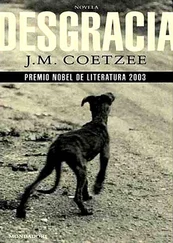
J. Coetzee - Disgrace
Здесь есть возможность читать онлайн «J. Coetzee - Disgrace» весь текст электронной книги совершенно бесплатно (целиком полную версию без сокращений). В некоторых случаях можно слушать аудио, скачать через торрент в формате fb2 и присутствует краткое содержание. Жанр: Старинная литература, на русском языке. Описание произведения, (предисловие) а так же отзывы посетителей доступны на портале библиотеки ЛибКат.
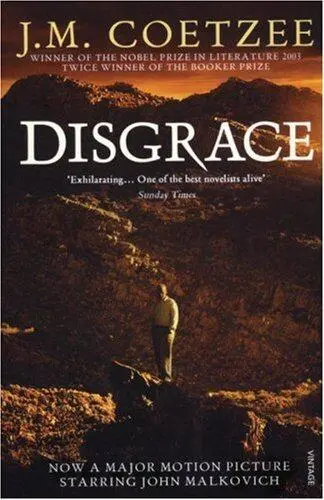
- Название:Disgrace
- Автор:
- Жанр:
- Год:неизвестен
- ISBN:нет данных
- Рейтинг книги:5 / 5. Голосов: 1
-
Избранное:Добавить в избранное
- Отзывы:
-
Ваша оценка:
Disgrace: краткое содержание, описание и аннотация
Предлагаем к чтению аннотацию, описание, краткое содержание или предисловие (зависит от того, что написал сам автор книги «Disgrace»). Если вы не нашли необходимую информацию о книге — напишите в комментариях, мы постараемся отыскать её.
Disgrace — читать онлайн бесплатно полную книгу (весь текст) целиком
Ниже представлен текст книги, разбитый по страницам. Система сохранения места последней прочитанной страницы, позволяет с удобством читать онлайн бесплатно книгу «Disgrace», без необходимости каждый раз заново искать на чём Вы остановились. Поставьте закладку, и сможете в любой момент перейти на страницу, на которой закончили чтение.
Интервал:
Закладка:
'I have a daughter myself, you will be interested to hear. She owns a farm; I expect to spend some of my time with her, helping out. Also I have a book to complete, a sort of book. One way or another I will keep myself busy.'
He pauses. Isaacs is regarding him with what strikes him as piercing attention.
'So,' says Isaacs softly, and the word leaves his lips like a sigh: 'how are the mighty fallen!'
Fallen? Yes, there has been a fall, no doubt about that. But mighty? Does mighty describe him? He thinks of himself as obscure and growing obscurer. A figure from the margins of history.
`Perhaps it does us good', he says, 'to have a fall every now and then. As long as we don't break.'
'Good. Good. Good,' says Isaacs, still fixing him with that intent look. For the first time he detects a trace of Melanie in him: a shapeliness of the mouth and lips. On an impulse he reaches across the desk, tries to shake the man's hand, ends up by stroking the back of it. Cool, hairless skin.
'Mr Lurie,' says Isaacs: 'is there something else you want to tell me, besides the story of yourself and Melanie? You mentioned there was something on your heart.'
‘On my heart? No. No, I just stopped by to find out how Melanie was.' He rises. 'Thank you for seeing me, I appreciate it.' He reaches out a hand, straightforwardly this time. 'Goodbye.'
'Goodbye.'
He is at the door - he is, in fact, in the outer office, which is now empty - when Isaacs calls out: 'Mr Lurie!
Just a minute!' He returns.
`What are your plans for the evening?'
'This evening? I've checked in at a hotel. I have no plans.'
'Come and have a meal with us. Come for dinner.'
'I don't think your wife would welcome that.'
'Perhaps. Perhaps not. Come anyway. Break bread with us. We eat at seven. Let me write down the address for you.'
‘You don't need to do that. I have been to your home already, and met your daughter. It was she who directed me here.' Isaacs does not bat an eyelid. 'Good,' he says.
The front door is opened by Isaacs himself. 'Come in, come in,' he says, and ushers him into the livingroom. Of the wife there is no sign, nor of the second daughter.
'I brought an offering,' he says, and holds out a bottle of wine.
Isaacs thanks him, but seems unsure what to do with the wine. Van I give you some? I'll just go and open it.' He leaves the room; there is a whispering in the kitchen. He comes back. 'We seem to have lost the corkscrew. But Dezzy will borrow from the neighbours.'
They are teetotal, clearly. He should have thought of that. A tight little petit-bourgeois household, frugal, prudent. The car washed, the lawn mowed, savings in the bank. All their resources concentrated on launching the two jewel daughters into the future: clever Melanie, with her theatrical ambitions; Desiree, the beauty.
He remembers Melanie, on the first evening of their closer acquaintance, sitting beside him on the sofa drinking the coffee with the shot-glass of whisky in it that was intended to - the word comes up reluctantly - lubricate her. Her trim little body; her sexy clothes; her eyes gleaming with excitement. Stepping out in the forest where the wild wolf prowls.
Desiree the beauty enters with the bottle and a corkscrew. As she crosses the floor towards them she hesitates an instant, conscious that a greeting is owed. 'Pa?' she murmurs with a hint of confusion, holding out the bottle.
So: she has found out who he is. They have discussed him, had a tussle over him perhaps: the unwanted visitor, the man whose name is darkness.
Her father has trapped her hand in his. 'Desiree,' he says, 'this is Mr Lurie.'
`Hello, Desiree.'
The hair that had screened her face is tossed back. She meets his gaze, still embarrassed, but stronger now that she is under her father's wing. 'Hello,' she murmurs; and he thinks, My God, my God!
As for her, she cannot hide from him what is passing through her mind: So this is the man my sister has been naked with! So this is the man she has done it with! This old man!
There is a separate little dining-room, with a hatch to the kitchen. Four places are set with the best cutlery; candles are burning. 'Sit, sit!' says Isaacs. Still no sign of his wife. 'Excuse me a moment.' Isaacs disappears into the kitchen. He is left facing Desiree across the table. She hangs her head, no longer so brave.
Then they return, the two parents together. He stands up. 'You haven't met my wife. Doreen, our guest, Mr Lurie.'
'I am grateful to you for receiving me in your home, Mrs Isaacs.'
Mrs Isaacs is a short woman, growing dumpy in middle age, with bowed legs that give her a faintly rolling walk. But he can see where the sisters get their looks. A real beauty she must have been in her day. Her features remain stiff, she avoids his eye, but she does give the slightest of nods. Obedient; a good wife and helpmeet. And ye shall be as one flesh. Will the daughters take after her?
'Desiree,' she commands, 'come and help carry.'
Gratefully the child tumbles out of her chair.
'Mr Isaacs, I am just causing upset in your home,' he says. 'It was kind of you to invite me, I appreciate it, but it is better that I leave.'
Isaacs gives a smile in which, to his surprise, there is a hint of gaiety. 'Sit down, sit down! We'll be all right! We will do it!' He leans closer. 'You have to be strong!'
Then Desiree and her mother are back bearing dishes: chicken in a bubbling tomato stew that gives off aromas of ginger and cumin, rice, an array of salads and pickles. Just the kind of food he most missed, living with Lucy.
The bottle of wine is set before him, and a solitary wine glass. 'Am I the only one drinking?' he says.
`Please,' says Isaacs. 'Go ahead.'
He pours a glass. He does not like sweet wines, he bought the Late Harvest imagining it would be to their taste. Well, so much the worse for him.
There remains the prayer to get through. The Isaacs take hands; there is nothing for it but to stretch out his hands too, left to the girl's father, right to her mother. 'For what we are about to receive, may the Lord make us truly grateful,' says Isaacs. 'Amen,' say his wife and daughter; and he, David Lurie, mumbles
'Amen' too and lets go the two hands, the father's cool as silk, the mother's small, fleshy, warm from her labours.
Mrs Isaacs dishes up. 'Mind, it's hot,' she says as she passes his plate. Those are her only words to him. During the meal he tries to be a good guest, to talk entertainingly, to fill the silences. He talks about Lucy, about the boarding kennels, about her bee-keeping and her horticultural projects, about his Saturday morning stints at the market. He glosses over the attack, mentioning only that his car was stolen. He talks about the Animal Welfare League, but not about the incinerator in the hospital grounds or his stolen afternoons with Bev Shaw.
Stitched together in this way, the story unrolls without shadows. Country life in all its idiot simplicity. How he wishes it could be true! He is tired of shadows, of complications, of complicated people. He loves his daughter, but there are times when he wishes she were a simpler being: simpler, neater. The man who raped her, the leader of the gang, was like that. Like a blade cutting the wind.
He has a vision of himself stretched out on an operating table. A scalpel flashes; from throat to groin he is laid open; he sees it all yet feels no pain. A surgeon, bearded, bends over him, frowning. What is all this stuff? growls the surgeon. He pokes at the gall bladder. What is this? He cuts it out, tosses it aside. He pokes at the heart. What is this?
'Your daughter - does she run her farm all alone?' asks Isaacs.
'She has a man who helps sometimes. Petrus. An African.' And he talks about Petrus, solid, dependable Petrus, with his two wives and his moderate ambitions.
Читать дальшеИнтервал:
Закладка:
Похожие книги на «Disgrace»
Представляем Вашему вниманию похожие книги на «Disgrace» списком для выбора. Мы отобрали схожую по названию и смыслу литературу в надежде предоставить читателям больше вариантов отыскать новые, интересные, ещё непрочитанные произведения.




Обсуждение, отзывы о книге «Disgrace» и просто собственные мнения читателей. Оставьте ваши комментарии, напишите, что Вы думаете о произведении, его смысле или главных героях. Укажите что конкретно понравилось, а что нет, и почему Вы так считаете.