J. Coetzee - Disgrace
Здесь есть возможность читать онлайн «J. Coetzee - Disgrace» весь текст электронной книги совершенно бесплатно (целиком полную версию без сокращений). В некоторых случаях можно слушать аудио, скачать через торрент в формате fb2 и присутствует краткое содержание. Жанр: Старинная литература, на русском языке. Описание произведения, (предисловие) а так же отзывы посетителей доступны на портале библиотеки ЛибКат.
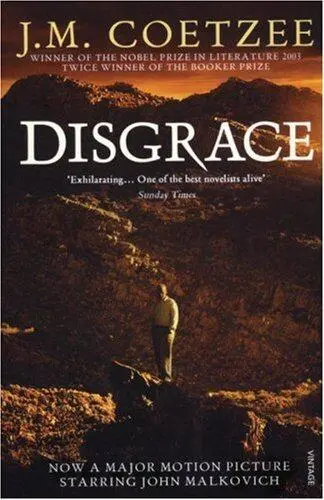
- Название:Disgrace
- Автор:
- Жанр:
- Год:неизвестен
- ISBN:нет данных
- Рейтинг книги:5 / 5. Голосов: 1
-
Избранное:Добавить в избранное
- Отзывы:
-
Ваша оценка:
Disgrace: краткое содержание, описание и аннотация
Предлагаем к чтению аннотацию, описание, краткое содержание или предисловие (зависит от того, что написал сам автор книги «Disgrace»). Если вы не нашли необходимую информацию о книге — напишите в комментариях, мы постараемся отыскать её.
Disgrace — читать онлайн бесплатно полную книгу (весь текст) целиком
Ниже представлен текст книги, разбитый по страницам. Система сохранения места последней прочитанной страницы, позволяет с удобством читать онлайн бесплатно книгу «Disgrace», без необходимости каждый раз заново искать на чём Вы остановились. Поставьте закладку, и сможете в любой момент перейти на страницу, на которой закончили чтение.
Интервал:
Закладка:
He had thought he would get used to it. But that is not what happens. The more killings he assists in, the more jittery he gets. One Sunday evening, driving home in Lucy's kombi, he actually has to stop at the roadside to recover himself. Tears flow down his face that he cannot stop; his hands shake.
He does not understand what is happening to him. Until now he has been more or less indifferent to animals. Although in an abstract way he disapproves of cruelty, he cannot tell whether by nature he is cruel or kind. He is simply nothing. He assumes that people from whom cruelty is demanded in the line of duty, people who work in slaughterhouses, for instance, grow carapaces over their souls. Habit hardens: it must be so in most cases, but it does not seem to be so in his. He does not seem to have the gift of hardness.
His whole being is gripped by what happens in the theatre. He is convinced the dogs know their time has come. Despite the silence and the painlessness of the procedure, despite the good thoughts that Bev Shaw thinks and that he tries to think, despite the airtight bags in which they tie the newmade corpses, the dogs in the yard smell what is going on inside. They flatten their ears, they droop their tails, as if they too feel the disgrace of dying; locking their legs, they have to be pulled or pushed or carried over the threshold. On the table some snap wildly left and right, some whine plaintively; none will look straight at the needle in Bev's hand, which they somehow know is going to harm them terribly.
Worst are those that sniff him and try to lick his hand. He has never liked being licked, and his first impulse is to pull away. Why pretend to be a chum when in fact one is a murderer? But then he relents. Why should a creature with the shadow of death upon it feel him flinch away as if its touch were abhorrent? So he lets them lick him, if they want to, just as Bev Shaw strokes them and kisses them if they will let her.
He is not, he hopes, a sentimentalist. He tries not to sentimentalize the animals he kills, or to sentimentalize Bev Shaw. He avoids saying to her, 'I don't know how you do it,' in order not to have to hear her say in return, 'Someone has to do it.' He does not dismiss the possibility that at the deepest level Bev Shaw may be not a liberating angel but a devil, that beneath her show of compassion may hide a heart as leathery as a butcher's. He tries to keep an open mind.
Since Bev Shaw is the one who inflicts the needle, it is he who takes charge of disposing of the remains. The morning after each killing session he drives the loaded kombi to the grounds of Settlers Hospital, to the incinerator, and there consigns the bodies in their black bags to the flames. It would be simpler to cart the bags to the incinerator immediately after the session and leave them there for the incinerator crew to dispose of. But that would mean leaving them on the dump with the rest of the weekend's scourings: with waste from the hospital wards, carrion scooped up at the roadside, malodorous refuse from the tannery - a mixture both casual and terrible. He is not prepared to inflict such dishonour upon them.
So on Sunday evenings he brings the bags to the farm in the back of Lucy's kombi, parks them overnight, and on Monday mornings drives them to the hospital grounds. There he himself loads them, one at a time, on to the feeder trolley, cranks the mechanism that hauls the trolley through the steel gate into the flames, pulls the lever to empty it of its contents, and cranks it back, while the workmen whose job this normally is stand by and watch.
On his first Monday he left it to them to do the incinerating. Rigor mortis had stiffened the corpses overnight. The dead legs caught in the bars of the trolley, and when the trolley came back from its trip to the furnace, the dog would as often as not come riding back too, blackened and grinning, smelling of singed fur, its plastic covering burnt away. After a while the workmen began to beat the bags with the backs of their shovels before loading them, to break the rigid limbs. It was then that he intervened and took over the job himself. The incinerator is anthracite-fuelled, with an electric fan to suck air through the flues; he guesses that it dates from the 1950s, when the hospital itself was built. It operates six days of the week, Monday to Saturday. On the seventh day it rests. When the crew arrive for work they first rake out the ashes from the previous day, then charge the fire. By nine a.m. temperatures of a thousand degrees centigrade are being generated in the inner chamber, hot enough to calcify bone. The fire is stoked until mid-morning; it takes all afternoon to cool down.
He does not know the names of the crew and they do not know his. To them he is simply the man who began arriving on Mondays with the bags from Animal Welfare and has since then been turning up earlier and earlier. He comes, he does his work, he goes; he does not form part of the society of which the incinerator, despite the wire fence and the padlocked gate and the notice in three languages, is the hub. For the fence has long ago been cut through; the gate and the notice are simply ignored. By the time the orderlies arrive in the morning with the first bags of hospital waste, there are already numbers of women and children waiting to pick through it for syringes, pins, washable bandages, anything for which there is a market, but particularly for pills, which they sell to muti shops or trade in the streets. There are vagrants too, who hang about the hospital grounds by day and sleep by night against the wall of the incinerator, or perhaps even in the tunnel, for the warmth.
It is not a sodality he tries to join. But when he is there, they are there; and if what he brings to the dump does not interest them, that is only because the parts of a dead dog can neither be sold nor be eaten. Why has he taken on this job? To lighten the burden on Bev
Shaw? For that it would be enough to drop off the bags at the dump and drive away. For the sake of the dogs? But the dogs are dead; and what do dogs know of honour and dishonour anyway?
For himself, then. For his idea of the world, a world in which men do not use shovels to beat corpses into a more convenient shape for processing.
The dogs are brought to the clinic because they are unwanted: because we are too menny. That is where he enters their lives. He may not be their saviour, the one for whom they are not too many, but he is prepared to take care of them once they are unable, utterly unable, to take care of themselves, once even Bev Shaw has washed her hands of them. A dog-man, Petrus once called himself. Well, now he has become a dogman: a dog undertaker; a dog psychopomp; a harijan. Curious that a man as selfish as he should be offering himself to the service of dead dogs. There must be other, more productive ways of giving oneself to the world, or to an idea of the world. One could for instance work longer hours at the clinic. One could try to persuade the children at the dump not to fill their bodies with poisons. Even sitting down more purposefully with the Byron libretto might, at a pinch, be construed as a service to mankind.
But there are other people to do these things - the animal welfare thing, the social rehabilitation thing, even the Byron thing. He saves the honour of corpses because there is no one else stupid enough to do it. That is what he is becoming: stupid, daft, wrongheaded.
SEVENTEEN
THEIR WORK AT the clinic is over for the Sunday. The kombi is loaded with its dead freight. As a last chore he is mopping the floor of the surgery.
'I'll do that,' says Bev Shaw, coming in from the yard. 'You'll be wanting to get back.'
'I'm in no hurry.'
'Still, you must be used to a different kind of life.'
'A different kind of life? I didn't know life came in kinds.'
Читать дальшеИнтервал:
Закладка:
Похожие книги на «Disgrace»
Представляем Вашему вниманию похожие книги на «Disgrace» списком для выбора. Мы отобрали схожую по названию и смыслу литературу в надежде предоставить читателям больше вариантов отыскать новые, интересные, ещё непрочитанные произведения.










Обсуждение, отзывы о книге «Disgrace» и просто собственные мнения читателей. Оставьте ваши комментарии, напишите, что Вы думаете о произведении, его смысле или главных героях. Укажите что конкретно понравилось, а что нет, и почему Вы так считаете.