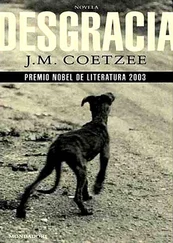
J. Coetzee - Disgrace
Здесь есть возможность читать онлайн «J. Coetzee - Disgrace» весь текст электронной книги совершенно бесплатно (целиком полную версию без сокращений). В некоторых случаях можно слушать аудио, скачать через торрент в формате fb2 и присутствует краткое содержание. Жанр: Старинная литература, на русском языке. Описание произведения, (предисловие) а так же отзывы посетителей доступны на портале библиотеки ЛибКат.
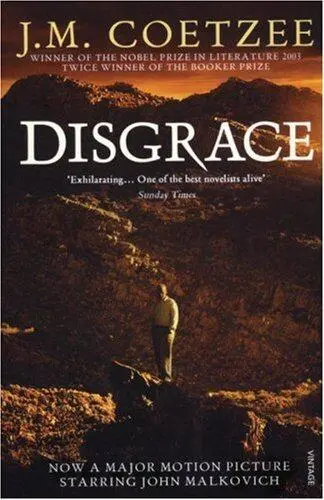
- Название:Disgrace
- Автор:
- Жанр:
- Год:неизвестен
- ISBN:нет данных
- Рейтинг книги:5 / 5. Голосов: 1
-
Избранное:Добавить в избранное
- Отзывы:
-
Ваша оценка:
Disgrace: краткое содержание, описание и аннотация
Предлагаем к чтению аннотацию, описание, краткое содержание или предисловие (зависит от того, что написал сам автор книги «Disgrace»). Если вы не нашли необходимую информацию о книге — напишите в комментариях, мы постараемся отыскать её.
Disgrace — читать онлайн бесплатно полную книгу (весь текст) целиком
Ниже представлен текст книги, разбитый по страницам. Система сохранения места последней прочитанной страницы, позволяет с удобством читать онлайн бесплатно книгу «Disgrace», без необходимости каждый раз заново искать на чём Вы остановились. Поставьте закладку, и сможете в любой момент перейти на страницу, на которой закончили чтение.
Интервал:
Закладка:
`What about?'
A tape recorder is thrust toward him. He pushes it away. ‘About how it was,' says the girl.
`How what was?'
The camera flashes again.
`You know, the hearing.'
‘I can't comment on that.'
‘OK, so what can you comment on?'
`There is nothing I want to comment on.'
The loiterers and the curious have begun to crowd around. If he wants to get away, he will have to push through them. ‘Are you sorry?' says the girl. The recorder is thrust closer. Do you regret what you did?'
`No,' he says. 'I was enriched by the experience.'
The smile remains on the girl's face. 'So would you do it again?'
‘I don't think I will have another chance.'
`But if you had a chance?'
`That isn't a real question.'
She wants more, more words for the belly of the little machine, but for the moment is at a loss for how to suck him into further indiscretion.
`He was what by the experience?' he hears someone ask sotto voce. `He was enriched.'
There is a titter.
‘Ask him if he apologized,' someone calls to the girl.
‘I already asked.'
Confessions, apologies: why this thirst for abasement? A hush falls. They circle around him like hunters who have cornered a strange beast and do not know how to finish it off.
The photograph appears in the next day's student newspaper, above the caption 'Who's the Dunce Now?' It shows him, eyes cast up to the heavens, reaching out a groping hand toward the camera. The pose is ridiculous enough in itself, but what makes the picture a gem is the inverted waste-paper basket that a young man, grinning broadly, holds above him. By a trick of perspective the basket appears to sit on his head like a dunce's hat. Against such an image, what chance has he?
`Committee tight-lipped on verdict,' reads the headline. 'The disciplinary committee investigating charges of harassment and misconduct against Communications Professor David Lurie was tight-lipped yesterday on its verdict. Chair Manas Mathabane would say only that its findings have been forwarded to the Rector for action.
`Sparring verbally with members of WAR after the hearing, Lurie (53) said he had found his experiences with women students "enriching".
`Trouble first erupted when complaints against Lurie, an expert on romantic poetry, were filed by students in his classes.'
He has a call at home from Mathabane. 'The committee has passed on its recommendation, David, and the Rector has asked me to get back to you one last time. He is prepared not to take extreme measures, he says, on condition that you issue a statement in your own person which will be satisfactory from our point of view as well as yours.'
`Manas, we have been over that ground. I - '
`Wait. Hear me out. I have a draft statement before me which would satisfy our requirements. It is quite short. May I read it to you?'
`Read it.'
Mathabane reads: 'I acknowledge without reservation serious abuses of the human rights of the complainant, as well as abuse of the authority delegated to me by the University. I sincerely apologize to both parties and accept whatever appropriate penalty may be imposed.'
' "Whatever appropriate penalty": what does that mean?'
`My understanding is, you will not be dismissed. In all probability, you will be requested to take a leave of absence. Whether you eventually return to teaching duties will depend on yourself, and on the decision of your Dean and head of department.'
`That is it? That is the package?'
`That is my understanding. If you signify that you subscribe to the statement, which will have the status of a plea in mitigation, the Rector will be prepared to accept it in that spirit.'
‘In what spirit?'
‘A spirit of repentance.'
`Manas, we went through the repentance business yesterday. I told you what I thought. I won't do it. I appeared before an officially constituted tribunal, before a branch of the law. Before that secular tribunal I pleaded guilty, a secular plea. That plea should suffice. Repentance is neither here nor there. Repentance belongs to another world, to another universe of discourse.'
`You are confusing issues, David. You are not being instructed to repent. What goes on in your soul is dark to us, as members of what you call a secular tribunal if not as fellow human beings. You are being asked to issue a statement.'
‘I am being asked to issue an apology about which I may not be sincere?'
`The criterion is not whether you are sincere. That is a matter, as I say, for your own conscience. The criterion is whether you are prepared to acknowledge your fault in a public manner and take steps to remedy it.'
`Now we are truly splitting hairs. You charged me, and I pleaded guilty to the charges. That is all you need from me.'
`No. We want more. Not a great deal more, but more. I hope you can see your way clear to giving us that.'
`Sorry, I can't.'
`David, I can't go on protecting you from yourself. I am tired of it, and so is the rest of the committee. Do you want time to rethink?'
`No.'
`Very well. Then I can only say, you will be hearing from the Rector.’
SEVEN
ONCE HE HAS made up his mind to leave, there is little to hold him back. He clears out the refrigerator, locks up the house, and at noon is on the freeway. A stopover in Oudtshoorn, a crack-ofdawn departure: by mid-morning he is nearing his destination, the town of Salem on the Grahamstown-Kenton road in the Eastern Cape.
His daughter's smallholding is at the end of a winding dirt track some miles outside the town: five hectares of land, most of it arable, a wind-pump, stables and outbuildings, and a low, sprawling farmhouse painted yellow, with a galvanized-iron roof and a covered stoep. The front boundary is marked by a wire fence and clumps of nasturtiums and geraniums; the rest of the front is dust and gravel. There is an old VW kombi parked in the driveway; he pulls up behind it. From the shade of the stoep Lucy emerges into the sunlight. For a moment he does not recognise her. A year has passed, and she has put on weight. Her hips and breasts are now (he searches for the best word) ample. Comfortably barefoot, she comes to greet him, holding her arms wide, embracing him, kissing him on the cheek. What a nice girl, he thinks, hugging her; what a nice welcome at the end of a long trip!
The house, which is large, dark, and, even at midday, chilly, dates from the time of large families, of guests by the wagonful. Six years ago Lucy moved in as a member of a commune, a tribe of young people who peddled leather goods and sunbaked pottery in Grahamstown and, in between stands of mealies, grew dagga. When the commune broke up, the rump moving on to New Bethesda, Lucy stayed behind on the smallholding with her friend Helen. She had fallen in love with the place, she said; she wanted to farm it properly. He helped her buy it. Now here she is, flowered dress, bare feet and all, in a house full of the smell of baking, no longer a child playing at farming but a solid countrywoman, a boervrou. ‘I'm going to put you in Helen's room,' she says. 'It gets the morning sun. You have no idea how cold the mornings have been this winter.'
`How is Helen?' he asks. Helen is a large, sad-looking woman with a deep voice and a bad skin, older than Lucy. He has never been able to understand what Lucy sees in her; privately he wishes Lucy would find, or be found by, someone better.
`Helen has been back in Johannesburg since April. I've been alone, aside from the help.'
`You didn't tell me that. Aren't you nervous by yourself?'
Lucy shrugs. 'There are the dogs. Dogs still mean something. The more dogs, the more deterrence. Anyhow, if there were to be a break-in, I don't see that two people would be better than one.'
Читать дальшеИнтервал:
Закладка:
Похожие книги на «Disgrace»
Представляем Вашему вниманию похожие книги на «Disgrace» списком для выбора. Мы отобрали схожую по названию и смыслу литературу в надежде предоставить читателям больше вариантов отыскать новые, интересные, ещё непрочитанные произведения.




Обсуждение, отзывы о книге «Disgrace» и просто собственные мнения читателей. Оставьте ваши комментарии, напишите, что Вы думаете о произведении, его смысле или главных героях. Укажите что конкретно понравилось, а что нет, и почему Вы так считаете.