Robert Robert - Scouting for Boys
Здесь есть возможность читать онлайн «Robert Robert - Scouting for Boys» весь текст электронной книги совершенно бесплатно (целиком полную версию без сокращений). В некоторых случаях можно слушать аудио, скачать через торрент в формате fb2 и присутствует краткое содержание. Жанр: Старинная литература, und. Описание произведения, (предисловие) а так же отзывы посетителей доступны на портале библиотеки ЛибКат.
- Название:Scouting for Boys
- Автор:
- Жанр:
- Год:неизвестен
- ISBN:нет данных
- Рейтинг книги:3 / 5. Голосов: 1
-
Избранное:Добавить в избранное
- Отзывы:
-
Ваша оценка:
Scouting for Boys: краткое содержание, описание и аннотация
Предлагаем к чтению аннотацию, описание, краткое содержание или предисловие (зависит от того, что написал сам автор книги «Scouting for Boys»). Если вы не нашли необходимую информацию о книге — напишите в комментариях, мы постараемся отыскать её.
Scouting for Boys — читать онлайн бесплатно полную книгу (весь текст) целиком
Ниже представлен текст книги, разбитый по страницам. Система сохранения места последней прочитанной страницы, позволяет с удобством читать онлайн бесплатно книгу «Scouting for Boys», без необходимости каждый раз заново искать на чём Вы остановились. Поставьте закладку, и сможете в любой момент перейти на страницу, на которой закончили чтение.
Интервал:
Закладка:
When once observation and deduction have been made habitual in the boy, a great step in the development of “character” has been gained.
The importance of tracking and tracking games as part of a Scout’s training cannot be overestimated. It is not so difficult as many people imagine. More tracking out-of-doors and yarns on tracks and tracking in the Troop room should be encouraged in all Scout Troops.
WHEN A SCOUT HAS LEARNED to notice “signs”, he must then learn to “put this and that together”, and so read a meaning from what he has seen. This is called “deduction”.
Here is an example which s hows how the young Scout can read the meaning from “signs”, when he has been trained to it.
Old Blenkinsop rushed out of his little store near the African Kaffir village. “Hi! Stop thief!” he shouted. “He’s stolen my sugar. Stop him!”
Stop whom? There was nobody in sight running away. “Who stole it?” asked the policeman. “I don’t know, but a whole bag of sugar is missing. It was there only a few minutes ago.”
A native police tracker was called in—and it looked a pretty impossible job for him to single out the tracks of the thief from among dozens of other naked footprints about the store. However, he presently started off hopefully at a jog-trot, away out into the bush. In some places he went over hard stony ground but he never checked his pace, although no footmarks could be seen.
At length the tracker suddenly stopped and cast around, having evidently lost the trail. Then a grin came on his face as he pointed with his thumb over his shoulder up the tree near which he was standing. There, concealed among the branches, they saw a native with the missing bag of sugar.
How had the tracker spotted him? His sharp eyes had seen some grains of sugar sparkling in the dust. The bag leaked, leaving a very slight trail of these grains. He followed that trail and when it came to an end in the bush the tracker noticed a string of ants going up a tree. They were after the sugar, and so was he, and between them they brought about the capture of the thief.
I expect that Old Blenkinsop patted the tracker on the back for his cleverness in using his eyes to see the grains of sugar and the ants, and in using his wits to see why the ants were climbing the tree.
The Lost Soldier
A cavalry soldier was lost in India, and some of his comrades were hunting all over to find him. They came across a native boy and asked him if he had seen the lost man. He immediately said: “Do you mean a very tall soldier, riding a roan horse that was slightly lame?”
They said, “Yes, that was the man. Where did you see him?”
The boy replied, “I have not seen him, but I know where he has gone.”
Thereupon they arrested him, thinking that probably the man had been murdered and made away with, and that the boy had heard about it.
But eventually he explained that he had seen tracks of the man.
He pointed out the tracks to them, and finally brought them to a place where the signs showed that the man had made a halt. Here the horse had rubbed itself against a tree, and had left some of its hairs sticking to the bark, which showed that it was a roan (speckled) horse. Its hoof marks showed that it was lame, that is, one foot was not so deeply imprinted on the ground and did not take so long a pace as the other feet. That the rider was a soldier was shown by the track of his boot, which was an army boot.
Then they asked the boy, “How could you tell that he was a tall man?” and the boy pointed out to where the soldier had broken a branch from the tree, which would have been out of reach of a man of ordinary height.
Deduction is exactly like reading a book.

A lame horse made these tracks. The question is: Which leg is he lame in? The long feet are the hind feet.
A boy who has never been taught to read, and who sees you reading from a book, would ask, “How do you do it?” You would point out to him that a number of small signs on a page are letters. These letters when grouped form words. And words form sentences, and sentences give information.
Similarly, a trained Scout will see little signs and tracks. He puts them together in his mind and quickly reads a meaning from them which an untrained man would never arrive at.
From frequent practice he gets to read the meaning at a glance, just as you do a book, without the delay of spelling out each word, letter by letter.
Instances of Deduction
I was one day, during the Matabele War in Africa out scouting with a native over a wide grassy plain near the Matoppo Hills.
Suddenly we crossed a track freshly made in grass, where the blades of grass were still green and damp, though pressed down—all were bending one way, which showed the direction in which the people had been travelling. Following up the track for a bit it got on to a patch of sand, and we then saw that it was the spoor of several women (small feet with straight edge, and short steps) and boys (small feet, curved edge, and longer steps), walking, not running, towards the hills, about five miles away, where we believed the enemy was hiding.
Then we saw a leaf lying about ten yards off the track. There were no trees for miles, but we knew that trees having this kind of leaf grew at a village fifteen miles away, in the direction from which the footmarks were coming. It seemed likely therefore that the women had come from that village, bringing the leaf with them, and had gone to the hills.
On picking up the Leaf we found it was damp, and smelled of native beer. The short steps showed that the women were carrying loads. So we guessed that according to the custom they had been carrying pots of native beer on their heads, with the mouths of the pots stopped up with bunches of leaves. One of these leaves had fallen out; and since we found it ten yards off the track, it showed that at the time it fell a wind was blowing. There was no wind now, that is, at seven o’clock, but there had been some about five o’clock.
So we guessed from all these little signs that a party of women and boys had brought beer during the night from the village fifteen miles away, and had taken it to the enemy in the hills, arriving there soon after six o’clock.
The men would probably start to drink the beer at once (as it goes sour in a few hours), and would, by the time we could get there, be getting sleepy and keeping a bad look-out, so we should have a favourable chance of looking at their position.
We accordingly followed the women’s tracks, found the enemy, made our observations, and got away with our information without any difficulty.
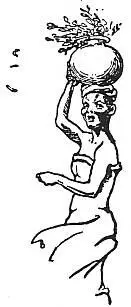
A single leaf that had blown
off a pot carried by a native
African woman made it possible
to secure information about the enemy.
And it was chiefly done on the evidence of that one leaf. So you see the importance of noticing even a little thing like that.
Dust Helping in Deduction
By noticing very small signs detectives have discovered crimes.
In one case a crime had been committed, and a stranger’s coat was found which gave no clue to the owner.
The coat was put into a stout bag, and beaten with a stick. The dust was collected from the bag, and examined under a powerful magnifying glass, and was found to consist of fine sawdust, which showed that the owner of the coat was probably a carpenter, or sawyer, or joiner. The dust was then put under a more powerful magnifying glass—called a microscope—and it was then seen that it also contained some tiny grains of gelatine and powdered glue. These things are not used by carpenters or sawyers, so the coat was shown to belong to a joiner, and the police got on the track of the criminal.
Читать дальшеИнтервал:
Закладка:
Похожие книги на «Scouting for Boys»
Представляем Вашему вниманию похожие книги на «Scouting for Boys» списком для выбора. Мы отобрали схожую по названию и смыслу литературу в надежде предоставить читателям больше вариантов отыскать новые, интересные, ещё непрочитанные произведения.
![Роберт Баден-Пауэлл - Искусство скаута-разведчика[Scouting for boys ; Искусство Разведки для мальчиков]](/books/70572/robert-baden-pauell-iskusstvo-skauta-thumb.webp)











Обсуждение, отзывы о книге «Scouting for Boys» и просто собственные мнения читателей. Оставьте ваши комментарии, напишите, что Вы думаете о произведении, его смысле или главных героях. Укажите что конкретно понравилось, а что нет, и почему Вы так считаете.