Thomas Perry - Vanishing Act
Здесь есть возможность читать онлайн «Thomas Perry - Vanishing Act» весь текст электронной книги совершенно бесплатно (целиком полную версию без сокращений). В некоторых случаях можно слушать аудио, скачать через торрент в формате fb2 и присутствует краткое содержание. Жанр: Старинная литература, на английском языке. Описание произведения, (предисловие) а так же отзывы посетителей доступны на портале библиотеки ЛибКат.
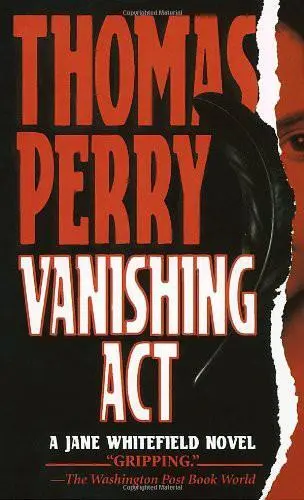
- Название:Vanishing Act
- Автор:
- Жанр:
- Год:неизвестен
- ISBN:нет данных
- Рейтинг книги:4 / 5. Голосов: 1
-
Избранное:Добавить в избранное
- Отзывы:
-
Ваша оценка:
Vanishing Act: краткое содержание, описание и аннотация
Предлагаем к чтению аннотацию, описание, краткое содержание или предисловие (зависит от того, что написал сам автор книги «Vanishing Act»). Если вы не нашли необходимую информацию о книге — напишите в комментариях, мы постараемся отыскать её.
--The New York Times
Jane Whitefield is a Native American guide who leads people out of the wilderness--not the tree-filled variety but the kind created by enemies who want you dead. She is in the one-woman business of helping the desperate disappear. Thanks to her membership in the Wolf Clan of the Seneca tribe, she can fool any pursuer, cover any trail, and then provide her clients with new identities, complete with authentic paperwork. Jane knows all the tricks, ancient and modern; in fact, she has invented several of them herself.
So she is only mildly surprised to find an intruder waiting for her when she returns home one day. An ex-cop suspected of embezzling, John Felker wants Jane to do for him what she did for his buddy Harry Kemple: make him vanish. But as Jane opens a door out of the world for Felker, she walks into a trap that will take all her heritage and cunning to escape....
"Thomas Perry keeps pulling fresh ideas and original characters out of thin air. The strong-willed heroine he introduces in Vanishing Act rates as one of his most singular creations."
--The New York Times Book Review
ONE THRILLER THAT MUST BE READ . . . . Perry has created his most complex and compelling protagonist."
--San Francisco Examiner
Vanishing Act — читать онлайн бесплатно полную книгу (весь текст) целиком
Ниже представлен текст книги, разбитый по страницам. Система сохранения места последней прочитанной страницы, позволяет с удобством читать онлайн бесплатно книгу «Vanishing Act», без необходимости каждый раз заново искать на чём Вы остановились. Поставьте закладку, и сможете в любой момент перейти на страницу, на которой закончили чтение.
Интервал:
Закладка:
"Oh?" said Jane with a hint of suspicion. "I can’t imagine that it isn’t the same person. It’s such a distinctive name. Do you have an address for her?"
"Oh," said the woman triumphantly. "I see the reason. She lives in St. Louis now. Lenore Sanders Cotton. Mrs. Robert Cotton, 5353 Dibbleton Way in St. Louis."
"That’s the one," said Jane. "But you say she hasn’t bought anything lately?"
"Not in almost a year. I guess she must stop in whenever she’s in town."
"Yes," said Jane. "That’s got to be right. She said she mailed something back to you that was damaged, and it wasn’t credited. What is your return policy?"
The woman sighed. "I’m afraid I know just what happened. The person who used to handle returns was ... Well, she’s no longer with us. So we’re undoubtedly guilty. What was the item?"
Jane took a guess. "It looks like a sweater."
The woman scanned the computer. "Yes. I see it. We’ll just send her another one."
"That sounds like a good idea. And I’ll tell you what. Since it was just one of those things and you’re going to the expense of fixing it, why don’t you just tell her it was a mistake you discovered yourself without talking to us? It’ll seem like a happy coincidence."
"Thank you so much," said the woman.
"You’re welcome," said Jane. "Goodbye."
She sat on the bed and thought about it. Lenore Sanders had managed to bounce back from the death of Jerry Cappadocia. She had left town and married somebody named Robert Cotton. Jane felt a strong curiosity about her that she couldn’t think of a way to justify. She certainly wasn’t going to find out anything about James Michael Martin from Lenore. The girlfriend hadn’t been present during the surveillance or she would have been mentioned in the report. She certainly wasn’t at the poker game the night Jerry was murdered.
Jane leafed through the pile of newspapers she had collected over the past few days, until she found the St. Louis Post-Dispatch. It was a morning paper, so they would be very busy right now. She scanned the bylines for a name that fit. It had to be somebody in one of the distant offices. She dialed the number she found on the editorial page.
"This is Ginny Surchow at the Washington bureau," she told the operator. "Can you connect me to research?"
There was only a second of delay before a woman answered, "Research."
"Hi," said Jane. "This is Ginny Surchow. I was wondering if you had anything for Mrs. Robert Cotton."
"Mrs. Robert Cotton? Yeah, some advice on choosing a husband."
Jane chuckled, not sure how funny that was. "Maybe I’d better start with him. Got a lot?"
"What haven’t we got? Come on down and take a look. We’ll be here until they put the paper to bed."
"I can’t come down. I’m in Washington. Just give me a quickie."
"All right," said the woman. "Give me a minute." After the minute was up, the woman returned. "I have an article here that has him being investigated for money laundering in ’seventy-nine, another one for receiving stolen goods in ’eighty-two. He owned the warehouse and he owned the truck, but the guys on the scene said they were moving the TV sets on their own. In ’eighty-five it was drugs, but he was nowhere near them and there was something wrong with the evidence, so the charge went away. By ’eighty-nine, we start running articles describing other people as ’having connections’ with Cotton."
"Anything really solid?" asked Jane.
"No recent convictions that I can see. So he’s described in the late ones as ’alleged organized crime figure.’ No, this last one has him promoted to ’suspected gang kingpin.’ "
"I get the picture," said Jane. "Thanks."
She hung up before the woman had a chance to ask her any questions. The whole exercise had been pointless. All she was doing now was filling in blank spaces in the story that didn’t need to be filled. Lenore Sanders had drifted out of the story entirely. She had gone off to another city and found herself a man who probably wasn’t noticeably different from Jerry Cappadocia. Jane knew all she was going to know about James Michael Martin.
She picked up the telephone again and called Jake Reinert.
"Janie?" he said. "Where are you?"
"I’m sorry I had to leave without you, Jake," she said. "I just wanted to spend some time alone. You understand."
"Where are you spending time alone?"
"The beach. It’s very restful here, and I was having such a good time that I started to feel guilty about you."
"Janie? Maybe you ought to come home."
She rapped on the table beside her bed. "Oh." She called over her shoulder, "I’ll be right there," then said, "I’ve got to go. It’s dinner time here. And no, it’s not a date, worse luck. It’s just another woman I met on the beach. ’Bye."
She turned in her key and left before dawn, driving along the perimeter of Tupper Lake slowly, stopping now and then to scan the shore. She drove up seven old logging roads before the sun came up without finding one that went farther than a few hundred yards. She knew it would be one of the old roads. From the time the Adirondacks had been surveyed, in the 1830s, until the government had decided to protect what was left of them, in the 1890s, logging had gone on unimpeded. After that it had been controlled in most of the park, but the roads were still visible in lots of places, even some of the old narrow-gauge railroad spurs that had been built to get the logs out. James Michael Martin had been born here, and he might even have picked out the one he would use while he was still sitting in his cell in Illinois.
It was after ten when Jane saw the tire tracks on the old road above the lake. The road was now only a set of ruts that started in the marshy land along the lake and turned up into the forest immediately. Down in the flats, the tracks from his new tires were deep, with black mud mushroomed out of the lozenge-shaped depressions even after three days. As the trail swung up and away they faded, soon only an impression of a big weight that had crushed the growth of thistle and milk-weed and goldenrod that had healed the ancient ruts. As the trail went higher, the ground was hard, with rocks close to the surface and a network of roots where the big trees on both sides intertwined. There were places here and there where the thick plastering of last fall’s leaves had been rotted black by standing water or washed away by spring rains, and then she could see the tire treads again. There was still the chance that even this early in the year, when the deep drifts of snow had barely melted from the high peaks above the lake, this might only be innocent fishermen trying to get to the fish while they were still eager and hungry.
The treads were the right pattern, but there might be hundreds of exact duplicates on pickups and jeeps all over the mountains. She drove on, bouncing her rented car over exposed roots and dipping into trenches where rain rivulets had rushed across the path toward the lake below.
At eleven she saw the first glint of light. It was sharp and piercing, a flash as though a chunk of the sun had fallen into the brush to the right of the road. She stopped the car, took her rifle, and walked the rest of the way off the path, stalking quietly along the carpet of wet leaves on the forest floor. When she was still thirty feet away, she stood still and stared at it.
The big black Bronco had been pulled off the path through some bushes and into a thicket of low thorny trees that formed a bower over the roof. She moved her head and saw the flash again and, this time, identified it. The rear window wasn’t curved like the rear window of a car, but broad and flat, and it caught the sun like a mirror.
She cautiously moved sideways until she could be sure that the cab was empty and the door locks pushed down. She walked up and touched the hood. It was warm, but the warmth was uniform from the baking of the sun, not a hot spot in the center because the engine had been running.
Читать дальшеИнтервал:
Закладка:
Похожие книги на «Vanishing Act»
Представляем Вашему вниманию похожие книги на «Vanishing Act» списком для выбора. Мы отобрали схожую по названию и смыслу литературу в надежде предоставить читателям больше вариантов отыскать новые, интересные, ещё непрочитанные произведения.











Обсуждение, отзывы о книге «Vanishing Act» и просто собственные мнения читателей. Оставьте ваши комментарии, напишите, что Вы думаете о произведении, его смысле или главных героях. Укажите что конкретно понравилось, а что нет, и почему Вы так считаете.