Thomas Perry - Shadow Woman
Здесь есть возможность читать онлайн «Thomas Perry - Shadow Woman» весь текст электронной книги совершенно бесплатно (целиком полную версию без сокращений). В некоторых случаях можно слушать аудио, скачать через торрент в формате fb2 и присутствует краткое содержание. Жанр: Старинная литература, на английском языке. Описание произведения, (предисловие) а так же отзывы посетителей доступны на портале библиотеки ЛибКат.
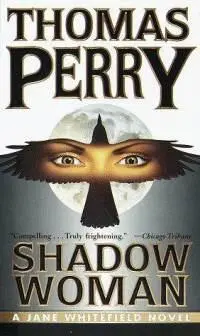
- Название:Shadow Woman
- Автор:
- Жанр:
- Год:неизвестен
- ISBN:нет данных
- Рейтинг книги:3 / 5. Голосов: 1
-
Избранное:Добавить в избранное
- Отзывы:
-
Ваша оценка:
Shadow Woman: краткое содержание, описание и аннотация
Предлагаем к чтению аннотацию, описание, краткое содержание или предисловие (зависит от того, что написал сам автор книги «Shadow Woman»). Если вы не нашли необходимую информацию о книге — напишите в комментариях, мы постараемся отыскать её.
From the Paperback edition. Amazon.com Review
When her latest client, a Las Vegas gaming executive who has lost the trust of his criminally-connected bosses, asks for help, Jane Whitefield gets him out of town with a spectacular display of casino magic. Then she keeps her promise, gives up her dangerous trade, marries her loyal doctor, and settles down to live peacefully in upstate New York. As if. Fifty pages into Thomas Perry's third book about Whitefield--who uses a mixture of her Seneca ancestors' wisdom and a lot of modern muscle and computer smarts to make people in danger disappear--her client screws up. Jane's highly developed code of honor makes her leave her bridal bed to rescue him from an eerily psychotic Los Angeles couple who use everything from sex games to attack dogs to track him down. Previous paperbacks in this first-rate series are
and
.
Shadow Woman — читать онлайн бесплатно полную книгу (весь текст) целиком
Ниже представлен текст книги, разбитый по страницам. Система сохранения места последней прочитанной страницы, позволяет с удобством читать онлайн бесплатно книгу «Shadow Woman», без необходимости каждый раз заново искать на чём Вы остановились. Поставьте закладку, и сможете в любой момент перейти на страницу, на которой закончили чтение.
Интервал:
Закладка:
“What?” said Pete.
“I hadn’t thought of that. They think they’ve got a sniper back there still taking shots across a highway at a restaurant. They don’t want to block the road out until they get people evacuated. What they’re blocking is the way in, so nobody gets shot.”
She went back to her road map. “All right. At Bigfork, turn right onto 35, to Creston, and keep heading north when it changes to 206.”
She set the map aside and stared out the back window. Maybe the shooter had not made it to his car in time to follow. He had been up above on the hillside, at least three hundred yards away. As soon as she had thought of it, she knew she was being foolish. It wasn’t likely that a pro would strand himself that far from his car and open fire. His car had been up there too, probably parked beside one of the firebreaks or timber roads cut into the forested hillside.
The reflection had not come from his equipment. All he had needed was a rifle and a scope, and the good ones were designed with that problem in mind. It was cars that were covered with chrome and mirrors. He was probably right behind them now, if not among the first few cars, then in the next pack.
“We have to talk,” she said.
“You start.”
“We have a problem here. I don’t have any idea how they knew where we were.”
“Obviously I don’t either.” He turned to her, eyes wide. “You don’t suppose Pam and Carol—”
“No,” she said. “If they had put two girls in your path to get you alone, that was when they would have killed you. And we left this morning before those two were up. They couldn’t have told anybody where we were going, because they didn’t know.”
“Then what could we have done to tell that guy where we were?”
“Maybe they have some spectacular new way of instantly picking out charges on the credit cards we’ve been using. Maybe they somehow found out about this car the day I bought it, and hid a transmitter in it. Whatever they’re using to trace us, it might as well be magic.”
“You’re making me more nervous than I am already, and I can hardly hold the wheel steady as it is.”
They passed a sign that said BIGFORK 5. She said, “We have five miles to make a choice. What I’m saying is that they shouldn’t be here. When I play this game, if my side wins a round, we get to play another round. If the other side wins one, the game is over.”
“A nice, sporting way of saying I’m dead.”
“We’ll both be dead. I’m trying to tell you we haven’t won any rounds. They had you in Denver, until the policeman got in the way. They had us twenty minutes ago, and that poor man took the bullet. They haven’t got you, but they haven’t exactly missed yet, either. It’s important to remember that. In a few minutes we’ll be in Bigfork. There are cops on the road there now, and more on the way. We could stop, tell them our story, and they would take over.”
“You mean give myself up?”
“You haven’t committed any crimes. They would protect you, beginning in four minutes. In a day or less, you could be a thousand miles away, telling the Justice Department what you know about Pleasure, Inc. They would keep you safe, at least until you testified in court.”
“Yeah, but what then?”
Jane threw up her hands and let them rest on her lap. “I can’t be sure. Probably they would do what I did: give you fake papers and a plane ticket. You’d be a protected witness. I’ll be honest with you. They’re very, very good at protecting you until you testify. After that you’re a drain on the budget and not much use. At that point you come back to me and I’ll try again.”
“I can’t go to the police,” said Pete.
“You said that when I met you. Now is the time to be sure.”
“There are three men who own Pleasure, Incorporated. I know enough about all of them to get the cops a warrant to investigate, and a few tips on specific places to look, and I’m done. I didn’t see things happen. I put two and two together. I heard them tell Calvin Seaver, the security guy, someone was a problem, and then read an obituary. I saw a rough count of the day’s take on a piece of paper, and then a lower number on the ledger in the computer. The paper’s gone. I’m not an eyewitness, I’m a rumormonger.”
Jane heard an edge in his voice. “You’re not telling everything. You did something.”
“The reason I was getting ready to leave was that I was expected to do things that could get me in trouble. I signed receipts when I knew the count was wrong. I deposited money that came in from side businesses I never saw, and sent it to investors without reporting it to the I.R.S. I never sat down and listed all the things like that, I just got out. I think the cops could find evidence against the owners, but I know they could find some against me. I’ll let you out of the car in Bigfork, or anything you want, but I can’t go to the police.”
“The people you worked for think you can.” Ahead, she could see the police cars parked at angles in the other lane.
“I’ve been over this in my mind a million times. They must think I saw more than I did, or took evidence with me, or God knows what. But I didn’t. I won’t end up in some protected place. I’ll be in a Nevada State Prison, and they’ll hire some lifer to kill me.” He drove past the roadblock, and Jane felt a little twinge in her chest.
Jane watched him take the turn just before the buildings began to cluster at Bigfork. He swung onto the smaller road and accelerated. She said, “Creston is eight miles. Bear right again there.” She turned around in her seat to stare out the back window. She saw a few cars go the other way, toward Kalispell and Whitefish, and wondered if that would have been the way to safety. The road always seemed to have forks in it, and all she could do was pick. Maybe what she was watching recede into the distance was her chance to ever go home again.
They were at the Creston intersection in ten minutes, then onto 206 and climbing again, higher into the gray mountains. At Columbia Heights they switched onto U.S. 2. The road curved around big stony outcroppings, always climbing. Ahead were towns too small to hide in—Hungry Horse, Martin City, Coram. Always Jane studied the map. The idea of moving around in these mountains, where there were places to stay and everyone was a tourist, had seemed to be a good one. But now the roads reminded her of the chutes in a stock pen. Each opening looked at first like a way out, but each was an irrevocable choice. The walls were too high to jump and the animal couldn’t turn around. The animal had no way to go but forward, pushed by the ones behind it. Somewhere, waiting at the end of the chutes, was a man with a hammer.
The hunters could see what the map told Jane as well as she could. She could leave this road only by two routes—along the east side of Glacier National Park and then north on Chief Mountain Highway to the Canadian border, or north along the west side of the park by the Flathead River on 486.
She looked more closely at the map. Route 486 stopped at the Canadian border. There were no little flags there to indicate a point of entry, as there were on the Chief Mountain Highway. She couldn’t risk choosing a road that might lead to a dead end with a fence across it. She turned the map over and studied the little detailed map of the area on the back.
The map showed Route 486 ending at the border. It showed the customs checkpoint on Chief Mountain Highway. But the checkpoint had a note under it in small black print. “Closed September 15–May 15.” After September 15 there was only one way to Canada by car.
Jane looked at Pete, driving the car along the highway.
He seemed to feel her gaze. He turned. “What?”
Читать дальшеИнтервал:
Закладка:
Похожие книги на «Shadow Woman»
Представляем Вашему вниманию похожие книги на «Shadow Woman» списком для выбора. Мы отобрали схожую по названию и смыслу литературу в надежде предоставить читателям больше вариантов отыскать новые, интересные, ещё непрочитанные произведения.
Обсуждение, отзывы о книге «Shadow Woman» и просто собственные мнения читателей. Оставьте ваши комментарии, напишите, что Вы думаете о произведении, его смысле или главных героях. Укажите что конкретно понравилось, а что нет, и почему Вы так считаете.