Thomas Perry - Shadow Woman
Здесь есть возможность читать онлайн «Thomas Perry - Shadow Woman» весь текст электронной книги совершенно бесплатно (целиком полную версию без сокращений). В некоторых случаях можно слушать аудио, скачать через торрент в формате fb2 и присутствует краткое содержание. Жанр: Старинная литература, на английском языке. Описание произведения, (предисловие) а так же отзывы посетителей доступны на портале библиотеки ЛибКат.

- Название:Shadow Woman
- Автор:
- Жанр:
- Год:неизвестен
- ISBN:нет данных
- Рейтинг книги:3 / 5. Голосов: 1
-
Избранное:Добавить в избранное
- Отзывы:
-
Ваша оценка:
Shadow Woman: краткое содержание, описание и аннотация
Предлагаем к чтению аннотацию, описание, краткое содержание или предисловие (зависит от того, что написал сам автор книги «Shadow Woman»). Если вы не нашли необходимую информацию о книге — напишите в комментариях, мы постараемся отыскать её.
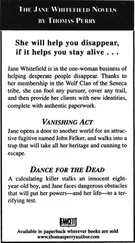
From the Paperback edition. Amazon.com Review
When her latest client, a Las Vegas gaming executive who has lost the trust of his criminally-connected bosses, asks for help, Jane Whitefield gets him out of town with a spectacular display of casino magic. Then she keeps her promise, gives up her dangerous trade, marries her loyal doctor, and settles down to live peacefully in upstate New York. As if. Fifty pages into Thomas Perry's third book about Whitefield--who uses a mixture of her Seneca ancestors' wisdom and a lot of modern muscle and computer smarts to make people in danger disappear--her client screws up. Jane's highly developed code of honor makes her leave her bridal bed to rescue him from an eerily psychotic Los Angeles couple who use everything from sex games to attack dogs to track him down. Previous paperbacks in this first-rate series are
and
.
Shadow Woman — читать онлайн бесплатно полную книгу (весь текст) целиком
Ниже представлен текст книги, разбитый по страницам. Система сохранения места последней прочитанной страницы, позволяет с удобством читать онлайн бесплатно книгу «Shadow Woman», без необходимости каждый раз заново искать на чём Вы остановились. Поставьте закладку, и сможете в любой момент перейти на страницу, на которой закончили чтение.
Интервал:
Закладка:
When he was inside his room, he pulled the mailer out of the back of his belt. He opened it and poured the mail out on the bed. The envelopes were all addressed to Stewart Hoffstedder, C.P.A. That was something that gave him hope, at first, because Stillman had said something about a man’s name. But the mail was almost all bills, as though they were for a real C.P.A. The bills were all for credit cards in different names—female, male, even corporate names. Were they all for this woman?
A horrible thought came to him. Stillman’s brain was probably not a perfectly developed organ to begin with. Since the age of ten it had probably been shorted out by drugs and jarred by blows. Maybe he had gotten the number wrong. Maybe this was some real C.P.A., a business manager who paid bills for a number of clients. The mail in the pouch seemed to have nothing to do with the dark-haired woman. It was possible that Seaver had scared Stillman so badly that he had cooked up a box number on the spot.
Seaver laid all of the bills out on the bed in a row and began to study them, looking desperately for similarities. On August 8, Wendy Wasserman had rented a car in Missoula, Montana. On August 10, Michael Phelan had rented a hotel room in Potomac, Montana. Katherine Webster had paid for lunch in Condon, Montana, the next morning. Seaver rocked back on his heels and smiled at the ceiling in relief. He had not wasted all this time and energy.
He glanced at the forwarding address on the label stuck to the mailer. It was just another post office box, this one in Chicago. If he needed to, he could go there and watch that one too. But right now, he had something infinitely better. He knew where the dark-haired woman was. She was on the move, driving around Montana with Pete Hatcher.
21
Carey drove up to the gate of the impound lot and parked. Susan stepped to the gate and rang the bell. Carey could hear the old-fashioned jangling noise a hundred feet away in the little shack in the center of the lot, and that meant trouble. There were no lights on in the windows. He stepped to the gate and stood beside her feeling useless.
Then he walked along the fence and around the corner. There was a small sign that said, LOT HOURS 6:00 A.M. TO 10:00 P.M. He walked back to Susan and frowned apologetically. “It’s closed until six in the morning.”
“No.” She seemed to see herself from outside. She was standing in a dark, desolate part of the city in the middle of the night, wearing three-inch heels and a strapless evening gown. Slowly, the beautiful smile reappeared. She let her arms come out from her sides in a “look at me” gesture.
He said, “Come on. I’ll take you home.”
They got into his car and he backed out of the drive. “You can’t really do that,” she said. “It’s all the way out in Orchard Park. If you could just drop me off at a hotel near here, you can go home and get some sleep.”
“Why would you stay in a hotel?” asked Carey. “It’s ridiculous.” Why was it that people who didn’t want to be any trouble always ended up being plenty?
“It’s now after midnight. If you drive me all the way to my apartment, it’ll be two before I’m asleep, and probably three before you are. So I’d get three hours’ sleep, call a cab, and for eighty dollars or so, he’d drive me to the other end of the county to get my car. That’s if I could even get a cab in Orchard Park at five in the morning. But if I stay here, I can be on the spot when the lot opens and drive myself home.”
“Here’s the problem with that. Look around you—factories, warehouses, and an impound lot. It isn’t very scenic in the daytime, so there’s a shortage of good hotels around here. By ‘good’ I don’t mean famous, I mean safe.”
“Oh,” she said.
“On the other hand, I happen to have a perfectly good house about twenty minutes away, with six spare bedrooms, five bathrooms, and clean towels.” He held his breath, hoping she would have a better idea.
“I hate to put you to that kind of trouble.”
That meant “yes.” He had no choice but to push the offer as graciously as he could manage at this hour, and make it sound easy. “I have to be at the hospital by seven, and I can take you to get your car on the way.” He glanced at her. “I might even be able to scare up some clothes for you that won’t look strange at dawn—like the bedraggled party-goer at the end of an Italian movie. Jane’s about your size.”
She looked at him with what seemed to be curiosity. “You would do that?”
“Sure.” What choice did he have?
“Won’t your—won’t Jane feel … uncomfortable?”
“What for?” he said too quickly. He had been concentrating on his own discomfort, so he had not yet thought about what Jane would feel. He cautiously considered the subject. He had a sudden vision of Jane’s eyes resting on Susan, taking an inventory—the long, golden hair, the little wisps on the nape of the long, delicate neck where they had escaped from the place where they had been tied, the impossibly smooth ivory skin—then focusing on Carey. But Jane’s look would be completely unjustified.
What he was doing was a simple act of kindness—no, it was even more innocent: an obligatory refusal to be unkind. He imagined Jane hearing his thoughts, and the gaze turned ironic. No, he thought. That wasn’t the way Jane would react at all—unless she was just teasing him. He was being irrational and unfair to her. She would never give him that look just because the person he helped happened to be female.
Then he admitted to himself that his deepest motive for taking her home with him had been provided by the needle on his gas gauge. He hadn’t insisted on driving her to her place, where she belonged, because he was afraid he wouldn’t be able to find an open gas station at this hour on the long, unfamiliar drive to Orchard Park. He might run out of gas, and then they’d both be stranded.
He realized he was taking too much time inside his own head. “If she were here, she would be the one asking you to stay. She’s always doing things like this.” It sounded true to him, as far as it went. He couldn’t quite get himself to feel certain that Jane would invite a woman who looked like Susan to stay in the house while she wasn’t there.
She looked at him closely. “I’d feel a lot better about it if I heard her say it. I’d hate to get you in trouble.”
He smiled and shook his head. “I’m not going to call her in the middle of the night to wake her up and ask her permission, no. But I’ll mention it the next time I talk to her.” He drove onto the boulevard and accelerated. “Of course, the first few times you meet her, you’ll have to get used to my calling you ‘Sister Mary Boniface.’ ”
She laughed the melodious, liquid laugh again. “Oh, well. I guess I’d rather just be your secret.”
Carey was still contemplating those words as he pulled into his driveway. He idled near the front door, where he usually parked in the summer, then found himself touching the gas pedal again to let the car glide the rest of the way up the long driveway before he stopped again at the old carriage house, out of sight of the street. There was no sense piquing the neighbors’ curiosity, he thought. The fact that what he was doing was innocent didn’t make it a worse story.
He opened Susan’s door, led the way to the back entry, unlocked the house, and let her enter first. He reached over her shoulder to flip the light switch just as she stopped to keep from stepping into a dark, unfamiliar room. It would have been much better if they had collided hard, but instead his body met hers softly. “Oops,” he said. “Excuse me.”
She half-turned to give him an utterly unreadable look, then stepped into the kitchen, looking around her. “Great kitchen,” she said. “Do you entertain a lot?”
Читать дальшеИнтервал:
Закладка:
Похожие книги на «Shadow Woman»
Представляем Вашему вниманию похожие книги на «Shadow Woman» списком для выбора. Мы отобрали схожую по названию и смыслу литературу в надежде предоставить читателям больше вариантов отыскать новые, интересные, ещё непрочитанные произведения.








Обсуждение, отзывы о книге «Shadow Woman» и просто собственные мнения читателей. Оставьте ваши комментарии, напишите, что Вы думаете о произведении, его смысле или главных героях. Укажите что конкретно понравилось, а что нет, и почему Вы так считаете.