Thomas Perry - Shadow Woman
Здесь есть возможность читать онлайн «Thomas Perry - Shadow Woman» весь текст электронной книги совершенно бесплатно (целиком полную версию без сокращений). В некоторых случаях можно слушать аудио, скачать через торрент в формате fb2 и присутствует краткое содержание. Жанр: Старинная литература, на английском языке. Описание произведения, (предисловие) а так же отзывы посетителей доступны на портале библиотеки ЛибКат.
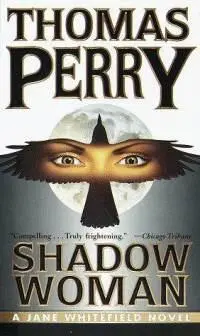
- Название:Shadow Woman
- Автор:
- Жанр:
- Год:неизвестен
- ISBN:нет данных
- Рейтинг книги:3 / 5. Голосов: 1
-
Избранное:Добавить в избранное
- Отзывы:
-
Ваша оценка:
Shadow Woman: краткое содержание, описание и аннотация
Предлагаем к чтению аннотацию, описание, краткое содержание или предисловие (зависит от того, что написал сам автор книги «Shadow Woman»). Если вы не нашли необходимую информацию о книге — напишите в комментариях, мы постараемся отыскать её.
From the Paperback edition. Amazon.com Review
When her latest client, a Las Vegas gaming executive who has lost the trust of his criminally-connected bosses, asks for help, Jane Whitefield gets him out of town with a spectacular display of casino magic. Then she keeps her promise, gives up her dangerous trade, marries her loyal doctor, and settles down to live peacefully in upstate New York. As if. Fifty pages into Thomas Perry's third book about Whitefield--who uses a mixture of her Seneca ancestors' wisdom and a lot of modern muscle and computer smarts to make people in danger disappear--her client screws up. Jane's highly developed code of honor makes her leave her bridal bed to rescue him from an eerily psychotic Los Angeles couple who use everything from sex games to attack dogs to track him down. Previous paperbacks in this first-rate series are
and
.
Shadow Woman — читать онлайн бесплатно полную книгу (весь текст) целиком
Ниже представлен текст книги, разбитый по страницам. Система сохранения места последней прочитанной страницы, позволяет с удобством читать онлайн бесплатно книгу «Shadow Woman», без необходимости каждый раз заново искать на чём Вы остановились. Поставьте закладку, и сможете в любой момент перейти на страницу, на которой закончили чтение.
Интервал:
Закладка:
“You’re thinking of building more casinos? When?”
Foley shrugged. “This has been in the works for several years. After some study, we decided that the most promising idea was Indian reservations. We put fifteen reservations under scrutiny, and came up with one we want.”
“Where is it?”
“Upstate New York. Draw a triangle from Rochester to Buffalo to Niagara Falls, and it’s in the middle. It’s less than two hundred miles from Cleveland and Toronto, less than four hundred from New York and Philadelphia, less than five hundred from Baltimore, Detroit, Hartford, Indianapolis. It sits just off the New York State Thruway. If you go by car from one of those cities to the other, you may very well have to go past it.”
Seaver looked at the three men, keeping his expression empty. He had no way of knowing whether it was a good idea or madness.
Buckley seemed to read his mind. “You’re thinking that we’re not exactly diversifying. But we are. Think of a full-service world-class resort. Casinos and hotels, of course. That’s our strength. Only this time they would be exclusive, on land only we had access to. But best of all, we could offer things that nobody else can do, anywhere.”
“You could?”
“An Indian reservation is a peculiar place, in the law. They can already sell tax-free gas and cigarettes. Why not foreign cars? High-ticket jewelry? Designer clothes? Appliances? Besides the tariffs, the sales tax in New York is eight and a half percent.”
“Are you saying that’s legal?”
“It hasn’t been tried yet. We think we could use the precedent of those companies that sell tickets to police benefits. As long as they give a cent to the police, they can keep ninety-nine for overhead and profit. We give a cent to the Indians and they still make millions a year. This could all be in the open. But what would not be in the open is even more intriguing. Indians have exclusive hunting and fishing rights on their land, with no external regulation. We could have live hunts with game we release: bag a rhino in Upstate New York. We could build a private port a few miles north, on Lake Ontario, connect it to the resort by rail, and offer cruises: package tours for Mom and the kids. For Dad, maybe a members-only junket with high-stakes games and even some exotic companionship. We could rotate girls in and out maybe once a week. The port would also give us access to the St. Lawrence Seaway into the Atlantic. We could take anything out, bring anything in.” He looked sad. “It was all intriguing. Very intriguing.”
Seaver shook his head. “I never heard a word about any of this. I’m amazed.”
The three smiled. “The world is a complicated place,” said Foley. “No one head can carry all of the pieces.”
“What about Hatcher’s? Is this what he knew?”
Salateri muttered something to himself that could have been a curse. “Hatcher knew nothing about this, because none of it has happened yet.”
“There have been delays,” said Foley. “The Indians have to accept the idea, and we haven’t really approached them yet, just left our card, you might say. First we needed to do feasibility studies, find out what wasn’t possible, then make it possible. The big delay has to do with the Indian Gaming Act. The federal law says that gambling is okay under conditions established by the state where the reservation is. Before we go handing money to a bunch of Indians we needed to be sure that we could get the state legislature’s approval. And we had to make friends in Albany and Washington.”
“How do you do that?”
Buckley smiled. “We’ll have to learn about the Indians—keep them in the dark while we study them. Politicians, on the other hand, are a tribe whose customs we know.”
“Hatcher handled the payouts,” Salateri blurted.
Seaver frowned. “I thought he didn’t know anything.”
Salateri scowled defensively. “It was all indirect. We didn’t want to see a videotape with a time and date in the corner and a shot of Hatcher counting out hundred-dollar bills to some New York politician in a hotel room. We set up a fund.”
“What kind of fund—cash?”
Buckley said, “It was a corporation that received some of its money in cash. We had a lot of land—here, in San Francisco, in Los Angeles—which we sold to the corporation for an imaginary sum before we brought Pete in. We converted various plots to parking lots—put asphalt over them. Pete was in charge of taking the money we said came in, and paying it to people we said were investors or creditors. He paid it to other corporations, middlemen, girlfriends, relatives, some to bank accounts in the Cayman Islands.”
“And Hatcher didn’t know what he was doing?”
“Never,” said Foley.
Salateri said, “He might have suspected that the money that started the corporation came fresh from the casino tables. There were a couple of times when he told us the numbers on the official slips were lower than the count that night. Max told him that it was because we needed a lot of cash in the vault in case somebody hit the million-dollar jackpot on the big slot. That way we could take publicity pictures of the guy up to his ass in hundreds. The money only gets reported when it’s taken out of play.”
“He bought that?”
“Maybe for a while, maybe never. He stopped asking. The worst he would have thought was that we were still skimming cash and mixing it in with the take on the parking lots.” Salateri shook his head. “Can you imagine that, after all we did for him? He turned his back on us because we were taking money out of our own casino—our own money! I still can’t believe it.”
Buckley shrugged. “We should make it clear that the corporation with the parking lots and so on wasn’t the problem. There was nothing wrong with it but where the money came from, and there’s no way he could have traced it. I think he resented the fact that he was the one who signed the slips with a short count on them.” He gave a puzzled little smile. “You see, that was enough to cost him his virginity.”
Seaver stared at the floor for a moment, then looked up at the row of three faces. “So the problem is that he can say he’s pretty sure that at one time, money was being diverted from the games and put into his own corporation. Then he paid it to a lot of people he didn’t know? I’d say let him.”
“Let him?” Foley looked troubled.
Seaver said, “When I was a cop, we needed evidence of a crime.”
Peter Buckley looked at him kindly, sympathetically. “I’m afraid you’re missing the problem. Pete Hatcher doesn’t know anything. If he somehow strained his capacities and figured out the names of the people in New York State who ultimately received the money, he never heard of them. They’re state legislators and bureaucrats and party functionaries in a distant place. People in their own state wouldn’t know who they are. But the F.B.I. would. And if they heard the little that Pete Hatcher could be assumed to remember—say, four or five names, dates, and amounts—they could trace the money backward to the accounts Hatcher controlled, and then forward to find out where the rest went.”
“But even if they did, the most they would be able to prove was that Pete gave money to politicians. Maybe that it came from here, but not who took it. If he signed for it, then he took it. And half the equation is missing. You have no interests in their state, and they aren’t doing anything in return for the money.” When he saw that the three men were looking at him without changing their expressions, he said, “You abandoned the project, right?”
“No,” said Max Foley. “Unfortunately, it isn’t right.”
“Why not?”
Salateri’s impatience made him look as though he were swelling up. “There are people in New York State who are already in the gambling business. They are big, scary people. In the twenties, if they didn’t like you, they mixed a tub of cement and put your feet in it. Now, if they want cement, they make a phone call and five hundred cement trucks arrive, with fifty government building inspectors to certify they did it right.”
Читать дальшеИнтервал:
Закладка:
Похожие книги на «Shadow Woman»
Представляем Вашему вниманию похожие книги на «Shadow Woman» списком для выбора. Мы отобрали схожую по названию и смыслу литературу в надежде предоставить читателям больше вариантов отыскать новые, интересные, ещё непрочитанные произведения.

Обсуждение, отзывы о книге «Shadow Woman» и просто собственные мнения читателей. Оставьте ваши комментарии, напишите, что Вы думаете о произведении, его смысле или главных героях. Укажите что конкретно понравилось, а что нет, и почему Вы так считаете.