Thomas Perry - The Face-Changers
Здесь есть возможность читать онлайн «Thomas Perry - The Face-Changers» весь текст электронной книги совершенно бесплатно (целиком полную версию без сокращений). В некоторых случаях можно слушать аудио, скачать через торрент в формате fb2 и присутствует краткое содержание. Жанр: Старинная литература, на английском языке. Описание произведения, (предисловие) а так же отзывы посетителей доступны на портале библиотеки ЛибКат.
- Название:The Face-Changers
- Автор:
- Жанр:
- Год:неизвестен
- ISBN:нет данных
- Рейтинг книги:5 / 5. Голосов: 1
-
Избранное:Добавить в избранное
- Отзывы:
-
Ваша оценка:
The Face-Changers: краткое содержание, описание и аннотация
Предлагаем к чтению аннотацию, описание, краткое содержание или предисловие (зависит от того, что написал сам автор книги «The Face-Changers»). Если вы не нашли необходимую информацию о книге — напишите в комментариях, мы постараемся отыскать её.
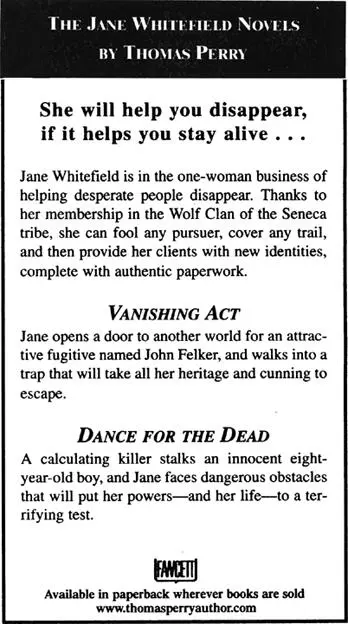
From the Paperback edition.
The Face-Changers — читать онлайн бесплатно полную книгу (весь текст) целиком
Ниже представлен текст книги, разбитый по страницам. Система сохранения места последней прочитанной страницы, позволяет с удобством читать онлайн бесплатно книгу «The Face-Changers», без необходимости каждый раз заново искать на чём Вы остановились. Поставьте закладку, и сможете в любой момент перейти на страницу, на которой закончили чтение.
Интервал:
Закладка:
During the day, Jane made her movements erratic, her routes unpredictable, and her destinations dull and quotidian. If she wanted to shop, she drove to a shopping center on the Youngmann Expressway or the New York State Thruway, got off at the wrong exit and then drove back, parked in the lot for one store and walked to another. If she wanted to go to a restaurant, she would go in the front door and leave through the back. When she drove out to the reservation to visit her old friends Violet and Billy Peterson, she parked on Sandy Road and walked through the chestnut grove to come out across from their house under the big hemlock.
Three times, Jane left the house just as a shift of watchers was about to be relieved by a fresh team. Nothing she did seemed to disconcert them. They operated on a series of situational models that they all knew, so no unexpected movement caused them to hesitate or confer. The person nearest to a car, from whatever shift, went after her. That officer followed her until she stopped, and then that person was replaced. The one time she made her move when there happened to be two people from different shifts in the same car, they both went after her.
On the tenth evening, Jane posted her bogus schedule on the bulletin board beside the telephone and called to make a plane reservation for a morning flight to South Dakota in the name Violet Peterson. She pulled her car out to the street, parked, put a suitcase in the trunk, and went back into the house.
Before long, the surveillance team saw Dr. and Mrs. McKinnon leaving the house. This time Mrs. McKinnon wore a light blue summer dress and carried a large canvas shoulder bag. A single car with two team members followed the black BMW to a small Italian restaurant on Main, then remained outside to watch them through the front window.
The directional microphone picked up little that seemed reportable. The subjects of the surveillance said they loved each other. This was not news. The male said that he wished he were accompanying the female on her trip. The female said she wished it were possible too, but that his job was to keep cutting open unsuspecting patients and removing things until he had paid for her trip. The ironic tone she used was familiar to the listeners, and the topic only confirmed for the team what they had already learned from the wire tap and the stationary observation vehicle: the female subject had made a flight reservation under the pseudonym Violet Peterson, packed a bag, and left it in her car on the street.
The team then followed the McKinnons to a large shopping plaza where they had followed Mrs. McKinnon before, and watched them enter a large movie theater complex called Cinema 12. It was observed that, after studying the marquee where the times and titles were posted, the female subject picked Theater 5, where a British-made film that was reputed to be romantic was about to begin. The male purchased two tickets, and the couple entered the big lobby and walked to the set of doors with a number 5 above it in blue neon.
One of the watchers, Officer David Foalts, bought a ticket for Theater 5, went in during the opening credits, and sat alone in the back row. The second, Sergeant Roger Horowitz, stayed in the chase car to watch the door and the BMW and monitor the radio.
After the film began, Mrs. McKinnon stood and walked up the aisle. Officer Foalts’s training told him that he had options. He could remain where he was and assume that Mrs. McKinnon would go to the ladies’ room or the snack counter and return. Ordinarily he might have gone out to the lobby and verified the obvious while keeping his eye on the only nonemergency door to Theater 5, then followed her back in. But the standing order was to watch Dr. McKinnon at all times, while Mrs. McKinnon’s situation was not quite as clear.
It was just possible that leaving the theater at the beginning of the film was her way of luring Foalts away from her husband. Officer Foalts decided not to risk letting Mrs. McKinnon see him make a move. Mrs. McKinnon’s call to the airline had been the first thing either of them had done since the beginning of the surveillance that showed promise of revealing anything. His superiors in the Buffalo police department and his colleagues in the F.B.I. would be very upset if she were spooked into canceling her trip.
Foalts stayed in the back and watched Dr. McKinnon. After what seemed to him to be a long time, he heard the door to the theater behind him open and close. The complex was new and well designed. A person had to enter a little anteroom and walk two paces before opening the inner door, and in that time, the outer door would automatically close to prevent a splash of light from disrupting the movie. Officer Foalts saw the shape he had been waiting for float down the aisle past him—a tall, thin woman, the long, straight black hair hanging at the back of the pale blue dress, the canvas shoulder bag. The shape found McKinnon in the dim light from the screen and sat down beside him.
Foalts stayed in the back until the film was about to end. He slipped out the door through the tiny anteroom and waited in the rear of the lobby near the back entrance that opened into the enclosed shopping mall. When the film in Theater 5 ended and the crowd streamed out, he faded into it and followed the couple outside. He rejoined Sergeant Horowitz in the chase car, and when the male and female subjects got into the BMW and drove away, the two policemen followed.
The BMW returned to the McKinnon house, and the team observed lights going on in the upstairs rooms, then going off. Officer Kemmel in the monitoring van heard the usual footsteps, the usual swishing noises of clothes being taken off, water running, toilets flushing, the clicks of light switches, the creaks of bedsprings. There was even less conversation than usual. The male subject said, “You’d better get some sleep. You have an early start,” and the female said, “Uh-hunh.”
At five A.M. the next shift observed a tall, slim woman with dark hair leaving the house and driving off in the car that had been parked in front. A team was waiting for her at the airport. As expected, the woman checked the bag that had been in the car trunk, then went to the downstairs desk and showed identification that said she was Violet Peterson. F.B.I. agent William Grey surreptitiously photographed her while she was waiting for her plane and moved off to transmit the photographs electronically. Agents Leah Caldicott and Ralph Mandessi boarded the flight to Chicago after her.
A second set of agents, using Grey’s photographs, waited for her at Chicago, where they followed her onto the flight to Rapid City, South Dakota. They reported that in her entire journey, she appeared to meet no one, and to speak to no one who didn’t work for the airline.
In Rapid City, she went to a car-rental agency and picked out a red Ford Escort. She drove the car from Rapid City east on Route 90 to Wall, near Badlands National Park, then took 14 north, switched to 63 outside Hayes, drove north across Cherry Creek onto the Cheyenne River Indian Reservation. She checked into a motel in Eagle Butte, and the F.B.I. agents settled in to wait. It was ten hours since she had driven to the Greater Buffalo International Airport, and seventeen since she had left the Cinema 12 complex. Then the subject of the surveillance showered and went to sleep.
At approximately that moment, Jane Whitefield was driving into the parking lot behind the apartment complex in Waterloo, Iowa, still trying to decide what her present to Violet Peterson would be. She supposed it would have to depend on what sort of inconvenience the F.B.I. caused for Vi and Billy. If they held Vi overnight in some women’s jail and frightened her, then a bouquet of flowers would seem like a pretty empty gesture. If she just got to spend a week or two at a few major Indian get-togethers at Jane’s expense, then anything more than the flowers would offend her.
Читать дальшеИнтервал:
Закладка:
Похожие книги на «The Face-Changers»
Представляем Вашему вниманию похожие книги на «The Face-Changers» списком для выбора. Мы отобрали схожую по названию и смыслу литературу в надежде предоставить читателям больше вариантов отыскать новые, интересные, ещё непрочитанные произведения.









Обсуждение, отзывы о книге «The Face-Changers» и просто собственные мнения читателей. Оставьте ваши комментарии, напишите, что Вы думаете о произведении, его смысле или главных героях. Укажите что конкретно понравилось, а что нет, и почему Вы так считаете.