Thomas Perry - The Face-Changers
Здесь есть возможность читать онлайн «Thomas Perry - The Face-Changers» весь текст электронной книги совершенно бесплатно (целиком полную версию без сокращений). В некоторых случаях можно слушать аудио, скачать через торрент в формате fb2 и присутствует краткое содержание. Жанр: Старинная литература, на английском языке. Описание произведения, (предисловие) а так же отзывы посетителей доступны на портале библиотеки ЛибКат.
- Название:The Face-Changers
- Автор:
- Жанр:
- Год:неизвестен
- ISBN:нет данных
- Рейтинг книги:5 / 5. Голосов: 1
-
Избранное:Добавить в избранное
- Отзывы:
-
Ваша оценка:
The Face-Changers: краткое содержание, описание и аннотация
Предлагаем к чтению аннотацию, описание, краткое содержание или предисловие (зависит от того, что написал сам автор книги «The Face-Changers»). Если вы не нашли необходимую информацию о книге — напишите в комментариях, мы постараемся отыскать её.
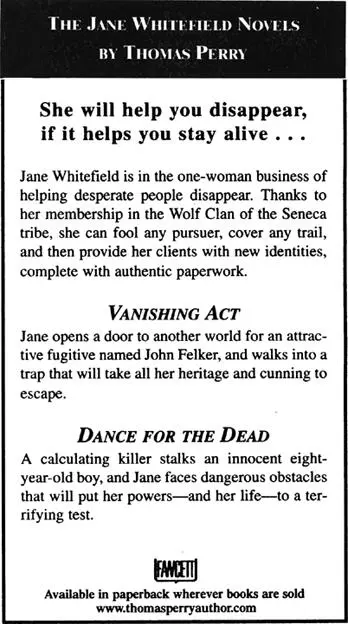
From the Paperback edition.
The Face-Changers — читать онлайн бесплатно полную книгу (весь текст) целиком
Ниже представлен текст книги, разбитый по страницам. Система сохранения места последней прочитанной страницы, позволяет с удобством читать онлайн бесплатно книгу «The Face-Changers», без необходимости каждый раз заново искать на чём Вы остановились. Поставьте закладку, и сможете в любой момент перейти на страницу, на которой закончили чтение.
Интервал:
Закладка:
That left only the two doctors in Chicago, Richard Dahlman and Sarah Hoffman. If either were murdered, there would be an immediate investigation. There was no way to avoid it. When that happened, the authorities were likely to try to ask questions of the people who had once worked with the victim, and they were going to find that a statistically unlikely number of them had recently died. So what the killers had chosen to do was to trigger the investigation themselves, so that the questions weren’t asked until they were ready to hand the police a killer. They had made sure that before any question could be asked, the police had an answer.
If the investigation led the police to change the suicide or the accident or the disappearance into murders, they would not start looking for new suspects. They would already have in custody a proven killer who was clearly out of his mind, and who’d had as little reason to murder his partner as any of the others. The real killers must have planned the deaths in a hundred different ways, a hundred different orders to see which of the five should be killed when, and which would be left to serve as perpetrator.
The more Jane thought about it, the more sophisticated the plan they had chosen seemed. The one who would simply disappear had to be one of the three women, because that happened to young women fairly regularly in big cities, and hardly ever to middle-aged men. The one killed in the car accident had to be someone who could be fooled into traveling a long distance by car. That way there would be lots of chances to arrange it and the investigators who were stuck with it would have very little information. The supposed murderer would have to be one of the men, because men who went mad were more likely to do it that way than women were. Jane wasn’t sure about suicides, but she suspected men did more of that too, and an anesthesiologist was the best candidate because he carried the means with him in his bag.
“What’s our next stop?”
Jane remembered Dahlman. He had to be talked to. Human beings were terribly fragile. A person had to be kept informed, kept thinking and participating or he would begin to lose his connection with the herd, and that was the same as losing his connection with the world. “I’m not sure,” she said. “I’ve been trying to think over everything you’ve told me so we’ll know what we should do.” She smiled apologetically. “It’s not very comforting stuff.”
His answer wasn’t a snap, the way it had been earlier. It was quiet and regretful. “You said you wanted to figure out who was chasing us. Did you figure it out?”
“The police in Chicago are interested, of course. Most of the time, getting out of Illinois would do a lot to solve that problem. When there’s a murder, the local police keep looking hard, but everywhere else you’d just be a name among thousands of others. The people who set you up took care of that. They’ve made it look as though you’re unpredictable and dangerous, so for the moment you’re probably near the top of the list everywhere. Since there are plenty of grounds for the federal authorities to come in, we have to assume that just about everyone in the country who hunts people for a living is looking for you.”
“You think I should turn myself in and take my chances at trial, don’t you?”
Jane shrugged, and slowly blew out a breath. “It’s a hard question. Most of the time, if someone is wrongly accused of a crime, I would say yes. If there’s evidence of your innocence that I haven’t heard, I would still say yes. Is there?”
“Not evidence in the sense you mean. A lifetime of decent behavior doesn’t seem to qualify.” He was silent for a moment. “How do you think I would do at a trial? Be honest.”
She squinted ahead at the road. “You’ve already been arrested. They got you a lawyer, everyone listened to your story two or three times, and they sent you to have your head examined. This is not a verdict, of course, but I think it’s pretty consistent with what you could expect next time. Since you’re clearly able to understand what’s said to you, I would also guess that it was done as a necessary formality. You would be declared sufficiently sane to participate in your defense, and would stand about a seventy- to eighty-percent chance of being convicted.”
“How can you put a percentage on it?”
“That’s about how the average defendant does in a murder trial in this country. Your chances are actually a bit worse, but it’s unrealistic to guess how much worse.”
“Why would mine be worse?”
“A lot of reasons. One is that you’ve been made to look very clever and sneaky. You can’t deny you escaped from a mental lockup by drugging someone, or that you slipped out of the hospital in Buffalo. Juries don’t like that kind of defendant, because they assume he’s a liar. Judges don’t like them either, so the close calls would go to the prosecution. The people who framed you have already had weeks to clean up any loose ends, and the police have had more weeks to examine the faked evidence, so I can’t hold out much hope that the frame will fall apart of its own weight.”
“I can’t live with this kind of injustice,” said Dahlman. “I can’t let them get away with what they’ve done.”
Jane sighed. “Then maybe the best thing to do isn’t to disappear, and I’m not the person you need right now.”
“What do you mean by that?”
“I’m not in the business of ensuring that justice is done. I’m just one small person, not smart enough to assume I always know what justice is, let alone imagine that I can make things happen that are neat and symmetrical enough to qualify as fair. What I do is take people who are about to be killed and move them to places where nobody wants to kill them. If you want to disappear, you come to me. If you want something else—revenge, keeping your enemies from hurting someone else, peace of mind, justice, I’m not interested.”
Dahlman was silent for a long time. Finally, he said, “I’m convinced that justice is a positive, verifiable, obtainable goal. I need you to keep me out of jail, but I’m not going to give up. I won’t lie to you about that.”
“Fine. Just don’t imagine that you and I are going after these people ourselves.”
“If that’s necessary, I’ll do it.”
“Really?” said Jane. “Then I guess you’d better do as much weighing and measuring in advance as you can.”
“What do you mean?”
“The authorities aren’t looking for the people who framed you. That leaves only you to do something about it. But if you see any of them again, they’ll be armed and trying to kill you. Will you let them?”
“Well, no,” he said. “The last time it happened I was under the mistaken impression that you wanted me to help ambush and shoot them. Naturally, I refused. But letting them kill me doesn’t serve justice. I would try not to let them do it.”
“Would you try with a gun?”
“I would certainly be reluctant, but if there were no other way to preserve my life—and what I know—then maybe I would.”
Jane shook her head. “The ‘no other way’ argument doesn’t work in real life. When it happens, you don’t have ten hours to work through each alternative to predict whether it will necessarily result in your death. You don’t have ten heartbeats. You see them and shoot, or they see you and shoot. It’s not about good and evil; it’s about who gets to feel the eleventh heartbeat.”
He nodded. “I suppose it could happen that way. There could be circumstances—”
“Yes,” she interrupted. “There could. And while you’re preparing for them, you’d better start working on the most likely of the circumstances.”
“What’s that?”
Читать дальшеИнтервал:
Закладка:
Похожие книги на «The Face-Changers»
Представляем Вашему вниманию похожие книги на «The Face-Changers» списком для выбора. Мы отобрали схожую по названию и смыслу литературу в надежде предоставить читателям больше вариантов отыскать новые, интересные, ещё непрочитанные произведения.




Обсуждение, отзывы о книге «The Face-Changers» и просто собственные мнения читателей. Оставьте ваши комментарии, напишите, что Вы думаете о произведении, его смысле или главных героях. Укажите что конкретно понравилось, а что нет, и почему Вы так считаете.