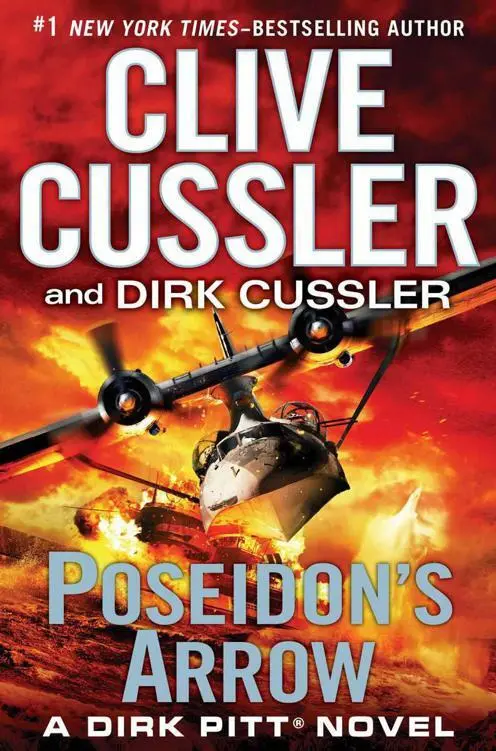
Clive Cussler - Poseidon's Arrow
Здесь есть возможность читать онлайн «Clive Cussler - Poseidon's Arrow» весь текст электронной книги совершенно бесплатно (целиком полную версию без сокращений). В некоторых случаях можно слушать аудио, скачать через торрент в формате fb2 и присутствует краткое содержание. Жанр: Старинная литература, на английском языке. Описание произведения, (предисловие) а так же отзывы посетителей доступны на портале библиотеки ЛибКат.
- Название:Poseidon's Arrow
- Автор:
- Жанр:
- Год:неизвестен
- ISBN:нет данных
- Рейтинг книги:5 / 5. Голосов: 1
-
Избранное:Добавить в избранное
- Отзывы:
-
Ваша оценка:
Poseidon's Arrow: краткое содержание, описание и аннотация
Предлагаем к чтению аннотацию, описание, краткое содержание или предисловие (зависит от того, что написал сам автор книги «Poseidon's Arrow»). Если вы не нашли необходимую информацию о книге — напишите в комментариях, мы постараемся отыскать её.
And now the Cusslers bring us Pitt’s most dangerous adventure of all...
It is the greatest advance in American defense technology in decades—an attack submarine capable of incredible underwater speeds. Nothing else in any other nation’s naval arsenal even comes close. There is only one problem: A key element of the prototype is missing—and the man who developed it is dead.
At the same time, ships have started vanishing mid-ocean, usually never to be found again, but when they are, sometimes bodies are found aboard . . . burned to a crisp.What is going on? And what does it have to do with an Italian submarine that itself disappeared in 1943, lost at sea? Or was she?
It is up to NUMA director Dirk Pitt and his team, aided by a beautiful NCIS agent and by Pitt’s children, marine engineer Dirk and oceanographer Summer, to go on a desperate international chase to find the truth, from Washington to Mexico, Idaho to Panama. What they discover at the end of it is a much, much greater threat than even they imagined.
If they don’t succeed in their mission, the world as they know it might end up a very different place—and not a pleasant one.
Filled with breathtaking suspense and extraordinary imagination, Poseidon’s Arrow is further proof that when it comes to adventure writing, nobody beats Clive Cussler.
Poseidon's Arrow — читать онлайн бесплатно полную книгу (весь текст) целиком
Ниже представлен текст книги, разбитый по страницам. Система сохранения места последней прочитанной страницы, позволяет с удобством читать онлайн бесплатно книгу «Poseidon's Arrow», без необходимости каждый раз заново искать на чём Вы остановились. Поставьте закладку, и сможете в любой момент перейти на страницу, на которой закончили чтение.
Интервал:
Закладка:
“Latin for ‘eagle,’” Dirk said.
Summer gave her brother a suspicious look.
“Astronomy,” he explained. “I remember it from a constellation near Aquarius.”
“Mule would have been a more befitting name,” Perlmutter said. “The Germans were concerned over their high loss of surface ships while trading war materials with Japan, so they convinced the Italians to convert eight of their largest, and somewhat outdated, submarines to transport duty. The interiors were gutted and most of their armaments removed so they could carry a maximum amount of cargo.”
“Sounds like dangerous duty,” Dirk said.
“It was. Four of the vessels were sunk outright, one was scuttled, and the other three captured in Asia before completing a round-trip. Or at least that’s what the history books say.” Perlmutter began scanning the pages, examining the dates.
“So what happened to the Barbarigo ?” Summer asked.
“Designated Aquila Five, she departed Bordeaux on June 16, 1943, bound for Singapore with a cargo of mercury, steel, and aluminum bars. Radio contact was lost a few days later, and it was presumed she was sunk somewhere near the Azores.”
He skipped ahead to the last page. “My Italian is deplorable, but I read the last entry as November 12, 1943.”
“Nearly five months later,” Dirk said. “Something doesn’t figure.”
“I have the answer, I hope, right here.” Summer pulled out a sheaf of printed pages. “I had Hiram scan the logbook into his computer system. He claimed it was child’s play to translate it into English and gave me the output right before we left.”
She began passing the pages around the table, letting Dirk and Perlmutter devour them like a pair of hungry coyotes.
“Here we go,” Dirk said. “It says here that they were spotted and attacked by two aircraft in the Bay of Biscayne shortly after leaving port but safely eluded them. Their radio mast was damaged, which prevented them from communicating with central command.”
Via the journal, they followed the Barbarigo ’s voyage around the Cape of Good Hope and across the Indian Ocean. The submarine off-loaded its cargo in Singapore and then was diverted to a small Malaysian port near Kuala Lumpur.
“‘On 23 September, we took on 130 tons of oxidized ore called Red Death by the locals,’” Summer read. “‘A German scientist named Steiner oversaw the loading and joined the crew for the return voyage.’”
“The first officer later wrote that Steiner stayed holed up in his cabin with a stack of physics books for the rest of the trip,” Dirk said.
“Red Death?” Perlmutter said. “I wonder if it is something like Edgar Allan Poe’s plague of the same name. I’ll have to take a look at that—and this fellow Steiner. Certainly a curious cargo.”
The trio flipped through several weeks of entries describing the submarine’s return across the Indian Ocean. On the ninth of November, the handwriting turned hurried, and the pages showed saltwater stains.
“This is where they got into trouble, while off the coast of South Africa,” Perlmutter said. He read aloud a terse description of the Barbarigo diving to avoid a nighttime air attack. After eluding several bombing runs, the crew believed they had escaped the attack—only to discover that the sub’s propeller had been disabled or blown off entirely.
Dirk and Summer sat silently as Perlmutter read of the resulting tragedy. With no propulsion, the sub remained submerged for twelve hours, fearing that additional aircraft had been called to the scene. Surfacing at midday, they found themselves in an empty sea, drifting to the southeast. Carried past the shipping lanes and without a long-range radio, the officers feared they might drift to their deaths in the Antarctica. Captain De Julio ordered the crew to abandon ship, and they took to the four life rafts stowed beneath the forward deck, saluting their beloved vessel as they left her side. In a mix-up of orders, the last officer off failed to prime the scuttle charges and sealed the main hatch. Rather than sinking before them, the Barbarigo drifted off toward the horizon.
Perlmutter stopped reading and raised his eyebrows like a pair of drawbridges. “My word,” he said quietly. “That is most curious.”
“What happened to the other three boats?” Summer asked.
“The log entries become spottier at this point,” Perlmutter said. “They attempted to reach South Africa and were within sight of land when a storm struck. The boats were dispersed in the rough seas, and Captain De Julio said the men in his boat never again saw the other three. During the ordeal they lost five men, all their food and water, and their sail and oars. The raft was carried east, drifting away from shore with the coastal current. Eventually the weather turned hot and dry. With no fresh water, they lost two more crewmen, leaving only the captain, the first officer, and two engineers.”
“Ravaged by thirst, they eventually spotted land again and were able to paddle closer. High winds and huge swells carried them ashore and tossed them onto the beach,” Perlmutter said. “They found themselves in a hot desert, desperate for water. The last entry states the captain went off alone in search of water, as the others were too weak to walk. The journal ends, ‘God bless the Barbarigo and her crew.’”
“We can attest to the barrenness of the region,” Summer said after a time. “What a tragedy that they nearly made it safely to South Africa and ended up a thousand miles away in Madagascar.”
“They fared slightly better than the crewmen in the other three boats,” Dirk said.
Perlmutter nodded, though he appeared lost in thought. He rose from his seat and padded into the living room, then returned a few minutes later with an armful of books and an inquisitive look. “Congratulations, Summer. It would appear as if you have solved two enduring mysteries of the sea.”
“Two?” she asked.
“Yes, the fate of the Barbarigo and the identity of the South Atlantic Wraith.”
“I’ll buy the former,” Dirk said, “but what’s this Wraith?”
Perlmutter opened the first book and flipped through its pages. “From the logbook of the merchant ship Manchester , off the Falkland Islands, February 14, 1946. ‘Light seas, winds out of the southwest three or four. At 1100, the first officer reported an object off our starboard beam. Appeared at first to be a whale carcass, but believe it is a man-made vessel.’”
He closed the book and opened another. “The freighter Southern Star , April 3, 1948, near Santa Cruz, Argentina. ‘Unknown object, possible sailing vessel, spotted adrift two miles distant. Black hull, small superstructure amidships. Appears abandoned.’”
Perlmutter picked up a third book. “Accounts of a South Georgia Whaling Station. In February of 1951, the whaler Paulita arrived with a kill of three mature gray whales. Captain reports spotting a ghost ship, low black hull, small sail amidships, drifting one hundred miles north. Crew called it the South Atlantic Wraith.”
“You think the Barbarigo is this Atlantic Wraith?” Summer asked.
“It’s entirely possible. For a period of twenty-two years, there were sightings of a supposed ghost ship adrift in the South Atlantic. For one reason or another, no one seemed to get a close view, but the descriptions are all similar. It seems to me that a bottled-up submarine could drift about an empty sea for quite a while.”
“At those southerly latitudes, the sub’s conning tower could easily ice over,” Dirk said, “so from a distance it resembled a sail.”
“That might be confirmed in the last recorded sighting.” Perlmutter opened the final book. “It was in 1964. An endurance sailor named Leigh Hunt was making a solo round-the-world voyage when he saw something unusual. Ah, here it is,” he said, and began reading aloud the passage,
Читать дальшеИнтервал:
Закладка:
Похожие книги на «Poseidon's Arrow»
Представляем Вашему вниманию похожие книги на «Poseidon's Arrow» списком для выбора. Мы отобрали схожую по названию и смыслу литературу в надежде предоставить читателям больше вариантов отыскать новые, интересные, ещё непрочитанные произведения.

Обсуждение, отзывы о книге «Poseidon's Arrow» и просто собственные мнения читателей. Оставьте ваши комментарии, напишите, что Вы думаете о произведении, его смысле или главных героях. Укажите что конкретно понравилось, а что нет, и почему Вы так считаете.