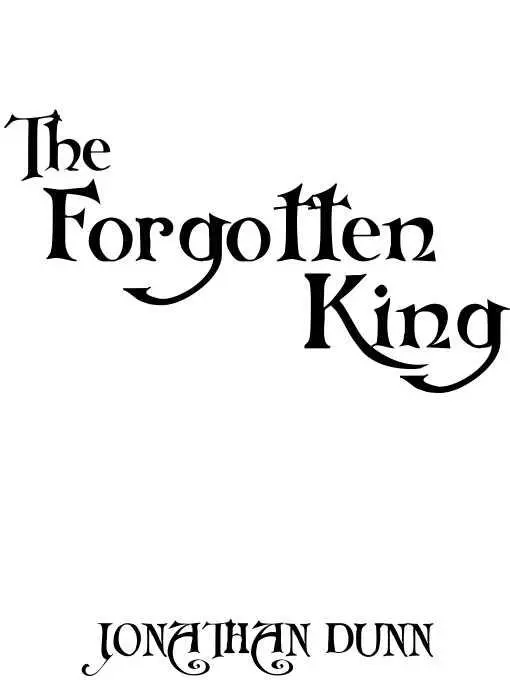
Jonathan Dunn - The Forgotten King
Здесь есть возможность читать онлайн «Jonathan Dunn - The Forgotten King» весь текст электронной книги совершенно бесплатно (целиком полную версию без сокращений). В некоторых случаях можно слушать аудио, скачать через торрент в формате fb2 и присутствует краткое содержание. Жанр: Старинная литература, на английском языке. Описание произведения, (предисловие) а так же отзывы посетителей доступны на портале библиотеки ЛибКат.
- Название:The Forgotten King
- Автор:
- Жанр:
- Год:неизвестен
- ISBN:нет данных
- Рейтинг книги:4 / 5. Голосов: 1
-
Избранное:Добавить в избранное
- Отзывы:
-
Ваша оценка:
The Forgotten King: краткое содержание, описание и аннотация
Предлагаем к чтению аннотацию, описание, краткое содержание или предисловие (зависит от того, что написал сам автор книги «The Forgotten King»). Если вы не нашли необходимую информацию о книге — напишите в комментариях, мы постараемся отыскать её.
The Forgotten King ebook is a history of the Dark Ages, of the forgotten ages that followed the fall of Rome. Civilization did not collapse with the Roman empire, however, but grew again on an island nation off the coast of Europe. It was called Atilta, a land of ancient forests and great, maritime capitals. At this time, it was at war with itself as its people fought for freedom. Yet the freedoms they desired were contradictory: some longed to overthrow their tyrannical king, others their tyrannical God. It was a fight of forest against city, and nature against civilization; of man against beast, and beast against God. But whom was the victor? For the island of Atilta is no longer to be found. Yet its history remains, embedded into the myths and legends of an exiled people. This is its story. This is the history of The Forgotten King.
The Forgotten King — читать онлайн бесплатно полную книгу (весь текст) целиком
Ниже представлен текст книги, разбитый по страницам. Система сохранения места последней прочитанной страницы, позволяет с удобством читать онлайн бесплатно книгу «The Forgotten King», без необходимости каждый раз заново искать на чём Вы остановились. Поставьте закладку, и сможете в любой момент перейти на страницу, на которой закончили чтение.
Интервал:
Закладка:
ADMIRAL: Loathe, indeed, Oren; but God has no place in councils of war. I see you made no plans to defend the bay by ship, Alfonzo, and I assume you leave that to me.
ALFONZO: I do.
ADMIRAL: Very well, I will begin at once. Milada, I trust you did not lose sight of the chain we took from Gylain after the coup?
MILADA: Not at all: it sits in the basement armory as we speak.
ADMIRAL: It is not wise to put such a massive chain in a basement armory, for it will be difficult to remove. It was built to protect the harbor in Eden, but it will do just as well in Thunder Bay. After that, we will sink whatever debris we can, to foul their larger ships. Then we can only hold the line or be damned.
ALFONZO: Any word from abroad?
ADMIRAL: None.
They were interrupted by a sharp knock on the outside door, which was opened without a wait. A man walked in, just from the forest: he smelled of trees and air. He wore leather armor, somewhat dirty, and his beard was thick, dark, and in every way the beard of a forest man.
MAN: A message for Alfonzo, from Osbert and Blaine.
ALFONZO: Go on.
MAN: We have met the enemy, sir. I was dispatched right away, to raise the alarm.
ALFONZO: Very good; and their number?
MAN: Five thousand, at least: the same force that left Eden two days ago. Blaine hopes to cripple them before they gain the open plain.
ALFONZO: He is ambitious, if trusty. Still, if he does not cripple them, they will do the same to us. It is time, friends: to war!
With that, he left the room to attend the preparations, as did the others.
Chapter 83
It was late afternoon, though the sun had already set in the deep Atiltian forest. The distance became invisible, the veranda blocked by rising trees. Still, the forest rangers could see what others could not.
“It begins,” Osbert said to Blaine Griffith, who stood beside him.
The former, with his low tide lips and sandy hair, wore only a plain leather jerkin. A bow rested in his hand and a large quiver on his back, while his leaf-shaped bronze sword was left in his belt. Blaine was attired in the same manner, though adorned with his animal eyes. In civilization, he was a meek and indirect man; in the wilderness a beast, a fierce hunter, a man of arms.
“So I have heard,” Griffith said. “The men say they are five thousand strong and our lives are forfeit in the attempt.”
“The men say many things,” Osbert hesitated, “Though in this they may be right. Come, old friend, let us grasp hands for the last,” and the two embraced firmly. “Once we reveal ourselves we will not rest until the battle is won, for us or for them.”
“So it will be: you take the left and I will have the right. There are arrows hidden along the way; perhaps we will meet when we rearm ourselves.” Griffith paused. “We will fish when we are through: you, me and Barnes. The men say the trout are best this time of year.”
Osbert looked away and the moist air condensed around his eyes. “Yes, we will have our trout.”
They crouched low to the ground as they spoke, a hundred yards from a large body of marching soldiers. While they stood directly before the soldiers’ path, there were two bodies of rangers – each a hundred strong – hiding to the left and right. The two friends returned to their men and took their positions in the fore. None of them wore armor or shields or helmets, only a bow and a bronze sword and a quiver of arrows on their backs. In the forest, nothing more was needed.
Osbert knelt behind an exposed root as he reached his men, taking his bow and fitting an arrow to its string. The others did the same.
“Let us not shoot too powerfully,” he whispered, “For beyond the soldiers crouch our comrades. If Gylain’s soldiers charge, fall back without hesitation and reform in the distance. We are not here to meet them in battle, but to weaken them for our comrades.”
In front of the soldiers rode an officer on horseback, a magnificent plume of feathers making his helmet conspicuous. Osbert pulled his arrow back until its string was steel, then waited: he could not shoot until they advanced to a certain spot, when both sides would attack simultaneously. The officer came forward slowly, drawing ever nearer to the fateful spot. Then, the same instant the horse’s hoof hit the spot, Osbert released his arrow. Its tail swirled silently as it sliced the air, then came a hollow clang, then the officer fell lifeless to the ground with an arrow camped in either side of his helmet. Yet before he had fallen, there was another arrow on Osbert’s string, and it was sent away as the officer’s body hit. The air was devoured by a dim droning and obscured by flashes of horizontal lightning.
Before the second string had been released, fifty of the soldiers had fallen. The remaining mass, however, was not thrown into chaos; rather, they continued marching at the same double pace they had previously employed. The leading officer was replaced by another with a thicker helmet and the actual commander was hidden safe within the ranks, out of the rebels’ sight.
“They take our assault without hesitation,” Osbert cried. “Keep up the pace, men!”
He returned his attentions to his prey, since no soldiers were detached to displace them. The first soldiers had passed through their ambush, though the long line continued to advance and take theirs in turn. Yet a battalion of soldiers from the rear had crept up and circled around Osbert’s company while they shot. Then, just before the ambuscade was ambushed, a cry came up from the rebels.
“Retreat!” he commanded, getting to his own feet. “Retreat, retreat!” and he fled into the forest abyss.
The rebels were unencumbered with heavy armor and soon left the soldiers behind. Still, a dozen of their fellows were lost in the surprise.
“Forward,” Osbert cried as he galloped through the trees. “Do not stop, or we will be slain.”
When they were safely away, they stopped and listened to the skirmish in the distance. Their pursuers could not be heard, but they did not stop to rest, following the rampant Osbert back into the fray. He led them to a point in advance of the enemy line and their attack began anew – albeit with sentries.
This time they released ten strings of arrows before they were displaced, and none of them were lost but a few who tripped along the way. Now, however, Osbert led them to a place where the grass was slightly discolored. He grabbed onto a knob that stuck out from the ground and pulled open a secret chamber, filled with arrows. The men refilled their quivers and refreshed themselves with water from a spring, then were once more sunk into the deluge of war. Only seventy-five remained.
This was continued all through the night. The soldiers were forced to continue their march without rest. Many were slain. By the next morning the men were weary and the adrenaline which had sustained them through the night began to give way. Their commander pulled them into ranks, where, under heavy guard, they ate a hasty breakfast. While their enemies rested, the archers kept to their work. They aimed high and shot far, dropping arrows deep into the camp, from which could be heard the sounds of dying men. Thus it was that the rangers – who would stop their work to assist an elderly man, or run through the night to fetch a doctor for an ill stranger – found themselves killing men whom they did not know and with whom they had no quarrel; they were merely on a different side of a name, a standard, a cause. This was war and there was nothing personal about it; yet those who killed and those who were killed were each persons. Such is the mystery of war.
The soldiers resumed the march and the rebels their harassing attacks. Then, at noon – after twelve hours of combat – Osbert pulled his twenty-five men together.
Читать дальшеИнтервал:
Закладка:
Похожие книги на «The Forgotten King»
Представляем Вашему вниманию похожие книги на «The Forgotten King» списком для выбора. Мы отобрали схожую по названию и смыслу литературу в надежде предоставить читателям больше вариантов отыскать новые, интересные, ещё непрочитанные произведения.







Обсуждение, отзывы о книге «The Forgotten King» и просто собственные мнения читателей. Оставьте ваши комментарии, напишите, что Вы думаете о произведении, его смысле или главных героях. Укажите что конкретно понравилось, а что нет, и почему Вы так считаете.