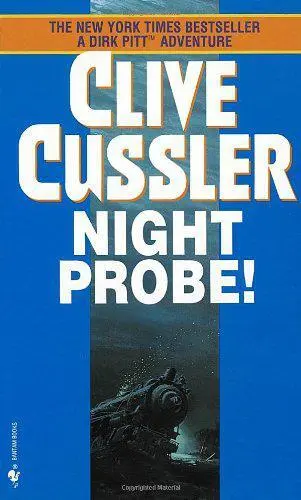
Night Probe! - Clive Cussler
Здесь есть возможность читать онлайн «Night Probe! - Clive Cussler» весь текст электронной книги совершенно бесплатно (целиком полную версию без сокращений). В некоторых случаях можно слушать аудио, скачать через торрент в формате fb2 и присутствует краткое содержание. Жанр: Старинная литература, на английском языке. Описание произведения, (предисловие) а так же отзывы посетителей доступны на портале библиотеки ЛибКат.
- Название:Clive Cussler
- Автор:
- Жанр:
- Год:неизвестен
- ISBN:нет данных
- Рейтинг книги:3 / 5. Голосов: 1
-
Избранное:Добавить в избранное
- Отзывы:
-
Ваша оценка:
Clive Cussler: краткое содержание, описание и аннотация
Предлагаем к чтению аннотацию, описание, краткое содержание или предисловие (зависит от того, что написал сам автор книги «Clive Cussler»). Если вы не нашли необходимую информацию о книге — напишите в комментариях, мы постараемся отыскать её.
****Dirk Pitt proved invincible in *Raise the Titanic!* Now, with the future of virtually every person in the world at stake, he is enlisted to spearhead his most daring mission yet—the rescue of a vital document for the United States. To an energy-starved, economically devastated America, possession of this document is worth billions. But to Great Britain, it’s worth a war. Pitt’s quest plunges him into a head-to-head confrontation with Britian’s most cunning secret agent—and into the throes of a torrid love triangle. As time runs out for a desperate America, Dirk Pitt races toward an underwater clash more terrifying than anything Clive Cussler has ever created—the breathtaking climax of **Night Probe!****
Clive Cussler — читать онлайн бесплатно полную книгу (весь текст) целиком
Ниже представлен текст книги, разбитый по страницам. Система сохранения места последней прочитанной страницы, позволяет с удобством читать онлайн бесплатно книгу «Clive Cussler», без необходимости каждый раз заново искать на чём Вы остановились. Поставьте закладку, и сможете в любой момент перейти на страницу, на которой закончили чтение.
Интервал:
Закладка:
"You let him go," Gunn said quietly.
"Yes, I let him go."
"Do you think it was wise?"
Pitt stood impassive and did not immediately answer, his incredible green eyes narrowed in conjecture. There was a smile but not a smile. The expression was almost menacing, that of a lion waiting in cover for a passing meal. "You saw the knife," Pitt said at last.
"He didn't have a prayer. Our boys would have fed him to the fish."
"The man was a killer." It was a simple statement, nothing more.
"We can still pick him up when he surfaces," Gunn persisted. "He would be helpless then."
"I don't think so."
"Any particular thought in mind?"
"Elementary," said Pitt. "We use a small fish to catch a big one.
"So that's it, eh?" Gunn said, unconvinced. "Wait until he meets up with his buddies, form a posse and round up the lot. Then turn them over to the authorities."
"For all we know, they are the authorities."
Gunn was more confused than ever. "So what's the percentage?"
"Our visitor was only on a scout mission. Next time he might bring some friends and really get nasty. We need to buy time. I think it would be worth our while to stop their clock."
Gunn made a peculiar twist with his lips and nodded. "I'm with you, but we had better get a move on. That guy will be boarding the next boat that passes by."
"No rush," Pitt said, quite relaxed. "He'll have to decompress for at least a half an hour. Probably has a spare set of air cylinders stashed on the river bottom somewhere."
Another question formed in Gunn's mind. "You said the gate-crasher was a killer. What made you say that?"
"He was too quick with the knife, too anxious to use it. Those who are born with a killer instinct never hesitate."
"So we're up against people with a license to kill," said Gunn thoughtfully. "Not exactly a cozy thought."
In the basin of the port of Rimouski, along the two deserted docks and the long warehouses, the predawn atmosphere was quiet and desolate, the stillness accented by the absence of wind.
It was too early for the appearance of the dockworkers, the eternally squawking seagulls, and the diesel locomotives that hauled the unloaded cargo to a nearby industrial park.
Tied to one dock was the tug that had towed an empty barge up and down the river past the Ocean Venturer only a few hours earlier. It was streaked with red rust, and the ravages from thirty years of hard use lay heavily on its uncompromising lines. A light streamed from the portholes of the master's cabin directly below the pilothouse, dimly reflecting across the black water.
Shaw checked his watch and pushed a tiny switch on what could have passed for a pocket calculator. He closed his eyes in thought a moment, and then began punching the rows of buttons.
Nothing like the old days, he mused, when an agent had to hide in an attic and mutter in low tones into the microphone of a radio transmitter. Now digital signals were relayed by satellite to a computer in London. There the message was decoded and sent to its proper destination by fiber optical transmission.
When he finished, he laid the electronic unit on the table and stood up to stretch. His muscles were stiff and his back sore. The bane of advancing age. He reached into his suitcase and pulled out the bottle of Canadian Club he had purchased after arriving at the Rimouski airport.
The Canadians called it whiskey, but to his British taste it seemed little different from American bourbon. It struck him as primitive to drink it warm-only the Scots preferred to down their liquor that way-but then, decrepit tugboats lacked such modern conveniences as ice makers He sat down in a chair and lit one of his specially o ordered cigarettes. At least something remained of the past. All he lacked was a warm companion. It was times like these, when he was alone with a bottle and reflecting on his life, that he regretted not having remarried.
His reverie was interrupted when the little device on the table gave off a muted beep. Then a fine slip of paper, no more than a quarter of an inch in width, began to issue from one end. A marvel of advanced technology; it never failed to amuse him.
He donned a pair of reading glasses, another curse of the creeping years, and began studying the diminutive wording on the paper. The full text consumed nearly half a meter. At the end he removed his glasses, switched off the transmitter receiver and replaced it in his pocket. "The latest news from jolly old England?" Shaw looked up to find Foss Gly standing in the doorway.
Gly made no move to enter. He just stared at Shaw from under questioning eyebrows and the expression in the eyes was that of a jackal sniffing the air.
"Merely an acknowledgment of my report on what you observed," replied Shaw casually. He began idly wrapping the message strip around his index finger in a roll.
Gly had changed from his thermal exposure suit into dungarees and a heavy turtleneck sweater. "I've still got the shivers. Mind if I help myself to a shot of your booze?"
"Be my guest."
Gly emptied half a water glass of the Canadian Club in two swallows. He reminded Shaw of an immense trained bear he'd once seen gulping a bucket of ale.
Gly expelled a long sigh. "Makes me feel almost human again.
"By my reckoning," said Shaw conversationally, "your decompression stage was five minutes on the down side. Are you feeling any ill effects?"
Gly made as if to pour himself another drink. "A slight tingling sensation, nothing more-" In a lightning movement his hand shot across the table and clutched Shaw's wrist in a steel grip. "That message wouldn't happen to concern liir-, liuw would it, dad?"
Shaw tensed as the nails dug into him. He flattened his feet on the floor, planning to thrust his body backward out of the chair. But Gly anticipated his thoughts.
"No tricks, dad, or I'll snap your bone."
Shaw sagged. Not from fear. From anger at being caught at a disadvantage.
"You overrate yourself, Inspector Gly. Why should the British secret service bother itself about you?"
"A thousand apologies," Gly sneered, maintaining the pressure. "I'm the suspicious type. Liars make me edgy."
"A crude accusation from a crude mind," said Shaw, coming back on balance. "I'd expect little else, considering the source."
Gly's lips twisted. "Clever words, Superspy. Suppose you tell me you didn't contact your boss in London and receive an acknowledgment over two hours ago."
"And if I say you're mistaken?"
"No good. I had a little chat with Doc Coli in the galley. Is your memory so rotten you've forgotten he helped you compose your report on that little gizmo? Or that you added a postscript after Coli left. A request for a rundown on Foss Gly. You know it, I know it. The reply is there in your hand."
The trapdoor had sprung and Shaw had fallen through. He cursed his transparency. He had little doubt that the ugly man across the table would murder if given the slightest opportunity. His only hope was to stall and throw Gly off his stride. He tried a long shot.
"Mr. Villon mentioned in passing that you might prove unstable. I should have taken him at his word."
The angry wideniing of the eyes told Shaw he had struck a nerve. He continued to turn the screw. "I believe he even used the term 'psycho.' "
The reaction was not what he expected. Not what he expected at all.
Instead of cold wrath, Gly's expression was suddenly transformed to one of enlightenment. He released Shaw's wrist and sat back. "So the double-talking scum stabbed me in the back," Gly muttered. "I might have guessed he'd eventually wise up to my scheme." He paused and looked at Shaw curiously. "I get the story now. Why I was always sent to do the underwater dirty work. Somewhere along the line you were to see to it I was conveniently drowned by an unfortunate accident."
Читать дальшеИнтервал:
Закладка:
Похожие книги на «Clive Cussler»
Представляем Вашему вниманию похожие книги на «Clive Cussler» списком для выбора. Мы отобрали схожую по названию и смыслу литературу в надежде предоставить читателям больше вариантов отыскать новые, интересные, ещё непрочитанные произведения.



Обсуждение, отзывы о книге «Clive Cussler» и просто собственные мнения читателей. Оставьте ваши комментарии, напишите, что Вы думаете о произведении, его смысле или главных героях. Укажите что конкретно понравилось, а что нет, и почему Вы так считаете.