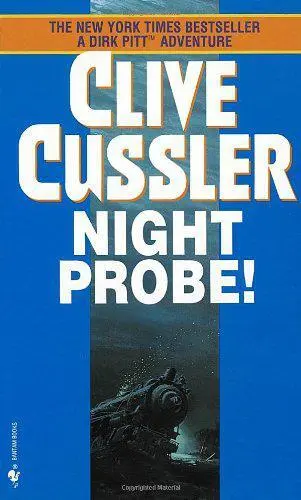
Night Probe! - Clive Cussler
Здесь есть возможность читать онлайн «Night Probe! - Clive Cussler» весь текст электронной книги совершенно бесплатно (целиком полную версию без сокращений). В некоторых случаях можно слушать аудио, скачать через торрент в формате fb2 и присутствует краткое содержание. Жанр: Старинная литература, на английском языке. Описание произведения, (предисловие) а так же отзывы посетителей доступны на портале библиотеки ЛибКат.
- Название:Clive Cussler
- Автор:
- Жанр:
- Год:неизвестен
- ISBN:нет данных
- Рейтинг книги:3 / 5. Голосов: 1
-
Избранное:Добавить в избранное
- Отзывы:
-
Ваша оценка:
Clive Cussler: краткое содержание, описание и аннотация
Предлагаем к чтению аннотацию, описание, краткое содержание или предисловие (зависит от того, что написал сам автор книги «Clive Cussler»). Если вы не нашли необходимую информацию о книге — напишите в комментариях, мы постараемся отыскать её.
****Dirk Pitt proved invincible in *Raise the Titanic!* Now, with the future of virtually every person in the world at stake, he is enlisted to spearhead his most daring mission yet—the rescue of a vital document for the United States. To an energy-starved, economically devastated America, possession of this document is worth billions. But to Great Britain, it’s worth a war. Pitt’s quest plunges him into a head-to-head confrontation with Britian’s most cunning secret agent—and into the throes of a torrid love triangle. As time runs out for a desperate America, Dirk Pitt races toward an underwater clash more terrifying than anything Clive Cussler has ever created—the breathtaking climax of **Night Probe!****
Clive Cussler — читать онлайн бесплатно полную книгу (весь текст) целиком
Ниже представлен текст книги, разбитый по страницам. Система сохранения места последней прочитанной страницы, позволяет с удобством читать онлайн бесплатно книгу «Clive Cussler», без необходимости каждый раз заново искать на чём Вы остановились. Поставьте закладку, и сможете в любой момент перейти на страницу, на которой закончили чтение.
Интервал:
Закладка:
There was a cold silence of perhaps ten seconds while Pitt hesitated. Finally he cleared his throat.
"For the sum of one billion dollars Great Britain sold Canada to the United States."
Pitt's words flew over the President's head. He sat blank, unbelieving of what he heard. "Say again," he demanded.
"We bought Canada for one billion dollars."
"That's absurd."
"But true," said Pitt firmly. "Before the war broke out there were many members of Parliament who doubted loyal support by the colonies and dominions. There were liberals as well as conservatives who openly stated that Canada was a drain on the empire."
"Can you show me proof?" asked the President, his eyes skeptical.
Pitt handed him a copy of Wilson's letter. "This was written by Woodrow Wilson to Prime Minister Asquith on June fourth. You'll note that it was creased through part of one sentence. I ran a spectrograph test on it and found the missing words cause the line to read: 'my countrymen are a possessive lot and would never idly stand by knowing with certainty that our neighbor to the north and our own beloved country had become one.' "
The President studied the letter for several minutes, then he set it on the coffee table. "What else do you have?"
Without comment Pitt passed over the photograph of Bryan, Essex and Shields leaving the White House with the treaty. Then he played his trump card.
"This is the desk diary of Richard Essex for the month of May. The entire scope of the conferences leading to the North American Treaty is set down in scrupulous detail. The last entry is dated May twenty-second, nineteen fourteen, the day Essex left the capital for Canada and the final signing of the treaties."
"You said treaties, plural."
"There were three copies, one for each country involved. The first to sign were Asquith and King George. Shields then carried the historic papers to Washington where, on May twentieth, Wilson and Bryan added their names. Two days later, Essex and Shields departed together by train to Ottawa where the Canadian prime minister, Sir Robert Borden, affixed the last signature."
"Then why was it no formal transfer of Canada into the Union took place?"
"A series of unfortunate circumstances," explained Pitt. "Harvey Shields, in company with a thousand other souls, went down with the transatlantic liner Empress of Ireland after it collided with a coal collier and sank in the St. Lawrence River.
His body and the British copy of the treaty were never recovered."
"But surely Essex reached Washington with the American copy.
Pitt shook his head. "The train carrying Essex plunged off a bridge into the Hudson River. The disaster became something of a classic mystery when neither the crew and the passengers, nor any trace of the train, was ever found."
"That still left one copy in Canadian hands."
"The trail goes cold at this point," said Pitt. "The rest is speculation. Apparently Asquith's cabinet rebelled. The ministers, including no doubt Churchill, must have been furious when they discovered the Prime Minister and the King had tried to sell off their largest dominion behind their backs."
"I doubt the Canadians were overly fond of the deal either."
"With two copies of the treaty gone it would have been a simple matter for Sir Robert Borden, a loyal Englishman, by the way, to have destroyed the third, leaving Wilson with no tangible evidence to advance an American claim."
"It doesn't seem possible official records concerning negotiations of such magnitude could be so conveniently lost," said the President.
"Wilson states in his letter he instructed his secretary to destroy all mention of the pact. I can't speak for the Foreign Office, but it seems a safe bet to say they're collectors. Traditionally, the British aren't given to throwing away or burning documents. Whatever treaty papers survive are probably buried under a ton of dust in some old Victorian warehouse."
The President rose and began pacing. "I wish I could have studied the wording of the treaty."
"You can." Pitt smiled. "Essex penned a draft in his desk diary."
"May I keep it?"
"Of course."
"How did you happen onto this diary?"
"It was in the possession of his grandson," Pitt answered without elaboration.
"John Essex?"
"Yes."
"Why did he keep it a secret all these years?"
"He must have been afraid its exposure would cause an international upheaval."
"He may have been right," said the President. "If the press blasted this discovery on a slow news week, there is no predicting the grassroots reaction by people on both sides of the border. Wilson was right: the Americans are a possessive lot. They might demand a takeover of Canada. And God only knows the hell Congress would raise."
"There is a catch," said Pitt.
The President stopped his pacing. "And that is?"
"There is no record of payment. The initial deposit was converted to a loan. Even if a copy of the treaty turned up, the British would reject it by claiming, and rightfully so, they were never compensated."
"Yes," the President said slowly, "nonpayment could void the treaty."
He moved to the tall windows and gazed across the winter brown grass of the White House lawn, saying nothing, struggling with his thoughts. Finally he turned and stared directly at Pitt.
"Who knows about the North American Treaty besides you?"
"Commander Heidi Milligan, who began the preliminary research after finding the Wilson letter, the Senate historian who uncovered the photographs, my father, and of course, Admiral Sandecker. Since he is my immediate superior I only felt it fair he should know what I was investigating."
"No one else?"
Pitt shook his head. "I can't think of anyone."
"Let's keep it a select club, shall we?"
"Whatever you say, Mr. President."
"I deeply appreciate your bringing this matter to my attention, Mr. Pitt."
"Would you like me to pursue it?"
"No, I think it best if we drop the treaty back in its coffin for now. There is no purpose in damaging our relations with Canada and the United Kingdom. I see it as a simple case of what nobody knows, won't hurt them."
"John Essex would have agreed."
"And you, Mr. Pitt, would you agree?"
Pitt closed his briefcase and stood up. "I'm a marine engineer, Mr. President. I steer well clear of political involvement."
"A wise course," said the President with an understanding smile. "A wise course indeed."
Five seconds after the door closed behind Pitt, the President spoke into his intercom. "Maggie, get me Douglas Oates on the holograph." He settled behind his desk and waited.
Soon after taking up residence in the White House he had ordered a holographic communications system installed in his office. He took an almost childlike interest in studying his cabinet members' expressions, body movements and outward emotions while he visually talked to them miles away.
The three-dimensional image of a man with wavy auburn hair and conservatively attired in a gray pinstripe suit materialized in the middle of the oval office. He was seated in a leather executive chair.
Douglas Oates, the secretary of state, nodded and smiled. "Good morning, Mr. President. How goes the battle?"
"Douglas, how much money has the United States given away to Britain since nineteen fourteen?"
Oates stared quizzically. "Given?"
"Yes, you know, war loans written off, economic aid, contributions, whatever."
Oates shrugged. "A pretty substantial sum, I should imagine."
"Over a billion dollars?"
"Easily," replied Oates. "Why do you ask?"
The President ignored the question. "Arrange for a courier. I have something of interest for my friend in Ottawa."
"More data on the oil bonanza?" Oates persisted.
Читать дальшеИнтервал:
Закладка:
Похожие книги на «Clive Cussler»
Представляем Вашему вниманию похожие книги на «Clive Cussler» списком для выбора. Мы отобрали схожую по названию и смыслу литературу в надежде предоставить читателям больше вариантов отыскать новые, интересные, ещё непрочитанные произведения.
Обсуждение, отзывы о книге «Clive Cussler» и просто собственные мнения читателей. Оставьте ваши комментарии, напишите, что Вы думаете о произведении, его смысле или главных героях. Укажите что конкретно понравилось, а что нет, и почему Вы так считаете.