Dennis Wheatley - Vendetta in Spain
Здесь есть возможность читать онлайн «Dennis Wheatley - Vendetta in Spain» весь текст электронной книги совершенно бесплатно (целиком полную версию без сокращений). В некоторых случаях можно слушать аудио, скачать через торрент в формате fb2 и присутствует краткое содержание. Жанр: Старинная литература, на английском языке. Описание произведения, (предисловие) а так же отзывы посетителей доступны на портале библиотеки ЛибКат.
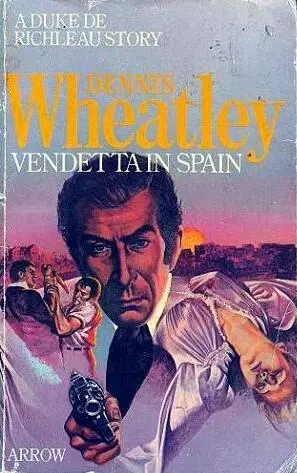
- Название:Vendetta in Spain
- Автор:
- Жанр:
- Год:неизвестен
- ISBN:нет данных
- Рейтинг книги:4 / 5. Голосов: 1
-
Избранное:Добавить в избранное
- Отзывы:
-
Ваша оценка:
Vendetta in Spain: краткое содержание, описание и аннотация
Предлагаем к чтению аннотацию, описание, краткое содержание или предисловие (зависит от того, что написал сам автор книги «Vendetta in Spain»). Если вы не нашли необходимую информацию о книге — напишите в комментариях, мы постараемся отыскать её.
Readers of
and other books in which the glamorous Lucretia-Jose appears with the Duke de Richleau may recall that her parentage was surrounded by mystery. Over the years many people have written, asking for an account of the great romance that led to her birth.
The story takes us back to Spain, in 1906, when the Duke had not yet succeeded his father, and was still the Count de Quesnoy. In these days it is not easy for us to realize that, less than fifty years ago, there was hardly a Monarch or President who could leave his bed in the morning with any certainty that he would live through the day. Anarchism permeated every country in Europe. Not a night passed without groups of fanatics meeting in cellars to plan attempts with knives, pistols or bombs against the representatives of law and order; not a month passed without some royalty or high official falling a victim to their plots.
In Spain, an historic bomb outrage that led to scores of innocent people being killed or injured, gave de Quesnoy ample cause to vow vengeance on the assassins. His attempt to penetrate anarchist circles in Barcelona nearly cost him his life. In San Sebastian, Granada and Cadiz he hunted and was hunted by them in a ruthless vendetta. Only after two years did it end in a final desperate gamble with death.
It is against this background of true history, subtle intrigue, sudden violence, terrorism, blackmail and suspense that there develops the bitter-sweet romance between the gallant young de Quesnoy and the beautiful Condesa Gulia, the wife of a friend he loves and honours. Their frustrated passion leads to a denouement that rivals in surprise and breath-taking effect the outcome of his vendetta against the anarchists.
Vendetta in Spain — читать онлайн бесплатно полную книгу (весь текст) целиком
Ниже представлен текст книги, разбитый по страницам. Система сохранения места последней прочитанной страницы, позволяет с удобством читать онлайн бесплатно книгу «Vendetta in Spain», без необходимости каждый раз заново искать на чём Вы остановились. Поставьте закладку, и сможете в любой момент перейти на страницу, на которой закончили чтение.
Интервал:
Закладка:
'Your persistence in making such a journey deserves a better reward than that you should now have to continue it for another few thousand miles to Siberia,' de Richleau remarked, this time with a cynical smile. 'But why, since you were prepared to go to such lengths to avenge your brother's death on me, did you not follow me to South America, instead of waiting until I returned to Europe?'
Tf I could have, I would,' Benigno scowled. 'But at the time Captain Robles shipped you off there I was in prison. It was over a year before I got out. As soon as I had learned the full details of Sanchez's death and what had happened to you, I wrote to correspondents in Rio. They informed me that you had left Brazil months before and were somewhere in Central America, but no one knew for certain where. I wanted to go out to search for you; but I had very little money and my father wouldn't help me. He said it would be better to wait until . . .'
'Your father!' exclaimed the Duke. 'Did he then escape too?'
'Escape!' repeated Benigno, giving him a blank look. 'Why, no; neither of us escaped. After a year in prison all of us who had been arrested at the time the Escuela Moderna was raided were released.'
De Richleau stared at him in astonishment. 'D'you mean to tell me that when you were tried not even your father received more than a twelve months' sentence?'
'We were never brought to trial. Evidently the police decided that they had not enough evidence to convict us; and many influential bodies in Spain who hold Liberal views agitated for us to be given our freedom.'
'And where is your father now?'
For the first time Benigno's face showed the flicker of a smile and his reply was tinged with malice. 'That is no secret. Soon after we were released he started his Escuela Moderna again. Not in the city because, the tyrants having confiscated our property, we could not afford to set up in another big house. The school now occupies an old building in a village just outside Barcelona. But, for having been unjustly imprisoned for a year, as was proved when the police had to let him go without preferring a charge against him, he is now looked on by all the Liberals in Spain as a martyr. No one would dare to lay a finger on him.'
At this revelation, de Richleau's thoughts began to race with furious intensity. That Francisco Ferrer, the evil genius who inspired the Spanish anarchists, the man who was basically responsible for the death of Angela and the deaths of scores of other innocent people, should again be at large, filled him with amazement. Why Ferrer and his associates had never been brought to trial seemed to him inexplicable; and that, owing to Liberal pressure, they should have been allowed to go free after only a year in prison shocked him profoundly.
He was quick to realize that, had he not been shanghaied to South America, that could not possibly have happened. They would undoubtedly have been tried and, on his evidence, convicted. Instead, it now emerged that the dreary weeks he had spent in Barcelona, the sufferings he had endured there, and the near loss of his life, had all gone for nothing. He had not, after all, as he had long believed, succeeded in avenging Angela's death. For well over a year and a half, Ferrer had been a free man, and not only free but left at liberty to incite again his admiring disciples to murder.
Benigno's last statement - that no one would now dare to lay a finger on his father - still echoed in the Duke's brain, but it needed only an instant's thought for him to realize that about that the young anarchist was wrong. He, de Richleau, had only to return to Spain and tell what he knew of Francisco Ferrer on oath before a magistrate for a warrant to be issued and a policeman to place a heavy hand on Ferrer's shoulder.
Had Benigno known better the man to whom he was speaking, he would have had more care for his father's safety than to issue such a challenge. It needed only another moment's thought for the Duke to decide that, while he could have been of little help to the Ocrana in Russia, he could still strike a great blow against the world-wide menace of anarchism by going again to Spain. Those grey eyes of his, flecked with their yellow lights, glinted and with sudden harshness he said to Benigno:
'Whatever your dupes - those guileless, woolly-minded, reform-for-reform's-sake, besotted Liberals - may think of your father, I know him to be a disciple of the Devil - a man who has not only planned murders himself, but has injected his poisonous philosophy of murder into the minds of scores of earnest, misguided young people and, if he could, would bring about unlimited misery by overturning all forms of law and order. You may take it from me, Benigno, that I will either have your father executed or put behind bars for life, if it is the last thing that I ever do.'
At that moment, the Inspector came in and said that he must take over the prisoner, as in a few minutes the Court would be sitting. With a reassuring nod to the white-faced Benigno, the Duke said, 'Don't worry. I am satisfied now that you did not mean to kill me'; then, having thanked the Inspector for letting him talk with the prisoner, he walked back into the outer office.
Benigno's case did not come on for the best part of an hour, while the Magistrates dealt with other prisoners on minor charges. Then the Duke was ushered into the witness-box. He told his story with an air of calm indifference. It was that when in Barcelona nearly three years ago, he had known this man Ferrer as an agitator who openly proclaimed himself an anarchist. Having heard him make threats against the Captain-General of the City, General Quiroga, he, de Richleau, had informed the authorities, upon which Ferrer had been arrested. No doubt Ferrer had realized who was responsible for his arrest and having, by chance, come upon him, de Richleau, again the previous night, he had sought to avenge himself by inflicting a wound.
With an innocent expression, and apparently in ignorance of the fact that he was overstepping the functions of a witness, de Richleau went on to say, 'It* is not for me to suggest to the Court how it should deal with this man. But in view of his past, it seems unlikely that he would have come to this country except at the invitation of the nihilists; or, in any event, having arrived here have not got into touch with them. I feel, therefore, that while the assault on myself might normally be regarded as an ordinary criminal offence, meriting only a few months' imprisonment, having regard to his political background it is quite a possibility that, when freed, he might attack and perhaps murder someone of considerable importance. To send him back to Spain would be a troublesome and costly business, and the Spanish authorities would certainly not thank us; so may I suggest that he should be sent to a place where for a long time to come he will be in no position to do harm to anyone.'
The Magistrates listened to the Duke with deference. As he ceased speaking they nodded their approval; then their Chairman pronounced the sentence which, at that time, had become a commonplace in all the cities of European Russia. 'The Court orders that the prisoner be dispatched forthwith to a penal settlement in Siberia, there to remain during His Imperial Majesty's pleasure.'
As de Richleau left the courtroom, he gave a last glance at Benigno. He had secured from him the information he was anxious to obtain, and he had not cheated him. Many hardened criminals survived for years the harsh life in the Siberian penal settlements; some even succeeded in escaping. But to do so needed resource, great courage and, above all, extreme physical fitness. Benigno had none of those, and the Duke would have been prepared to wager heavy odds that he would not last six months in the salt mines. He felt satisfied that this second member of the foul Ferrer brood would make no further contribution to the infliction of agony and grief on innocent people; it now remained to choke the fount from which the poison sprang.
Читать дальшеИнтервал:
Закладка:
Похожие книги на «Vendetta in Spain»
Представляем Вашему вниманию похожие книги на «Vendetta in Spain» списком для выбора. Мы отобрали схожую по названию и смыслу литературу в надежде предоставить читателям больше вариантов отыскать новые, интересные, ещё непрочитанные произведения.




Обсуждение, отзывы о книге «Vendetta in Spain» и просто собственные мнения читателей. Оставьте ваши комментарии, напишите, что Вы думаете о произведении, его смысле или главных героях. Укажите что конкретно понравилось, а что нет, и почему Вы так считаете.