Clive Cussler - Black Wind
Здесь есть возможность читать онлайн «Clive Cussler - Black Wind» весь текст электронной книги совершенно бесплатно (целиком полную версию без сокращений). В некоторых случаях можно слушать аудио, скачать через торрент в формате fb2 и присутствует краткое содержание. Жанр: Старинная литература, на английском языке. Описание произведения, (предисловие) а так же отзывы посетителей доступны на портале библиотеки ЛибКат.
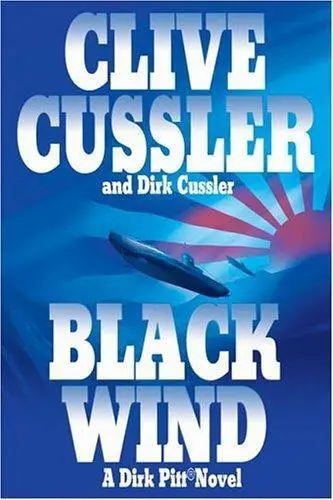
- Название:Black Wind
- Автор:
- Жанр:
- Год:неизвестен
- ISBN:нет данных
- Рейтинг книги:5 / 5. Голосов: 1
-
Избранное:Добавить в избранное
- Отзывы:
-
Ваша оценка:
Black Wind: краткое содержание, описание и аннотация
Предлагаем к чтению аннотацию, описание, краткое содержание или предисловие (зависит от того, что написал сам автор книги «Black Wind»). Если вы не нашли необходимую информацию о книге — напишите в комментариях, мы постараемся отыскать её.
Black Wind — читать онлайн бесплатно полную книгу (весь текст) целиком
Ниже представлен текст книги, разбитый по страницам. Система сохранения места последней прочитанной страницы, позволяет с удобством читать онлайн бесплатно книгу «Black Wind», без необходимости каждый раз заново искать на чём Вы остановились. Поставьте закладку, и сможете в любой момент перейти на страницу, на которой закончили чтение.
Интервал:
Закладка:
“The Naval Ministry records were somewhat limited. It's a shame that most all of the original documents were returned to the Japanese government in the fifties. The available records in the archives are, of course, written in Japanese, using a variety of dialects, so I had to set up several translation programs before I could initiate a scan.”
Yaeger paused and poured himself a cup of coffee from a large silver urn before continuing.
“As it is, you are in luck. I found a log of operations orders from the Japanese Sixth Fleet covering the last six months of 1944.”
“Including the I-403?” Dirk asked.
“Yep. Its mission of December 1944 evidently had high importance. It was approved by the fleet admiral himself. The actual sailing order was short and sweet.”
Yaeger pulled a sheet of paper from a thin folder and read aloud. “”Proceed northerly route to Pacific West Coast, refueling Amchitka (Moriokd). Initiate aerial strike with Maka^e ordnance earliest practicable. Primary Target: Tacoma, Seattle, Vancouver, Victoria. Alternate Target: Alameda, Oakland, San Francisco. With the emperor's blessing.“ ”
“That's a pretty ambitious target list for just two planes,” Gunn remarked.
“Think about it, though,” Dirk said. “The cities are concentrated enough all to be reached on a single flyover. Two or three biological bombs per city would wreak deadly havoc, if that's in fact what they were. Hiram, you said the ordnance was referred to as Maka^e. St. Julien Perlmutter found mention of the same term. Any information on what they were?”
“I was curious about that myself,” Yaeger replied. “I found that the 'iferal translation was 'evil wind' or 'black wind.” But there was no additional information in the official naval records."
Yaeger paused and sat back in his chair with a knowing, look.
“Well, did you find anything else?” Gunn finally goaded.
“It was Max, actually,” Yaeger replied proudly. “After exhausting the National Archives data, I had her search the public databases in the U.S. and Japan. In a Japanese genealogy database, she hit pay dirt, locating an obscure diary from a sailor who served aboard the I-403 during the war.” Holding a printout up to his face, he continued. “Mechanic First Class Hiroshi Sakora, Imperial Navy Air Corps, was a lucky devil. He came down with appendicitis while the sub was crossing the Pacific on its fateful voyage in December of 1944 and was transferred off the boat and onto the refueling ship in the Aleutian Islands. All his shipmates, of course, went on to perish when the sub was sunk off Washington State.”
“And he made mention of the I-403's mission?” Dirk asked.
“In vivid detail. It turns out that the young Mr. Sakora, in addition to his aircraft mechanic duties, was also in charge of aerial ordnance for the submarine's airplanes. He wrote that before they left port on their final voyage, an Army officer named Tanaka brought aboard an unusual type of aerial bomb that was to be used on the mission. The shipboard morale became very high, he added, when the crew learned they were to make an attack on the United States. But there was much mystery and speculation about the unknown weapon.”
“Did he identify what it was?” Gunn pressed.
“He tried to, but working with the fellow Tanaka was difficult. ”A gloomy, overbearing, obstinate taskmaster," he wrote about the officer.
Typical Army-Navy rivalry, I suppose, plus the submariners didn't like his being a last-minute addition to the sailing crew. At any rate, he pressed Tanaka for information, but to no avail. Finally, just before he fell ill and was transferred off the sub in the Aleutians, he wriggled the information out of one of the pilots. The pilot, so the story goes,
shared some sake with Tanaka and was able to pry the secret payload out of him. It was smallpox."
“Good God, so it's true!” Gunn exclaimed.
“Apparently so. He wrote that the payload was a freeze-dried virus, which was to be detonated and dispersed at altitude above the most concentrated population points of each city. Within two weeks, an outbreak of smallpox was expected all along the West Coast. With a thirty percent mortality rate, the deaths would have been staggering. The Japanese figured the resulting panic would allow them to negotiate a peace settlement on their terms.”
"The threat of more smallpox bombs on our home soil might very well have changed the resolve of many people to finish the war, Gunn speculated.
An uneasiness crept over the room as the three considered how history may have played out differently had the I-403 successfully completed its mission. Their thoughts then turned to the possibility of a more current threat.
“You mentioned that the virus was freeze-dried. So they must have had the ability to store the virus for long periods and then rejuvenate it,” Dirk commented.
“Necessary for a long sea voyage,” Yaeger added. “According to Max the Japanese had difficulty in keeping the viruses alive in their munitions for any length of time. They ultimately perfected a way of freeze-drying the virus, for easier handling and longer storage, until the need for activation when deployed. Insert a little H2O and you're in business.”
“So the virus could still be a viable danger, even after sixty years at the bottom of the sea,” Gunn remarked. “I guess that answers Jost's question.”
“There's no reason the smallpox wouldn't survive in freeze-dried form if the canisters hadn't cracked during sinking. Since they're made of porcelain, the canisters could survive intact for centuries underwater,” Dirk said. “Might also explain the various interior segments to the bomb. A compartment with water was needed to rejuvenate the virus.”
“Perhaps it was more fortunate than we know that all but one of the canisters were demolished on the I-403,” Gunn remarked.
“That still leaves one canister unaccounted for,” Dirk replied.
“Yes, as well as the other mission ordnance,” Yaeger added.
Dirk and Gunn looked at each other. “What other mission?” Gunn asked incredulously.
“The I-411.”
Yaeger felt their eyes boring right through him.
“Didn't you know?” he asked. “There was a second submarine, the I-411. It, too, was armed with the Maka^e ordnance and was sent to attack the eastern seaboard of the United States,” Yaeger said quietly, realizing he had just dropped a bomb of his own.
It had been a long day for Takeo Yoshida. A crane operator for the Yokohama Port Development Corporation, Yoshida had toiled since six in the morning loading an aged Iberian freighter with container after container of Japanese consumer electronics bound for export. He had just secured the last of the metal containers onto the ship's deck when a radio crackled in the crane's control cabin.
“Yoshida, this is Takagi,” the deep voice of his foreman grumbled. “Report to Dock D-5 upon completion with San Sebastian. A single loading for the vessel Baekje. Takagi, out.”
“Affirmed, Takagi-san,” Yoshida answered, holding his disdain under his breath. Just twenty minutes to go on his shift and Takagi gives him a last-minute assignment across the shipyard. Securing the crane, Yoshida walked eight hundred yards across the Honmoku Port Terminal toward Dock D-5, cursing Takagi's name with each step he took. As he approached the end of the pier, he glanced beyond at the waters of the bustling port of Yokohama, where a constant stream of commercial ships jockeyed into position for loading and unloading.
With three hundred meters of waterfront, container terminal D-5 was big enough to handle the largest cargo ships afloat. Yoshida was surprised to find the vessel tied to the dock was not the typical jumbo containership awaiting a load of industrial cargo but a special-purpose cable ship. Yoshida even recognized the Baekje as having been built in the nearby Mitsubishi Heavy Industries shipyard. At 436 feet long and with a beam of 133 feet, the stout vessel was designed to lay fiber-optic cable on the seafloor while withstanding the turbulent seas of the North Pacific. With a modern-appearing superstructure and white paint that still glistened, Yoshida could tell that it had not been many years since the high-tech ship slid into Yokohama Bay for the first time. She sported a Korean flag above the bridge mast and a blue lightning bolt across the funnel, which Yoshida recalled was the signature of a Kang Enterprises vessel. Short on Korean history, the crane operator did not know that her name, Baekje, represented one or the early Korean tribal kingdoms that dominated the peninsula in the third century a.d.
Читать дальшеИнтервал:
Закладка:
Похожие книги на «Black Wind»
Представляем Вашему вниманию похожие книги на «Black Wind» списком для выбора. Мы отобрали схожую по названию и смыслу литературу в надежде предоставить читателям больше вариантов отыскать новые, интересные, ещё непрочитанные произведения.
Обсуждение, отзывы о книге «Black Wind» и просто собственные мнения читателей. Оставьте ваши комментарии, напишите, что Вы думаете о произведении, его смысле или главных героях. Укажите что конкретно понравилось, а что нет, и почему Вы так считаете.