Philippa Gregory - Meridon
Здесь есть возможность читать онлайн «Philippa Gregory - Meridon» — ознакомительный отрывок электронной книги совершенно бесплатно, а после прочтения отрывка купить полную версию. В некоторых случаях можно слушать аудио, скачать через торрент в формате fb2 и присутствует краткое содержание. Жанр: Старинная литература, на английском языке. Описание произведения, (предисловие) а так же отзывы посетителей доступны на портале библиотеки ЛибКат.
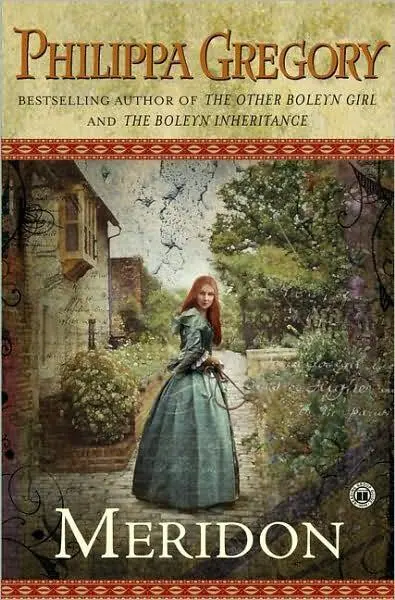
- Название:Meridon
- Автор:
- Жанр:
- Год:неизвестен
- ISBN:нет данных
- Рейтинг книги:4 / 5. Голосов: 1
-
Избранное:Добавить в избранное
- Отзывы:
-
Ваша оценка:
Meridon: краткое содержание, описание и аннотация
Предлагаем к чтению аннотацию, описание, краткое содержание или предисловие (зависит от того, что написал сам автор книги «Meridon»). Если вы не нашли необходимую информацию о книге — напишите в комментариях, мы постараемся отыскать её.
From Publishers Weekly
With this elaborate tapestry of a young woman's life, the Lacey family trilogy ( Wideacre and The Favored Child ) comes to a satisfying conclusion. Meridon is the lost child whose legacy is the estate of Wideacre. She and her very different sister, Dandy, were abandoned as infants and raised in a gypsy encampment, learning horsetrading and other tricks of survival. They are indentured to a circus master whose traveling show is made successful by Meridon's equestrian flair and Dandy's seductive beauty on the trapeze. Meridon's escape from this world is fueled by pregnant Dandy's murder and her own obsessive dream of her ancestral home. After claiming Wideacre, Meridon succumbs for a while to the temptation of the "quality" social scene, but eventually she comes to her senses, and, in a tricky card game near the end of the saga, triumphs fully. The hard-won homecoming in this historical novel is richly developed and impassioned.
Meridon — читать онлайн ознакомительный отрывок
Ниже представлен текст книги, разбитый по страницам. Система сохранения места последней прочитанной страницы, позволяет с удобством читать онлайн бесплатно книгу «Meridon», без необходимости каждый раз заново искать на чём Вы остановились. Поставьте закладку, и сможете в любой момент перейти на страницу, на которой закончили чтение.
Интервал:
Закладка:
‘Now,’ Lady Clara said as she joined me on the terrace and we watched his departing back. ‘Now, my girl, you are going to start work.’
I laughed at that, for I had known work that Lady Clara could never have dreamed of. But I laughed a good deal less once the work started.
Of course it was never hard, not like trapeze work or horsetraining. But it was wearying in a way that those skills had not been. I found I was as tired in the evenings as if I had been working hard each day, and I could not think what ailed me. Lady Clara never stopped watching me, she had me walk across the room a dozen times, she had me sit in a chair and get up again, over and over. She ordered the carriage out into the yard, and a phaeton and a curricle, and sent me up and down the steps into each of them time after time, until I could engage not to tread on the hem of my gown, or bang my bonnet on the carriage roof.
At mealtimes we dined quite alone. Not even Perry ate with us; the servants laid the table and were then dismissed. Then patiently, like a warder with an idiot, she taught me how to hold my knife and, at the same time, to hold my fork, how to put them down on the plate between mouthfuls, how to drink from my glass only when my mouth was empty so there was no greasy stain left on the rim. How to talk while I ate, and how to cope with chicken wings and chop bones without seizing them up and gnawing and sucking at them. She taught me to wipe the tips of my fingers on my napkin, she taught me to balance it on my knees so that it did not slide to the floor. How much wine to drink, and when it was polite to refuse or polite to accept.
All the time, every minute of the day, she corrected my speech. By just raising one of her arched eyebrows she warned me that I was talking Rom, talking rough, or talking bawdy. Over and over again I would try to tell her something and she would make me try the phrase, like a horse at a difficult jump, until I could get it out with the right words and the right inflexion.
‘Fortunately, some of the best ladies in society talk like farm-hands,’ she said acidly. ‘And a good few can read and write no more than you. But still you will learn, Sarah. You are coming along fast.’
I could not help but respect her. She never so much as flickered one of her long-lashed eyes, whatever I did. Whatever the mistakes I made – and I was too ignorant even to know how much she must be offended – she never even looked surprised. One evening, after an especially hard day when she had been trying to teach me to pick flowers in the garden and arrange them in a glass, I had burst out:
‘Lady Clara, this is hopeless. It is driving me half mad, and you must be fashed to death of me. I’ll never learn it. I’ve started too late. You are trying to school me in tricks I should’ve learned when I was learning to walk. I am too old for them now. I’ll go back to my own place and I’ll get Mr Fortescue’s old lady to live with me. I’ll never learn all I ought, and you must have had a bellyful of teaching me.’
‘Don’t say bellyful,’ she said instantly. ‘Or fashed.’ Then she paused. ‘No, my dear,’ she said. ‘I am not weary of it, and I think you are learning well. I am not disposed to give it all up. I think you will be a credit to me, to all of us. I want us to go on. I am pleased with your progress.’
‘But Lady Clara,’ I said. ‘The Season starts in autumn. I shall never be ready in time.’
She leaned back her head on the parlour chair. We were in the Blue Parlour and the colour of the upholstery matched her eyes as if it had been chosen with her colouring in mind. It probably had.
‘You must leave that decision to me,’ she said. ‘I am your sponsor into this new world, you have to trust my judgement. I shall tell you what is best for you, and I shall tell you when you are ready.’
‘And then what?’ I asked baldly. ‘When I am ready, when I am introduced into your society? What happens then? What do you think happens then?’
She raised her eyebrows, her blue eyes were very distant, very cold. ‘Why, you amuse yourself,’ she said. ‘You are the heiress to a considerable estate. You are sponsored by a woman of immaculate credentials (that’s me) and you will be squired by the best-looking young man in London, a peer of the realm himself (that, God help us, is Perry). If you want to be in Society, you will have reached the pinnacle of your ambitions.’
‘And then what?’ I pressed her.
She gave me a weary cold smile. ‘Then you decide, my dear,’ she said. ‘Most young women marry the best offer, the highest bidder. Their parents judge for them, their elders advise. But you have no parents to judge for you, and the circles where I will take you would never receive Mr Fortescue. You are your own mistress. If you fall head over heels in love I suppose you could marry your choice, whether he is footman or groom. No one would stop you.’
I looked back at her, and my green eyes were as hard as her blue ones. ‘You know as well as I do, that will not happen,’ I said blankly. ‘I am not the sort for that kind of love affair. I don’t like it.’
‘Then I suggest a marriage of convenience,’ she said. ‘Once you are married you can take control of your own estates and you need no longer apply to Mr Fortescue for your allowance. You can run your land as you wish and send these land-sharers and profit-stealers packing. You can make Wideacre a highly profitable place again and live as you please. If you choose a husband who will not trouble you, you can pay him an income to stay away from you and you can live the life you wish.’
I looked at her, and suddenly I understood. ‘Peregrine,’ I said flatly.
She did not even flinch. ‘Peregrine if you wish,’ she conceded. ‘Or any other. The choice is yours, my dear. I should never coerce you.’
I nodded. I had been waiting a long time to discover what Lady Clara was after. I knew a pitch for a gull when I saw one, she had been patient with me, she had played me on a long line. But I understood now what she was after. And I admired her for not denying it.
‘I am sorry,’ I said flatly. ‘I should never want to marry. Not Peregrine, not anyone. I am ready to go home at once. Mr Fortescue will arrange a companion for me. I am grateful to you for your kindness. But you need teach me no more.’
The languid movement of her fan waved me back into my chair.
‘I said it should be as you wish,’ she said gently. ‘If you do not wish to marry Perry then you need not. I would have thought you would have liked to get your hands on your own land and on your own wealth; and if you do not marry Perry it will be a long and wearisome wait for you – five long years, Sarah! – but the choice is yours. Wideacre is yours, whatever happens. And I am happy to teach you and present you at Court – whatever happens.’
I dipped my head. Once again, as happened nearly every day, she had shown me the elegance and generosity which came so easy to those that had never been hungry, who had never been short of space, who were never pressed for time. She had the generosity of a woman who had never known hunger. It came easily to her. I longed to learn that same casual, easy nonchalance.
‘Thank you,’ I said gruffly.
‘Voice,’ she said, without a change in her tone.
I lifted my head and spoke more clearly. ‘Thank you,’ I said.
She smiled at me, her eyes an impenetrable blue. ‘Don’t mention it,’ she said charmingly.
25
I did not like Mr Fortescue being gone. I did not like it that Wideacre Hall was lived in only by Becky and Sam. I did not like it that there was no smoke coming out of the front chimneys when I rode along the Common behind the house and looked down on it. I did not like it that the front door was always shut.
Читать дальшеИнтервал:
Закладка:
Похожие книги на «Meridon»
Представляем Вашему вниманию похожие книги на «Meridon» списком для выбора. Мы отобрали схожую по названию и смыслу литературу в надежде предоставить читателям больше вариантов отыскать новые, интересные, ещё непрочитанные произведения.



Обсуждение, отзывы о книге «Meridon» и просто собственные мнения читателей. Оставьте ваши комментарии, напишите, что Вы думаете о произведении, его смысле или главных героях. Укажите что конкретно понравилось, а что нет, и почему Вы так считаете.