Philippa Gregory - Meridon
Здесь есть возможность читать онлайн «Philippa Gregory - Meridon» — ознакомительный отрывок электронной книги совершенно бесплатно, а после прочтения отрывка купить полную версию. В некоторых случаях можно слушать аудио, скачать через торрент в формате fb2 и присутствует краткое содержание. Жанр: Старинная литература, на английском языке. Описание произведения, (предисловие) а так же отзывы посетителей доступны на портале библиотеки ЛибКат.
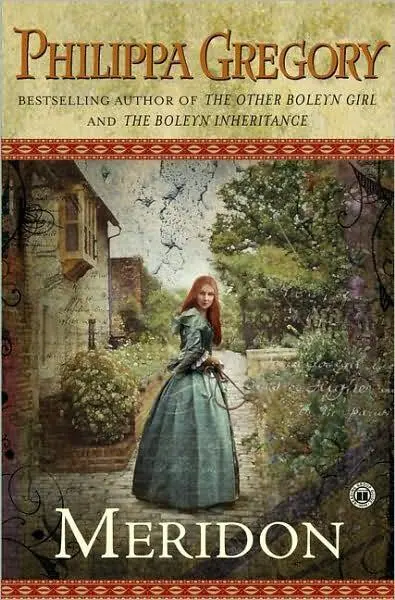
- Название:Meridon
- Автор:
- Жанр:
- Год:неизвестен
- ISBN:нет данных
- Рейтинг книги:4 / 5. Голосов: 1
-
Избранное:Добавить в избранное
- Отзывы:
-
Ваша оценка:
Meridon: краткое содержание, описание и аннотация
Предлагаем к чтению аннотацию, описание, краткое содержание или предисловие (зависит от того, что написал сам автор книги «Meridon»). Если вы не нашли необходимую информацию о книге — напишите в комментариях, мы постараемся отыскать её.
From Publishers Weekly
With this elaborate tapestry of a young woman's life, the Lacey family trilogy ( Wideacre and The Favored Child ) comes to a satisfying conclusion. Meridon is the lost child whose legacy is the estate of Wideacre. She and her very different sister, Dandy, were abandoned as infants and raised in a gypsy encampment, learning horsetrading and other tricks of survival. They are indentured to a circus master whose traveling show is made successful by Meridon's equestrian flair and Dandy's seductive beauty on the trapeze. Meridon's escape from this world is fueled by pregnant Dandy's murder and her own obsessive dream of her ancestral home. After claiming Wideacre, Meridon succumbs for a while to the temptation of the "quality" social scene, but eventually she comes to her senses, and, in a tricky card game near the end of the saga, triumphs fully. The hard-won homecoming in this historical novel is richly developed and impassioned.
Meridon — читать онлайн ознакомительный отрывок
Ниже представлен текст книги, разбитый по страницам. Система сохранения места последней прочитанной страницы, позволяет с удобством читать онлайн бесплатно книгу «Meridon», без необходимости каждый раз заново искать на чём Вы остановились. Поставьте закладку, и сможете в любой момент перейти на страницу, на которой закончили чтение.
Интервал:
Закладка:
‘Common land and home,’ I said. I glanced at the sun. ‘What time do they eat dinner?’
‘At six,’ he said coldly. ‘But they’ll wait till you are home before they serve dinner.’
I looked aghast. ‘That would be awful,’ I exclaimed.
The black look was wiped off his face in a second. Will laughed aloud. ‘If you think so,’ he said chuckling. ‘I’ll get you home in plenty of time. Could your horse do with a gallop?’
‘Oh yes,’ I said. Sea had been fretting ever since his hooves had been on the soft turf.
‘This way then!’ said Will and his brown cob sprang forward, suprisingly quickly for a horse that size. Sea was after him in a moment, and we chased them along the level track which arrowed, straight as a die, along the top of the Downs. We drew level in a few minutes and I heard Will laugh as we forged past them, Sea put his ears forward at the thunder of the hooves and then slackened his speed so that the brown cob inched forward again. They raced side by side, changing the leads as if they were enjoying themselves until Will called ‘Hulloa! Woah!’ and we slowed them down and they dropped into a canter and then we pulled them up.
‘We’ll go down this little track,’ Will said, and led the way down a track which was sticky with white creamy mud. Sea blew out and followed the cob as it skidded and slipped. The ground levelled off at the bottom and the mud gave way to white sand.
‘This is the Common,’ Will said.
It was a different kind of landscape entirely, but as familiar to me and as beloved as the Downland and parkland of my home. It was wild countryside, there were no hedges or fields or any sign of farming. As I listened I could hear the faint tinkle of a cow-bell or goat-bell. The busy village of Acre and the well-tended fields, away to the south, seemed miles away.
The hills were covered in heather, the fresh growth showing as a pale mist around the dead white flowers and grey of the old plants. All around us young fronds of ferns were growing leggy and short, necks curled up towards the sky. Over to my right there was a little coppice of silver birches, their trunks pale as paper.
‘Some of this has been enclosed, it is wonderful growing soil,’ Will said. ‘But most of it has been left as it always has been. A bit of a wilderness.’
He turned his horse’s head and Sea fell in beside the cob. The path was very wide, pure white sand, with a covering of black soil at the edges.
‘We keep this open for a firebreak,’ Will said.
‘It catches fire?’ I asked, bemused.
‘Sometimes in a very hot summer, but also we burn off the old heather and bracken so that it stays fit for grazing,’ he explained. ‘Even in the old days, when the Laceys ruled the land as they wished, it was always a right for the people of Acre to graze their own beasts up here. Cows mostly, but some people keep goats or sheep. Quite a few pigs, too.’
I nodded.
‘We’ll just go and look at the orchard, and then cut across the Common for home,’ he said. ‘Have I lost you yet?’
I screwed up my face to think. ‘No,’ I said. ‘The Downs curve around the village and we came down that path so that we were north of the village. I reckon it’s that way…’ I gestured with my left hand.
Will nodded. ‘You’ve a good sense of direction,’ he said. ‘But you would have that with the travelling you must have done.’
He waited in case I should tell him something about my travelling but I said nothing and he trotted on ahead of me along the firebreak, across a marshy little stream, where Sea jinked and shied, and then in a long easy canter along a path and into a wood of tall beech trees and the occasional pine. Ahead of us was the river and I followed Will on the brown cob when he turned to the left and rode along its banks. The water was deep, dark brown in the curves and bends by the banks, but sparkling and bright in the shallows. We came out on to a cart track and then Will pulled his horse up and said, ‘There.’
Ahead of us was a high and lovely fold of hills, capped by silver birches and the ungainly growing heads of baby ferns. Over to our left the hills ran down to the river, brown with last year’s bracken but lightened with the new growth. The old heather showed as dull pewter and old silver. Before us, in a huge sprawl of a field, were straight well-planted rows of apple trees, the leaves green with soft silvery undersides as the wind rolled through them.
‘Your ma planted this,’ Will said and his voice was filled with wonder. ‘Before you were born. Your ma Julia planted it, and my cousin Ted Tyacke was here when she did it. He said it took them all day to plant it and when they had finished they were so tired they could hardly walk home.’
I nodded. For a moment I forgot my sadness and my anger as I looked at the great fertile sweep of the land and saw how the strong branches bobbed as the wind played through them.
Will’s voice was warm. ‘Ted told me that none of them had ever planted apple trees before, it was a new idea. To set the estate back on its feet after the fire and everything going bad. He said that it was one of the first things Julia ever did on her own. She worked all day on her own down here and she counted out all the trees and got them set in straight rows.’
I looked again at the orchard. I thought I could even tell that they had planted from left to right, the first two rows were a bit wobbly, as if they had been learning how to keep to the line. After that they were straighter. I thought of my mother, a young woman little older than me, trying to set the land right.
‘He said she was up and down each row twenty times,’ Will said, a laugh in the back of his voice. ‘And at the end of it, all the trees were in and she looked around and there was one left on the cart! They laughed until they cried and she swore that she would give the sapling to the village to keep so the children could have apples off it.’ He paused. ‘She planted it on the green,’ he said. ‘The tree is getting old now, but the apples are very sweet.’
I felt a rush of tenderness for the mother I had never known, for the other Tyacke who had worked with her and laughed when she ended with one tree too many, for all the people she knew who worked with her to set this land on its feet again so that it could grow rich and fertile.
‘Thank you,’ I said, and for that moment I was simply grateful that he had taken the time and the trouble to bring me down here, to show me the orchard, and to explain to me what the land had meant to my mother. How she had been when she had been a young girl with the rights and duties of a squire. How she had been when she had loved and owned the land.
Will nodded and clicked to his horse so that we rode on beside the river, past the orchard. ‘She wanted to end the line of the Laceys,’ he said gently. ‘She told them that in the village one day. When her husband Squire Richard was bringing in day labourers and paying only the poor-rate wages. She said there should be no more squires.’
I felt myself stiffen, and the cold hardness which had been around me all my life came back to me.
‘Then she should have drowned me in the river as she planned, and not given me away,’ I said. ‘She should have had the courage to do the thing properly, or not at all. She gave me away and I was lost for all those years. So now I do not understand the land, and the village is used to having no squire.’
Will looked very attentively at the path ahead of us, at the stream moving so sweetly and easily across the land.
‘We could become accustomed,’ he said. ‘We will both have to change a little. We will become accustomed to having a Lacey in the Hall again. You will learn how to be Quality. Perhaps this is the best way. For she did not end the squires, but here you are, a squire who knows what it is to be poor. It is different for you, because you were not bred to it. You’ve seen both sides. You’ve not been trained in Quality ways, you’ve not learned to look away when you see beggars. Your heart is not hard in the way they learn.’
Читать дальшеИнтервал:
Закладка:
Похожие книги на «Meridon»
Представляем Вашему вниманию похожие книги на «Meridon» списком для выбора. Мы отобрали схожую по названию и смыслу литературу в надежде предоставить читателям больше вариантов отыскать новые, интересные, ещё непрочитанные произведения.



Обсуждение, отзывы о книге «Meridon» и просто собственные мнения читателей. Оставьте ваши комментарии, напишите, что Вы думаете о произведении, его смысле или главных героях. Укажите что конкретно понравилось, а что нет, и почему Вы так считаете.