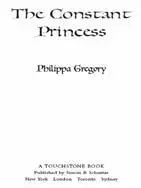
Philippa Gregory - The Constant Princess
Здесь есть возможность читать онлайн «Philippa Gregory - The Constant Princess» — ознакомительный отрывок электронной книги совершенно бесплатно, а после прочтения отрывка купить полную версию. В некоторых случаях можно слушать аудио, скачать через торрент в формате fb2 и присутствует краткое содержание. Жанр: Старинная литература, на английском языке. Описание произведения, (предисловие) а так же отзывы посетителей доступны на портале библиотеки ЛибКат.
- Название:The Constant Princess
- Автор:
- Жанр:
- Год:неизвестен
- ISBN:нет данных
- Рейтинг книги:4 / 5. Голосов: 1
-
Избранное:Добавить в избранное
- Отзывы:
-
Ваша оценка:
The Constant Princess: краткое содержание, описание и аннотация
Предлагаем к чтению аннотацию, описание, краткое содержание или предисловие (зависит от того, что написал сам автор книги «The Constant Princess»). Если вы не нашли необходимую информацию о книге — напишите в комментариях, мы постараемся отыскать её.
Thus, bestselling author Philippa Gregory introduces one of her most unforgettable heroines: Katherine of Aragon. Known to history as the Queen who was pushed off her throne by Anne Boleyn, here is a Katherine the world has forgotten: the enchanting princess that all England loved. First married to Henry VIII's older brother, Arthur, Katherine's passion turns their arranged marriage into a love match; but when Arthur dies, the merciless English court and her ambitious parents -- the crusading King and Queen of Spain -- have to find a new role for the widow. Ultimately, it is Katherine herself who takes control of her own life by telling the most audacious lie in English history, leading her to the very pinnacle of power in England.
Set in the rich beauty of Moorish Spain and the glamour of the Tudor court, The Constant Princess presents a woman whose constancy helps her endure betrayal, poverty, and despair, until the inevitable moment when she steps into the role she has prepared for all her life: Henry VIII's Queen, Regent, and commander of the English army in their greatest victory against Scotland.
From Publishers Weekly
As youngest daughter to the Spanish monarchs and crusaders King Ferdinand and Queen Isabella, Catalina, princess of Wales and of Spain, was promised to the English Prince Arthur when she was three. She leaves Spain at 15 to fulfill her destiny as queen of England, where she finds true love with Arthur (after some initial sourness) as they plot the future of their kingdom together. Arthur dies young, however, leaving Catalina a widow and ineligible for the throne. Before his death, he extracts a promise from his wife to marry his younger brother Henry in order to become queen anyway, have children and rule as they had planned, a situation that can only be if Catalina denies that Arthur was ever her lover. Gregory's latest (after Earthly Joys) compellingly dramatizes how Catalina uses her faith, her cunning and her utter belief in destiny to reclaim her rightful title. By alternating tight third-person narration with Catalina's unguarded thoughts and gripping dialogue, the author presents a thorough, sympathetic portrait of her heroine and her transformation into Queen Katherine. Gregory's skill for creating suspense pulls the reader along despite the historical novel's foregone conclusion.
The Constant Princess — читать онлайн ознакомительный отрывок
Ниже представлен текст книги, разбитый по страницам. Система сохранения места последней прочитанной страницы, позволяет с удобством читать онлайн бесплатно книгу «The Constant Princess», без необходимости каждый раз заново искать на чём Вы остановились. Поставьте закладку, и сможете в любой момент перейти на страницу, на которой закончили чтение.
Интервал:
Закладка:
“Oh, I don’t think I resign myself.”
Henry was intrigued. “You don’t?”
“No. I think I trust in God that He knows what is right for all of us, and His will shall be done.”
“Even when His ways are hidden and we sinners have to stumble about in the dark?”
“I know my destiny,” Catalina said calmly. “He has been gracious to reveal it to me.”
“Then you’re one of the very few,” he said, thinking to make her laugh at herself.
“I know,” she said without a glimmer of a smile. He realized that she was utterly serious in her belief that God had revealed her future to her. “I am blessed.”
“And what is this great destiny that God has for you?” he said sarcastically. He hoped so much that she would say that she should be Queen of England, and then he could ask her, or draw close to her, or let her see what was in his mind.
“To do God’s will, of course, and bring His kingdom to earth,” she said cleverly, and evaded him once more.
I speak very confidently of God’s will, and I remind the king that I was raised to be Princess of Wales, but in truth God is silent to me. Since the day of Arthur’s death I can have no genuine conviction that I am blessed. How can I call myself blessed when I have lost the one thing that made my life complete? How can I be blessed when I do not think I will ever be happy again? But we live in a world of believers—I have to say that I am under the especial protection of God, I have to give the illusion of being sure of my destiny. I am the daughter of Isabella of Spain. My inheritance is certainty.
But in truth, of course, I am increasingly alone. I feel increasingly alone. There is nothing between me and despair but my promise to Arthur, and the thin thread, like gold wire in a carpet, of my own determination.
MAY 1503
King Henry did not approach Catalina for one month for the sake of decency, but when he was out of his black jacket he made a formal visit to her at Durham House. Her household had been warned that he would come and were dressed in their best. He saw the signs of wear and tear in the curtains and rugs and hangings and smiled to himself. If she had the good sense that he thought she had, she would be glad to see a resolution to this awkward position. He congratulated himself on not making it easier for her in this last year. She should know by now that she was utterly in his power and her parents could do nothing to free her.
His herald threw open the double doors to her presence chamber and shouted, “His Grace, King Henry of England…”
Henry waved aside the other titles and went in to his daughter-in-law.
She was wearing a dark-colored gown with blue slashings on the sleeve, a richly embroidered stomacher, and a dark blue hood. It brought out the amber in her hair and the blue in her eyes, and he smiled in instinctive pleasure at the sight of her as she sank into a deep formal curtsey and rose up.
“Your Grace,” she said pleasantly. “This is an honor indeed.”
He had to force himself not to stare at the creamy line of her neck, at the smooth, unlined face that looked back up at him. He had lived all his life with a beautiful woman of his own age; now here was a girl young enough to be his daughter, with the rich-scented bloom of youth still on her and breasts full and firm. She was ready for marriage, indeed, she was over-ready for marriage. This was a girl who should be bedded. He checked himself at once, and thought he was part lecher, part lover to look on his dead son’s child bride with such desire.
“Can I offer you some refreshment?” she asked. There was a smile in the back of her eyes.
He thought if she had been an older, a more sophisticated woman, he would have assumed she was playing him, as knowingly as a skilled angler can land a salmon.
“Thank you. I will take a glass of wine.”
And so she caught him. “I am afraid I have nothing fit to offer you,” she said smoothly. “I have nothing left in my cellars at all, and I cannot afford to buy good wine.”
Henry did not show by so much as a flicker that he knew she had trapped him into hearing of her financial difficulties. “I am sorry for that. I will have some barrels sent over,” he said. “Your housekeeping must be very remiss.”
“It is very thin,” she said simply. “Will you take a cup of ale? We brew our own ale very cheaply.”
“Thank you,” he said, biting his lip to hide a smile. He had not dreamed that she had so much self-confidence. The year of widowhood had brought out her courage, he thought. Alone in a foreign land she had not collapsed as other girls might have collapsed, she had gathered her power and become stronger.
“Is My Lady the King’s Mother in good health and the Princess Mary well?” she asked, as confidently as if she were entertaining him in the gold room of the Alhambra.
“Yes, thank God,” he said. “And you?”
She smiled and bowed her head. “And no need to ask for your health,” she remarked. “You never look any different.”
“Do I not?”
“Not since the very first time we met,” she said. “When I had just landed in England and was coming to London and you rode to meet me.” It cost Catalina a good deal not to think of Arthur as he was on that evening, mortified by his father’s rudeness, trying to talk to her in an undertone, stealing sideways looks at her.
Determinedly she put her young lover from her mind and smiled at his father, and said: “I was so surprised by your coming, and so startled by you.”
He laughed. He saw that she had conjured the picture of when he first saw her, a virgin by her bed, in a white gown with a blue cape with her hair in a plait down her back, and how he thought then that he had come upon her like a ravisher, he had forced his way into her bedchamber, he could have forced himself onto her.
He turned and took a chair to cover his thoughts, gesturing that she should sit down too. Her duenna, the same sour-faced Spanish mule, he noticed irritably, stood at the back of the room with two other ladies.
Catalina sat perfectly composed, her white fingers interlaced in her lap, her back straight, her entire manner that of a young woman confident of her power to attract. Henry said nothing and looked at her for a moment. Surely she must know what she was doing to him when she reminded him of their first meeting? And yet surely the daughter of Isabella of Spain and the widow of his own son could not be willfully tempting him to lust?
A servant came in with two cups of small ale. The king was served first and then Catalina took a cup. She took a tiny sip and set it down.
“D’you still not like ale?” He was startled at the intimacy in his own voice. Surely to God he could ask his daughter-in-law what she liked to drink?
“I drink it only when I am very thirsty,” she replied. “But I don’t like the taste it leaves in my mouth.” She put her hand to her mouth and touched her lower lip. Fascinated, he watched her fingertip brush the tip of her tongue. She made a little face. “I think it will never be a favorite of mine,” she said.
“What did you drink in Spain?” He found he could hardly speak. He was still watching her soft mouth, shiny where her tongue had licked her lips.
“We could drink the water,” she said. “In the Alhambra the Moors had piped clean water all the way from the mountains into the palace. We drank mountain spring water from the fountains; it was still cold. And juices from fruits of course, we had wonderful fruits in summer, and ices, and sherbets and wines as well.”
“If you come on progress with me this summer, we can go to places where you can drink the water,” he said. He thought he was sounding like a stupid boy, promising her a drink of water as a treat. Stubbornly, he persisted. “If you come with me, we can go hunting, we can go to Hampshire, beyond, to the New Forest. You remember the country around there? Near where we first met?”
Читать дальшеИнтервал:
Закладка:
Похожие книги на «The Constant Princess»
Представляем Вашему вниманию похожие книги на «The Constant Princess» списком для выбора. Мы отобрали схожую по названию и смыслу литературу в надежде предоставить читателям больше вариантов отыскать новые, интересные, ещё непрочитанные произведения.








Обсуждение, отзывы о книге «The Constant Princess» и просто собственные мнения читателей. Оставьте ваши комментарии, напишите, что Вы думаете о произведении, его смысле или главных героях. Укажите что конкретно понравилось, а что нет, и почему Вы так считаете.