Jack Whyte - The Skystone
Здесь есть возможность читать онлайн «Jack Whyte - The Skystone» весь текст электронной книги совершенно бесплатно (целиком полную версию без сокращений). В некоторых случаях можно слушать аудио, скачать через торрент в формате fb2 и присутствует краткое содержание. Жанр: Старинная литература, на английском языке. Описание произведения, (предисловие) а так же отзывы посетителей доступны на портале библиотеки ЛибКат.
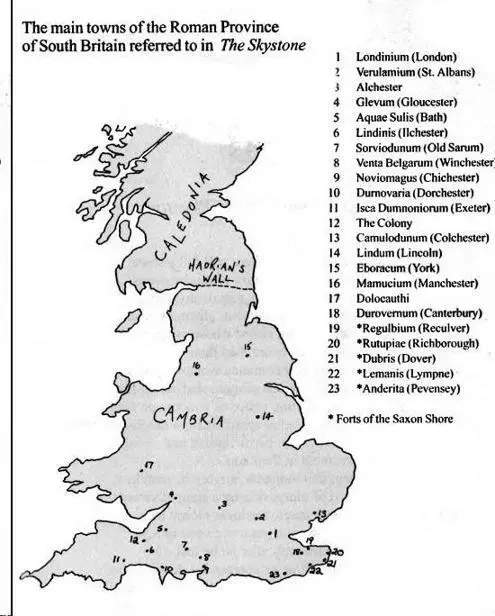
- Название:The Skystone
- Автор:
- Жанр:
- Год:неизвестен
- ISBN:нет данных
- Рейтинг книги:5 / 5. Голосов: 1
-
Избранное:Добавить в избранное
- Отзывы:
-
Ваша оценка:
The Skystone: краткое содержание, описание и аннотация
Предлагаем к чтению аннотацию, описание, краткое содержание или предисловие (зависит от того, что написал сам автор книги «The Skystone»). Если вы не нашли необходимую информацию о книге — напишите в комментариях, мы постараемся отыскать её.
During the days of the decaying Roman Empire, the legions of Britain struggle to preserve the ancient principles of loyalty and discipline-virtues embodied in the Roman general Caius Britannicus and his friend Publius Varrus, an ex-soldier turned ironsmith. Whyte re-creates the turbulence and uncertainty that marked fifth-century Britain and provides a possible origin for one of the greatest artifacts of Arthurian myth-the legendary sword Excalibur. Strong characters and fastidious attention to detail make this a good choice for most libraries and a sure draw for fans of the Arthurian cycle.
The Skystone — читать онлайн бесплатно полную книгу (весь текст) целиком
Ниже представлен текст книги, разбитый по страницам. Система сохранения места последней прочитанной страницы, позволяет с удобством читать онлайн бесплатно книгу «The Skystone», без необходимости каждый раз заново искать на чём Вы остановились. Поставьте закладку, и сможете в любой момент перейти на страницу, на которой закончили чтение.
Интервал:
Закладка:
I marked Luceiia Britannicus mentally as a woman to be courteous to and to avoid, and our talk moved on to other things, among which was the shocking information that Caius had lost his wife, Heraclita, and his three youngest children to a pestilence during their first year in Africa. I had never met the Commander's family, but I knew of his love for all of them, and in particular for his wife Heraclita, and I mourned for his grief, years old as it was by now. I recalled clearly and in detail the loving way he had spoken, while we lay immobilized together, of his family, and of his belief in every man's need for the love of a good woman. I wondered how he had coped with his loss.
We drank deeply and at length that night, between mourning for Caius and his loss and celebrating our own meeting. Varo was staying in the same lodgings as I, and I have no idea what time we staggered off to sleep, but we arranged to breakfast together the following morning and then to travel together to Quintus's home, and thence to Caius's villa.
XVI
The villa that Quintus Varo called home was enormous, far bigger than anything I had ever seen around Colchester. In fact, when I first saw it from the top of a small hill as we approached from the east, I almost took it for a small, walled village. I was to discover in a very short time, however, that the Villa Varo was, in all honesty, a modest establishment for this part of the country.
Later, when I had had time to gain some kind of understanding of the values that applied in this region, I realized that the villa suited its owner. Quintus Varo was an honest, open man of simple tastes and unsophisticated ideas. He was a fanner who had been a soldier for a time, and the fact that he was a noble and titled citizen of Rome was a matter that bothered him but little and only very occasionally, when self-important visitors demanded to be entertained and courted. His villa was a family place, dedicated to cultivating the land and raising children in a loving atmosphere. It was a compliment to me that he did not treat me as a mere visitor, but chose instead to honour me by accepting me as a fellow soldier and an honest, unpretentious guest in his home. We had ridden south and east from Aquae Sulis on a misty, beautiful morning that soothed the ravages of the previous evening's drinking. By the time the sun had risen high enough to burn away the mists, I was feeling euphoric. Accompanied by the singing of a hundred different kinds of birds, we made excellent time on the arrow-straight road and penetrated deeper by the mile into the lushest farmland I had ever seen. The healthy fullness of fast-ripening crops of barley and oats was evident everywhere, and besides these I saw other crops that were totally alien to my eyes. Fat, healthy-looking oxen browsed knee-deep in rich grazing, and huge haystacks baked and browned in the warm, autumn sunlight. Throughout the entire day, Quintus Varo was never silent, and not once did I wish he would be. He talked endlessly and fascinatingly of the countryside, his family, his estates, his crops and his brother-in-law. And when he was not talking, he sang in a deep, strong, pleasant voice. We left the paved road eventually, around mid afternoon, and struck out across the fields along a rutted wagon track that eventually led us to the summit of the green hill from which I saw Varo's villa for the first time.
As I have said, it was enormous, and it was laid out as a great rectangle of connected buildings, with the villa proper set in an L-shape in the north-west corner and smaller buildings — lesser dwellings, workshops, storage buildings and cattle sheds — stretching out from each wing of the house to the southern and eastern corners and turning at right angles to meet in the south-east. The central stockyard must have measured three hundred paces diagonally, corner to corner, and there was only one entrance to the massive enclosure thus formed, as far as I could see. At first glance, it seemed to me that all of the buildings were made of stone and thatched with straw, although I later discovered that the walls were of mud and timber, thickly coated with some kind of dried plaster and artfully finished to look like stone. The central area, much like a forum, was filled with animals and people.
At my soft whistle of amazement, Varo threw me a questioning look, to which I felt obliged to respond.
"It's massive, Quintus. Much bigger than I expected. It's very..., " I groped for a word, "... fine!"
He grunted, half laugh, half scoff. "It's a farm, Varrus, just a farm. Wait till you see Cay's place. That's fine! My wife and I have neither his wealth nor his taste. But it's home, and it's as near impregnable as I can make it."
"Impregnable?" The word surprised me. "Why does it need to be impregnable? Surely you can't be afraid of attack. Not here. "
He reined in and I brought my horse to a stop beside him. Together we sat for a space, staring at the scene below us. He pointed at a thick column of smoke rising away to our right, its source out of sight to the north-east.
"Clearing more land over there. Not because we need the arable space, either. The woodland is just too damn close to the buildings. " He sniffed loudly, hawked up some phlegm and spat it out. "Not worried about an attack today. Nor tomorrow, either. But if you believe at all in what Cay says, then it's best to be prepared against some future tomorrow. I'd rather be laughed at and ready for anything than be caught unprepared. Anyway, it's land that we'll be able to use. Can always find a use for good farmland. "
Having delivered himself of that, he kicked his horse to a canter and I followed him down into the valley, where we turned onto a wide, deeply rutted track that led to the main entrance to the villa. On the way we passed several wagons, some two-wheeled and some four-wheeled, all drawn by teams of oxen. All of the drivers and all of the pedestrians we met greeted Quintus Varo courteously and cheerfully, and I noticed that they all addressed him as Domine or Master. He knew each of them by name and spoke to all of them in a tone that made me aware, although I had never doubted it, that the Villa Varo was a friendly, happy and well-run place.
Our arrival and my unexpected visit threw the entire Varo household into a turmoil, but in the upheaval I had unwittingly created I had time to admire Varo's wife Veronica and the control she had over both her large family and her staff of servants. A seemingly vast brood of children, ranging in age from a boy of about fifteen to a tiny, toddling sweetmeat of some eighteen months, were made known to me individually and then bustled away out of sight. Veronica lost no time in instructing her kitchen and household staff to prepare a welcoming meal and to ready the guest quarters for me. That done, she turned her attention to my immediate comfort and needs, which I tried without success to assure her was unnecessary.
Veronica was not a beautiful woman, but she was clear-skinned, healthy and attractive, and the evidence of abundant fertility and frequent childbearing was there in her matronly body. She was still young in face and in mind, and she had a sweet and cheerful disposition that made me feel comfortable and welcome immediately. Like her husband, she was fully aware of who I was and of much that I had done, including the story of my first meeting with her brother-in-law in Africa and our campaigns together thereafter. I found her attentions both flattering and gratifying, even though I was a bit flustered, being unused to having a maternal, organizing female force focused upon me personally.
Varo and I enjoyed a long and delightful session in his opulent bath house under the care and attention of a magnificent masseur named Nemo, who steamed and oiled and pummelled the hundreds of miles of road dust out of my pores and my muscles. When we emerged, a servant was waiting to tell us that dinner would be served in an hour, and Varo clapped me on the shoulder.
Читать дальшеИнтервал:
Закладка:
Похожие книги на «The Skystone»
Представляем Вашему вниманию похожие книги на «The Skystone» списком для выбора. Мы отобрали схожую по названию и смыслу литературу в надежде предоставить читателям больше вариантов отыскать новые, интересные, ещё непрочитанные произведения.







Обсуждение, отзывы о книге «The Skystone» и просто собственные мнения читателей. Оставьте ваши комментарии, напишите, что Вы думаете о произведении, его смысле или главных героях. Укажите что конкретно понравилось, а что нет, и почему Вы так считаете.