Jack Whyte - The Eagles' Brood
Здесь есть возможность читать онлайн «Jack Whyte - The Eagles' Brood» весь текст электронной книги совершенно бесплатно (целиком полную версию без сокращений). В некоторых случаях можно слушать аудио, скачать через торрент в формате fb2 и присутствует краткое содержание. Жанр: Старинная литература, на английском языке. Описание произведения, (предисловие) а так же отзывы посетителей доступны на портале библиотеки ЛибКат.
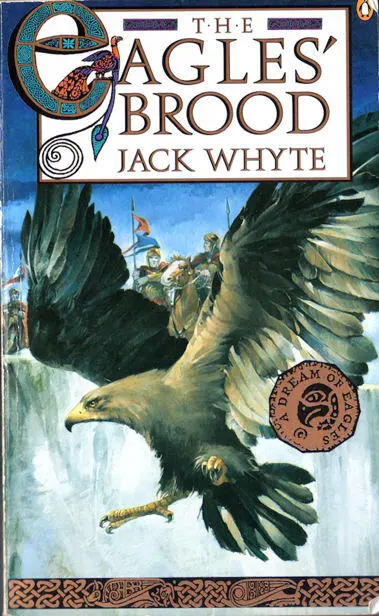
- Название:The Eagles' Brood
- Автор:
- Жанр:
- Год:неизвестен
- ISBN:нет данных
- Рейтинг книги:4 / 5. Голосов: 1
-
Избранное:Добавить в избранное
- Отзывы:
-
Ваша оценка:
The Eagles' Brood: краткое содержание, описание и аннотация
Предлагаем к чтению аннотацию, описание, краткое содержание или предисловие (зависит от того, что написал сам автор книги «The Eagles' Brood»). Если вы не нашли необходимую информацию о книге — напишите в комментариях, мы постараемся отыскать её.
In the author's The Skystone (1996), set in the last years of the Roman occupation of fifth-century Britain, the sword Excalibur was forged, presaging the reign of King Arthur years later. This time, the narrator, grand-nephew of the forger of the sword, is none other than that (traditionally) eerie being, Merlin the sorcerer--sanitized here to the most high-minded of soldiers who survives wars, betrayal, and a tragic love affair. Caius Merlyn Britannicus, born in a.d. 401, is the son of the Commander in Chief of the forces of the fortress/town of Camulod, a community of Romans and Britons. Merlyn's best friend from boyhood is his cousin Uther Pendragon, a mighty warrior and the son of a Celtic king, though with a terrible temper that can show itself off the fields of war. Torturing Merlyn is the suspicion that it might have been Uther who brutally beat the waif whom Merlyn will name Cassandra after she violently resists Uther's sexual games. The deaf and dumb Cassandra (her real identity will be a surprise) is healed and then secluded, eventually becoming Merlyn's wife until her savage death. There are wars and invasions, waged principally by King Lot of Cornwall, wars that bring awful innovations like poisoned arrows. There are also theological conflicts, since the free-will doctrines of Pelagius are condemned as heretical by the Church. Merlyn's trek to a seminal debate of theologians is marked by skirmishes--he rescues the warrior/bishop Germanus at one point--and by the discovery of a half-brother. All ends with the deaths of those fierce antagonists Lot and Uther, and with Merlyn holding up Uther's baby son by Lot's dead queen, a baby who hasthe deep golden eyes of . . . a mighty bird of prey . . . a King perhaps, to wield Excalibur.'' With plenty of hacking and stabbing, pontifications, dogged sex, and a few anachronistic mind-sets: another dipperful from the fertile Arthurian well, sans magic but brimful of action.
The Eagles' Brood — читать онлайн бесплатно полную книгу (весь текст) целиком
Ниже представлен текст книги, разбитый по страницам. Система сохранения места последней прочитанной страницы, позволяет с удобством читать онлайн бесплатно книгу «The Eagles' Brood», без необходимости каждый раз заново искать на чём Вы остановились. Поставьте закладку, и сможете в любой момент перейти на страницу, на которой закончили чтение.
Интервал:
Закладка:
Neither the fire in her hut nor the one in the clearing had been lit since I had taught her the lesson of the smoke, so I lit the interior fire now, as the late afternoon shadows changed to evening shades, and set out to gather more firewood while there was still enough light to find it by, thinking to myself that I was lucky to have arrived no later than I had, and that the daylight hours here in Avalon were very short.
That thought led me back to Cassandra's welcome and to an uncomfortable consideration of the means Cassandra must use to pass the time she spent alone between my visits. And that in turn gave rise to a series of questions that troubled me increasingly as I wandered far from the clearing in search of wood to burn. How did she spend her time? Living in a world of total silence as she did, how could she amuse herself? What did she do all day alone? And all night, on those long, dark evenings? Sunny days and fine evenings were one thing, I thought, but cold, stormy, dank and cloudy times must be quite another. Even this search for wood, I realized, would be a killing task on a wet, miserable day. In the past, fuel had always been plentiful here. No one had ever stayed in the valley long enough to consume the firewood that lay readily to hand. Now, however, with two fires burning night and day, every day, fuel was becoming hard to find. It had to be sought out, further and further from the clearing, and then carried, or dragged, back through the underbrush. And in my absence, Cassandra must do it by herself.
We made love in the firelight that night until I fell into an exhausted sleep from which I awoke twice with the image of my father's corpse in my mind.
It was late in the morning when I left to return to Camulod for the funeral rites, and the parting was more difficult for me than it had ever been before. My heart ached to leave her alone there by the little lake, and anxiety over my newly awakened recognition of her solitude plagued me all the way home. I knew the day would come soon when, one way or another, despite my own fears, I must bring her back to civilization and the company of others.
I found Titus and Flavius talking together in my father's day-room, Titus seated behind the desk, on my father's stool, and Flavius perched on one of the other chairs as they reviewed the arrangements they had made. Everything was well in hand, they told me. News of the funeral service had been circulated to everyone, and the event was scheduled for the third hour of the afternoon, which left me two hours, during which I had nothing to do but change into my ceremonial uniform and try to empty my mind of my concern over Cassandra while I prepared for the occasion, an unprecedented event for Camulod.
When I had last spoken with Titus, Flavius and Popilius, before leaving for Avalon the previous day, I had outlined my wishes for the ceremony. I had admitted freely that I was improvising, never having seen or experienced a military cremation. In the interim, however, Lucanus, who had followed the Eagles longer than any other officer now alive in the Colony, had produced several documents on the subject of military funerals in ancient times, and in my absence the four of them had decided to adhere to the procedures outlined in these records.
Flavius now informed me that Popilius, as primus pilus, would officiate at the ceremony, since this was a military occasion and not a religious one. The entire garrison of the Colony, excepting only a skeleton crew of guards, would be on parade in full dress uniform. Titus, as titular Legate and acting Commanding Officer, would inspect the troops, while Lucanus, as Senior Surgeon and now die senior serving officer surviving, would deliver the eulogy. Popilius would head the Centuriate, as was his right, and would supervise the order of the ceremonies, direct the honour guard, and attend to the lighting of the fire that would consume the corpse.
The pyre itself, Flavius assured me, would burn well and quickly. It had been built upon an iron grid mounted on an altar of stones to ensure strong, clean ventilation, and its timbers were solid, seasoned and dry—massive, hand-hewn beams torn from the interior of the Council Hall and drenched in pitch to make them burn the hotter. Gratified and impressed by the thoroughness of their planning, yet depressed by the prospect ahead of all of us, I thanked them for their efforts and left them, making my way out into the main courtyard. The work of cleaning up was almost complete already, and I could see where reconstruction had begun in several places, although no one was working there this afternoon. The grim pyre that would consume my father's body dominated the entire area, standing alone in the centre of the great yard. This was the first such pyre I had seen, and I could only presume that Lucanus's documents had contained some details on the building of such things. Fascinated, I approached it and gazed into its heart.
It was a massive, five-layer bed of square-cut timbers, each two handspans thick. Three of these layers, forming the top, bottom and middle strata of the bed, were made of beams cut four paces long. The two remaining layers, laid crosswise between the three long ones, were shorter—only three paces long. The beams were spaced evenly on all five levels, leaving a latticed pattern of air vents to feed the flames. Every beam had been soaked in pitch, and the smell of it caught at my throat. Above this bed, our carpenters had built a box, an oven, of the same materials, open at one end to receive the iron box that would contain my father's body. The roof of this box, too, was three layers thick, the timbers arranged the same way as those in the bed beneath. The heat generated by this pyre would be intolerable. My father's flesh and bones would melt and dry into dust long before the flames burned down and the ferocious embers settled into ash.
Pensive and disturbed afresh, I left the place and walked out through the main gate, nodding in passing to Marcus, the centurion of the guard. Below me lay the new camp built by Popilius and his men. To my right, far off in the southern distance, I could see the enormous pit dug by our Cornish prisoners to hold their dead. The pit on my far left, much smaller, though still enormous, would hold our own dead thousand. The smallest pit, almost directly below me, on the northern side of the new camp, would hold our officers. Nothing moved on the plain, and I realised that Popilius must have kept his burial parties working through the night, for there were no bodies to be seen, and the pits themselves seemed to be almost filled.
Donuil joined me as I stood there musing, and waited beside me patiently until I spoke to him. He had come to ask my permission to attend my father's funeral, and I was both surprised and touched that he should wish to do so. My father had shown him little tolerance in the brief time they had known each other. I told him I would be glad to see him there, and again we stood in silence for a time.
It was only as I turned to re-enter the fort that I noticed he was frowning, mulling something over as he gazed into the distance, looking at nothing. I asked him what was troubling him and he began, hesitantly at first, but then with increasing confidence and conviction, to tell me about his continuing concern that we had missed something vitally important in our dealings with the two dead warlocks. Their baggage, according to Donuil, should have contained a cornucopia of black arts. I assured him again that all of their possessions had been searched thoroughly and nothing sinister had been found, but he was unconvinced. He asked me whether their iron-bound chests had been found, and when I told him there had been no such chests he shook his head in emphatic denial. He had seen those chests with his own eyes, he swore, in his father's Hall, and they were the most precious things the warlocks owned. Caspar had told his father, in Donuil's hearing, that they went nowhere without them. If the boxes had not been brought into Camulod, then the warlocks must have hidden them before their arrival. They must have stopped somewhere on the road.
Читать дальшеИнтервал:
Закладка:
Похожие книги на «The Eagles' Brood»
Представляем Вашему вниманию похожие книги на «The Eagles' Brood» списком для выбора. Мы отобрали схожую по названию и смыслу литературу в надежде предоставить читателям больше вариантов отыскать новые, интересные, ещё непрочитанные произведения.







Обсуждение, отзывы о книге «The Eagles' Brood» и просто собственные мнения читателей. Оставьте ваши комментарии, напишите, что Вы думаете о произведении, его смысле или главных героях. Укажите что конкретно понравилось, а что нет, и почему Вы так считаете.