Jack Whyte - The Eagles' Brood
Здесь есть возможность читать онлайн «Jack Whyte - The Eagles' Brood» весь текст электронной книги совершенно бесплатно (целиком полную версию без сокращений). В некоторых случаях можно слушать аудио, скачать через торрент в формате fb2 и присутствует краткое содержание. Жанр: Старинная литература, на английском языке. Описание произведения, (предисловие) а так же отзывы посетителей доступны на портале библиотеки ЛибКат.
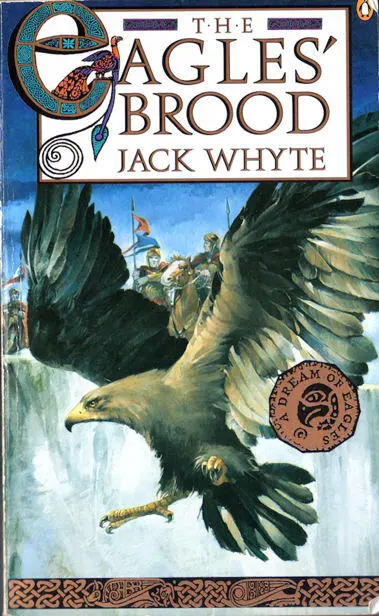
- Название:The Eagles' Brood
- Автор:
- Жанр:
- Год:неизвестен
- ISBN:нет данных
- Рейтинг книги:4 / 5. Голосов: 1
-
Избранное:Добавить в избранное
- Отзывы:
-
Ваша оценка:
The Eagles' Brood: краткое содержание, описание и аннотация
Предлагаем к чтению аннотацию, описание, краткое содержание или предисловие (зависит от того, что написал сам автор книги «The Eagles' Brood»). Если вы не нашли необходимую информацию о книге — напишите в комментариях, мы постараемся отыскать её.
In the author's The Skystone (1996), set in the last years of the Roman occupation of fifth-century Britain, the sword Excalibur was forged, presaging the reign of King Arthur years later. This time, the narrator, grand-nephew of the forger of the sword, is none other than that (traditionally) eerie being, Merlin the sorcerer--sanitized here to the most high-minded of soldiers who survives wars, betrayal, and a tragic love affair. Caius Merlyn Britannicus, born in a.d. 401, is the son of the Commander in Chief of the forces of the fortress/town of Camulod, a community of Romans and Britons. Merlyn's best friend from boyhood is his cousin Uther Pendragon, a mighty warrior and the son of a Celtic king, though with a terrible temper that can show itself off the fields of war. Torturing Merlyn is the suspicion that it might have been Uther who brutally beat the waif whom Merlyn will name Cassandra after she violently resists Uther's sexual games. The deaf and dumb Cassandra (her real identity will be a surprise) is healed and then secluded, eventually becoming Merlyn's wife until her savage death. There are wars and invasions, waged principally by King Lot of Cornwall, wars that bring awful innovations like poisoned arrows. There are also theological conflicts, since the free-will doctrines of Pelagius are condemned as heretical by the Church. Merlyn's trek to a seminal debate of theologians is marked by skirmishes--he rescues the warrior/bishop Germanus at one point--and by the discovery of a half-brother. All ends with the deaths of those fierce antagonists Lot and Uther, and with Merlyn holding up Uther's baby son by Lot's dead queen, a baby who hasthe deep golden eyes of . . . a mighty bird of prey . . . a King perhaps, to wield Excalibur.'' With plenty of hacking and stabbing, pontifications, dogged sex, and a few anachronistic mind-sets: another dipperful from the fertile Arthurian well, sans magic but brimful of action.
The Eagles' Brood — читать онлайн бесплатно полную книгу (весь текст) целиком
Ниже представлен текст книги, разбитый по страницам. Система сохранения места последней прочитанной страницы, позволяет с удобством читать онлайн бесплатно книгу «The Eagles' Brood», без необходимости каждый раз заново искать на чём Вы остановились. Поставьте закладку, и сможете в любой момент перейти на страницу, на которой закончили чтение.
Интервал:
Закладка:
Slowly, lying on her back, her gaze fixed on mine, she raised the covering in a plain request for me to join her. Eventually I moved to do so, reaching for the edge of the covering, but she dropped it immediately and shook her head and pointed her chin explicitly at my tunic. I removed it, feeling strange—not foolish, but unsure of myself, for I could hear Daffyd's exhortations against doing anything that might hurt her either physically or in her mind. I moved again to join her, now wearing nothing but my breech clout, and again she stopped me with an upraised palm and three distinct, pointing jabs of her finger. I nodded my understanding and rose to extinguish the lamps, after which I returned to find her holding up the covering to allow me to climb in beside her.
The furs smelled of wild lavender and roses and I wondered how she had managed to achieve that effect as I lowered myself cautiously to rest beside her. We had soft bedclothes at home in Camulod, but still used skins on campaign. My own campaign bed skins still smelled feral after years of use. I could see her face quite clearly in the flickering firelight, although my face must have been in shadow to her. As I came to rest facing her, lying on my left side, she moved slightly towards me and I felt the warmth of the soft underside of her thigh against my bent knee. I held my breath, not daring to believe that this was actually happening. I lay there unmoving, drinking in the beauty of her, my knee, our sole point of contact, feeling as though it was being burned with exquisite fire. We lay like that for long moments until my breathing steadied and my smile became less like a rictus, and then I felt her thigh withdraw from my knee and knew bitter disappointment until I realized what she was doing. She pulled herself up on her right elbow above me and undid the fastening of her hair with her left hand, allowing it to fall in a loose cascade across her face. The action exposed her breasts to my view from a distance of less than a handspan and I gazed at the tension of the firm skin and the pointed pinkness of her tiny nippies. She reached her free hand towards me and traced the outline of my cheek in a feather-like caress. I felt a lump of pure tenderness swell in my throat. Goose-flesh broke out all over my body as her fingertips dropped from my chin to my neck and moved down almost weightlessly to trace the length of my breastbone. She saw my hissed intake of breath and felt the involuntary stiffening of my whole body, for she smiled again and increased the pressure of her index finger by a hair's weight, continuing her movement until her fingertip rested gently in my navel. My stomach was as tight as a drum as her hand retraced its delicious journey until her palm and fingers gently cupped my right shoulder and pushed until I was lying flat on my back. I closed my eyes and felt a shudder pass through my body with the pressure of her breast against my chest and the soft, moist, unbelievable warmth of her glorious mouth covering my own, and I realized that all of the kisses I had ever experienced had been waiting for this.
I am an old man, now, recalling this night across the abyss of fifty years and more, but the memory of that kiss still stirs the hairs on my arms and causes nightingales to sing in my memory. In all of his writings, save for those in which he dealt with his friend Equus's sister Phoebe and with Scilla Titens and a few intimate recollections of his marriage, Publius Varrus kept his private thoughts of his women to himself, as did my grandfather Caius. My father spoke to me of love and lust on a few occasions, straightforwardly as a soldier will, but I, for my part, spoke to no man of love. I was regarded as a celibate, which indeed I became. But I have known a love that transformed my life and shaped the man I was to become, and I feel no constraint in writing of that love today. The awakening of it that night, when I was reborn into a world of brilliant colours and amazing textures, changed my life and reshaped the foundations of my manhood.
It was the most wondrous night of my whole life, and I passed through it as one would a wonderland of purest fantasy, willing the falling sands of time to float like thistledown in summer zephyrs and struggling mightily now and again, flaring in silent rebellion, each time an errant thought of Camulod and that other, lesser life teased at the edges of my consciousness to remind of me of things undone and duties unfulfilled. The hours stretched slowly, filled with wondrous, rippling darkness and unearthly joys the like of which I had never imagined.
I avoided the hour of reckoning—of wakening—as resolutely as I could. Eventually, however, I could procrastinate no longer. Camulod and my duties were waiting and I had to go to them. Cassandra helped me to dress and walked with me, her arm around my waist, to where my horse stood grazing. I felt a stab of guilt that I had left the poor beast there all night wearing his saddle. I tightened the girth and turned to bid my love farewell, but she was gone. I looked all around me, scanning the entire valley with my eyes. She was nowhere to be seen, yet I knew she was watching me, unwilling to display the tears that this leaving must bring.
I stepped up into the saddle and walked my horse away, back into the world of men and their cares and woes.
XV
The door of my father's office stood open and the sentry on duty there saluted smartly as I approached. I returned the salute and stepped into the doorway, rapping my knuckles lightly on the door post as I saw my father in his usual position at his table, his head bent over an unfinished report. He looked up under his brows and grunted at me.
"Ah! You're back, good. Have a seat. I'll be with you in a moment."
I took off my helmet and made myself comfortable, looking around at the Spartan austerity of this tiny cubicle where General Picus Britannicus spent so' much of his working life. The room measured less than four good paces long by the same in width and held nothing but my father's work table, two chairs, two wooden chests bound with iron, and his own stool. Along the back wall ran a double shelf that held some bound books, a pile of reports and some rolled maps. His swordbelt, helmet and cloak hung from wooden pegs in the wall beside the door, and a large leather bucket by his feet served as a receptacle for anything he did not want to keep lying around. I looked long at the battered table on which he was writing; it was as much a part of my father as anything else he owned. Long and narrow, it formed a partitioned box two handsbreadths deep and sat on two collapsible trestles that fitted into slots fashioned to hold them on the underside of the table. It could be locked with a spring-loaded tumbler lock, and it went with him everywhere he went, loaded upon the commissary wagon. On campaign, it held the same place in his tent that it held here within his office.
On the wall at his back, above the double shelves, hung a simple wooden cross, a gift from his old friend Bishop Alaric, and I wondered again, as I did each time I came here, at the strength of the faith of men that had turned this symbol of shame and degradation into a symbol of triumph and love.
There had never been anything admirable about a cross in Roman eyes. Since the beginnings of time it has stood for the direst punishment a criminal could suffer. Death on the cross meant death by slow degrees of consummate agony as the force of gravity dragged inexorably at the victim's body, tearing the bones from their sockets, ripping joints and sinews, searing his brain with pain that dragged on with no respite until death, which came more often from thirst and starvation than from any other cause, and thirst and starvation are slow ways to die.
The Christ, they said, had died in three short hours, nailed to his cross. If that were true, he had been fortunate and had barely known the pain of crucifixion—some men screamed for days up there. He had been fortunate, or he had had help. The spearpoint that pierced his side might have been premature, and might have been heavily handled. It should have been a mere test to see if blood still flowed in the veins of the condemned man, for while blood flowed, life remained, and while life remained the body stayed on the cross. I have heard people swear it was the nails that killed him. That is flat untrue. Nails through the wrists and ankles will cripple and maim, but they will not cause death. That would have been too merciful a death for someone sentenced to the cross. Others said the flogging he received had caused his death. That might have some truth in it, especially if the man was already weak, but this man was the Son of God. How could he, then, be weak within Himself? Besides, I knew about the skill of Roman floggers. They had centuries of tradition behind their art and knew precisely how far they could go without causing fatal damage. My father's voice broke in upon my thoughts.
Читать дальшеИнтервал:
Закладка:
Похожие книги на «The Eagles' Brood»
Представляем Вашему вниманию похожие книги на «The Eagles' Brood» списком для выбора. Мы отобрали схожую по названию и смыслу литературу в надежде предоставить читателям больше вариантов отыскать новые, интересные, ещё непрочитанные произведения.







Обсуждение, отзывы о книге «The Eagles' Brood» и просто собственные мнения читателей. Оставьте ваши комментарии, напишите, что Вы думаете о произведении, его смысле или главных героях. Укажите что конкретно понравилось, а что нет, и почему Вы так считаете.