Jack Whyte - The Eagles' Brood
Здесь есть возможность читать онлайн «Jack Whyte - The Eagles' Brood» весь текст электронной книги совершенно бесплатно (целиком полную версию без сокращений). В некоторых случаях можно слушать аудио, скачать через торрент в формате fb2 и присутствует краткое содержание. Жанр: Старинная литература, на английском языке. Описание произведения, (предисловие) а так же отзывы посетителей доступны на портале библиотеки ЛибКат.
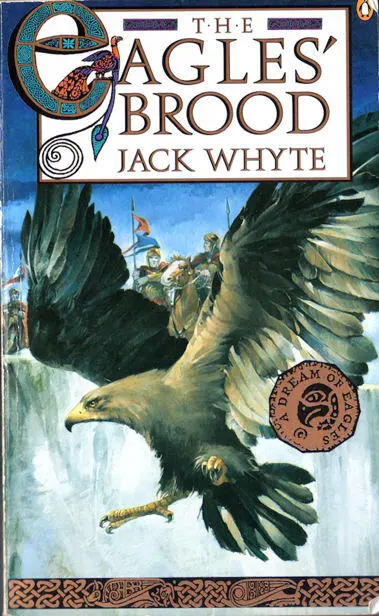
- Название:The Eagles' Brood
- Автор:
- Жанр:
- Год:неизвестен
- ISBN:нет данных
- Рейтинг книги:4 / 5. Голосов: 1
-
Избранное:Добавить в избранное
- Отзывы:
-
Ваша оценка:
The Eagles' Brood: краткое содержание, описание и аннотация
Предлагаем к чтению аннотацию, описание, краткое содержание или предисловие (зависит от того, что написал сам автор книги «The Eagles' Brood»). Если вы не нашли необходимую информацию о книге — напишите в комментариях, мы постараемся отыскать её.
In the author's The Skystone (1996), set in the last years of the Roman occupation of fifth-century Britain, the sword Excalibur was forged, presaging the reign of King Arthur years later. This time, the narrator, grand-nephew of the forger of the sword, is none other than that (traditionally) eerie being, Merlin the sorcerer--sanitized here to the most high-minded of soldiers who survives wars, betrayal, and a tragic love affair. Caius Merlyn Britannicus, born in a.d. 401, is the son of the Commander in Chief of the forces of the fortress/town of Camulod, a community of Romans and Britons. Merlyn's best friend from boyhood is his cousin Uther Pendragon, a mighty warrior and the son of a Celtic king, though with a terrible temper that can show itself off the fields of war. Torturing Merlyn is the suspicion that it might have been Uther who brutally beat the waif whom Merlyn will name Cassandra after she violently resists Uther's sexual games. The deaf and dumb Cassandra (her real identity will be a surprise) is healed and then secluded, eventually becoming Merlyn's wife until her savage death. There are wars and invasions, waged principally by King Lot of Cornwall, wars that bring awful innovations like poisoned arrows. There are also theological conflicts, since the free-will doctrines of Pelagius are condemned as heretical by the Church. Merlyn's trek to a seminal debate of theologians is marked by skirmishes--he rescues the warrior/bishop Germanus at one point--and by the discovery of a half-brother. All ends with the deaths of those fierce antagonists Lot and Uther, and with Merlyn holding up Uther's baby son by Lot's dead queen, a baby who hasthe deep golden eyes of . . . a mighty bird of prey . . . a King perhaps, to wield Excalibur.'' With plenty of hacking and stabbing, pontifications, dogged sex, and a few anachronistic mind-sets: another dipperful from the fertile Arthurian well, sans magic but brimful of action.
The Eagles' Brood — читать онлайн бесплатно полную книгу (весь текст) целиком
Ниже представлен текст книги, разбитый по страницам. Система сохранения места последней прочитанной страницы, позволяет с удобством читать онлайн бесплатно книгу «The Eagles' Brood», без необходимости каждый раз заново искать на чём Вы остановились. Поставьте закладку, и сможете в любой момент перейти на страницу, на которой закончили чтение.
Интервал:
Закладка:
XIII
From my lookout at the edge of the little wood I saw the distant figure of my decurion scout emerge from a clump of bushes and wave to me. I spoke over my shoulder.
"There's the signal. They've passed. Let's move up." I kicked my horse to a walk and began to move along the floor of the little ravine-like valley that had hidden us between two ridges. Behind me, four hundred mounted men rode in double file. I crossed the wide, beaten path of the Hibernian Scots Who had passed us transversely and counted one hundred more paces before reining in and turning my horse to the left to face the steeply rising ridge. A glance to my left showed my men lined up and waiting for my command. I looked to the top of the ridge before me and made myself count again to one hundred, slowly. I knew what lay on the other side of the ridge and I did not want to commit us too soon. Finally, I gave the signal and we put our horses to the slope and soon arrived at the crest overlooking the valley below. Four hundred of us, a double line of men and horses, two hundred to a line, now straddled the road that the Hibernians had followed down to the valley bottom. I sat there, gentling my horse with my hand on its neck and looking at the scene before me.
Most of the valleys in this part of the country stretched from east to west, widening to the coast. We were now facing south across a valley that was different, deepening as it fell inland away from the coast. It was almost two miles , wide from where we sat to the top of the opposite ridge. Thick forest blocked it inland to the east and covered the hillside opposite us, but the hill on our side was bare and green, as was the floor of the valley, which rose gradually towards the sea on our right until the valley itself tapered out among high crags. It was the valley floor that had made us choose this spot for our action; a deathtrap of a place, as my father had said. The roadway ran directly south across the centre of it, from crest to crest, and more than half a mile of it lay on the flat valley floor, flanked on each side by innocent-looking grass that covered deep and treacherous bogs capable of swallowing a troop of horsemen and their mounts and leaving no sign of them thereafter. On the other side of this flat stretch, the road began to rise again to the south, through thickening trees that encroached on it from both sides until the road itself resembled a tunnel. From where I sat, I could see no signs of the two thousand men we had hidden among the trees.
Timing was crucial now. The enemy had to be beyond the point of no return before we moved. They had to be hemmed in by the bogs, so that when we began our charge at their backs, they could not spread out defensively to meet us. We wanted to panic diem. But the bogs were as much our enemy as theirs. We had to pull up short of them, and before we did that, we had to make these Hibernians run— up the road ahead of them and through the trees with their two thousand hidden men, and out of the valley to where my father waited with another thousand to receive those who escaped the trap.
I raised my shield arm high, holding it there, gauging my moment and enjoying the strain on the muscles of my arm and shoulder. The enemy force was a great black caterpillar on the road below us, more than half of them already on the road through the bogs. I dropped my arm, our trumpets sounded, and we began to advance at a walk. The effect was instantaneous: those in the rear who heard our trumpets looked back and saw us coming, and even above the noise of our own advance we could hear their shouted warnings to the men in front of them, and could see the worm of panic start to squirm. We broke into a canter, our rear line moving up between the men in front, forming a solid line.
The first signs of real disorder below appeared in the rear ranks as the men there began to increase their pace, crowding in on those in front of them. Not all were panicked, however. A number of figures broke from the column and began to organize lines of defence, but they were too late. My timing had been right. The bogs had them. The lines they tried to throw out on their flanks floundered in mud as men slipped and fell helplessly in the sucking muck. And then the rout began in earnest. I had ordered my trumpeters to sound without let-up, and now my men began screaming. Our pace had been increasing steadily and we were now less than three hundred paces from the rear ranks of our quarry, with fifty paces less than that between us and the start of the bogs. Now there was not a man among the enemy who did not know we were behind them. The increasing pressure from the rear transmitted itself visibly along the column, which was not less than six men deep by about five hundred long. All space between the marchers disappeared, and those at the very front broke and ran from the press, heading for the apparent safety of another open valley at the crest of the tunnel-road through the trees ahead. The entire column was running by the time I pulled my horsemen to a halt just short of the bogs. We sat there and watched the shock wave recoil as the men in front crested the hill to find themselves confronted by two Roman cohorts drawn up in maniple formation, waiting to receive them. As they bunched together in fatal hesitation, our concealed men hit them from both sides.
Militarily, I suppose it was a great success. The slaughter was appalling, for as the men we had hidden in the woods moved in for the kill, the enemy packed on the road itself were unable to fight back. We, the cavalry, had served our purpose. All we had to do now was watch and wait for any attempt at retreat that came our way.
At first there were about a dozen, perhaps a score of men who fled back from the tunnel of death that awful road had become. They stopped when they saw us waiting for them.
While they were in no immediate danger, their numbers grew until there were perhaps two hundred of them in a great knot on the road, half-way between the woods and us. After a time, the fugitives from the tunnel grew fewer, until the flow ceased completely. At first, rather than face us, a number of them tried desperately to escape through the bogs on either side of the road, but the man who travelled furthest made less than a hundred steps before he fell for the last time. He had been wearing garish red and green, but he was ho more than a black blob by the time he vanished. I turned to Achmed Cato, my lieutenant.
"How many, do you think?"
"Two hundred, perhaps three? Hard to count, Commander."
"Say three hundred. Out of three thousand." I watched them, remembering Publius Varrus. "Are you a Christian, Cato?"
"Aye, Commander, in Camulod."
"What do you mean?" I looked at him. "Not here?"
He grinned, embarrassed. "Mithras is the soldier's god, Commander. He has not let me down in battle yet."
"I know what you mean. Christianity can be uncomfortable when it comes to killing. Sometimes I think the Druids have the right of it. Their gods are not so prickly. They seem older, somehow, easier to live with." I remembered Uncle Varrus's description of his own dilemma as he faced three bound Hibernians on a stony beach. They were defenceless, but vicious and dangerous. To kill them would be murder, according to .his Christian faith, but if he released them they would surely murder others, and he could not take them with him. I faced three hundred now, and I had no archers poised on the cliffs above me to relieve me from the responsibility of making a choice. I spoke again to Cato. "I wonder if the Christian Church will ever breed soldiers among its ranks?" He looked at me as if I had gone mad. He had no idea of what was in my mind. "Cato," I went on, "these men are going to come to us. I don't want to kill them, but we cannot take three hundred prisoners."
"Then let them fight, Commander."
Читать дальшеИнтервал:
Закладка:
Похожие книги на «The Eagles' Brood»
Представляем Вашему вниманию похожие книги на «The Eagles' Brood» списком для выбора. Мы отобрали схожую по названию и смыслу литературу в надежде предоставить читателям больше вариантов отыскать новые, интересные, ещё непрочитанные произведения.







Обсуждение, отзывы о книге «The Eagles' Brood» и просто собственные мнения читателей. Оставьте ваши комментарии, напишите, что Вы думаете о произведении, его смысле или главных героях. Укажите что конкретно понравилось, а что нет, и почему Вы так считаете.