Jack Whyte - The Eagles' Brood
Здесь есть возможность читать онлайн «Jack Whyte - The Eagles' Brood» весь текст электронной книги совершенно бесплатно (целиком полную версию без сокращений). В некоторых случаях можно слушать аудио, скачать через торрент в формате fb2 и присутствует краткое содержание. Жанр: Старинная литература, на английском языке. Описание произведения, (предисловие) а так же отзывы посетителей доступны на портале библиотеки ЛибКат.
- Название:The Eagles' Brood
- Автор:
- Жанр:
- Год:неизвестен
- ISBN:нет данных
- Рейтинг книги:4 / 5. Голосов: 1
-
Избранное:Добавить в избранное
- Отзывы:
-
Ваша оценка:
The Eagles' Brood: краткое содержание, описание и аннотация
Предлагаем к чтению аннотацию, описание, краткое содержание или предисловие (зависит от того, что написал сам автор книги «The Eagles' Brood»). Если вы не нашли необходимую информацию о книге — напишите в комментариях, мы постараемся отыскать её.
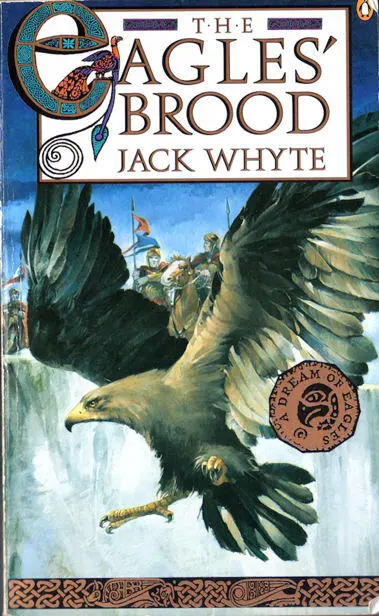
In the author's The Skystone (1996), set in the last years of the Roman occupation of fifth-century Britain, the sword Excalibur was forged, presaging the reign of King Arthur years later. This time, the narrator, grand-nephew of the forger of the sword, is none other than that (traditionally) eerie being, Merlin the sorcerer--sanitized here to the most high-minded of soldiers who survives wars, betrayal, and a tragic love affair. Caius Merlyn Britannicus, born in a.d. 401, is the son of the Commander in Chief of the forces of the fortress/town of Camulod, a community of Romans and Britons. Merlyn's best friend from boyhood is his cousin Uther Pendragon, a mighty warrior and the son of a Celtic king, though with a terrible temper that can show itself off the fields of war. Torturing Merlyn is the suspicion that it might have been Uther who brutally beat the waif whom Merlyn will name Cassandra after she violently resists Uther's sexual games. The deaf and dumb Cassandra (her real identity will be a surprise) is healed and then secluded, eventually becoming Merlyn's wife until her savage death. There are wars and invasions, waged principally by King Lot of Cornwall, wars that bring awful innovations like poisoned arrows. There are also theological conflicts, since the free-will doctrines of Pelagius are condemned as heretical by the Church. Merlyn's trek to a seminal debate of theologians is marked by skirmishes--he rescues the warrior/bishop Germanus at one point--and by the discovery of a half-brother. All ends with the deaths of those fierce antagonists Lot and Uther, and with Merlyn holding up Uther's baby son by Lot's dead queen, a baby who hasthe deep golden eyes of . . . a mighty bird of prey . . . a King perhaps, to wield Excalibur.'' With plenty of hacking and stabbing, pontifications, dogged sex, and a few anachronistic mind-sets: another dipperful from the fertile Arthurian well, sans magic but brimful of action.
The Eagles' Brood — читать онлайн бесплатно полную книгу (весь текст) целиком
Ниже представлен текст книги, разбитый по страницам. Система сохранения места последней прочитанной страницы, позволяет с удобством читать онлайн бесплатно книгу «The Eagles' Brood», без необходимости каждый раз заново искать на чём Вы остановились. Поставьте закладку, и сможете в любой момент перейти на страницу, на которой закончили чтение.
Интервал:
Закладка:
XXXI
We set out jauntily on the second day of our march, filled with well-being, and confident of reaching Sorviodunum by mid-afternoon. The sun, too, began its journey across the new day's sky bravely, blinding us as we rode directly into its brilliance, but the sky behind us in the west soon filled with banked clouds that outmarched both us and the sun. By mid-morning the brightness had gone from the day, and by noon we were riding through rain squalls that followed each other like yoked oxen, ever more frequently until the rain fell relentlessly and stayed with us all the way to Sorviodunum.
I do not know what we had expected to find in Sorviodunum, but I remember that the town's dreary dilapidation appalled all of us. It was a town in name alone, in that it was a large concentration of buildings, many of which had been public edifices at one time and more of which had been the homes of townsfolk. Now almost all the buildings were in ruins and the citizens—we used the word reluctantly—ran in terror from our approach. Needless to say, we found no food to purchase. We camped overnight in an overgrown field outside the town and moved on at daybreak.
Fortunately for our spirits, the weather had improved overnight and we were greeted once again by clear skies come daybreak. We made good time from then on, meeting no one on the road, so that, in time, my unease over the deterioration of the once-fine town of Sorviodunum began to dwindle. The weather continued pleasant, with no more of the rain that had fallen on our second day out of Camulod. We skirted the tiny town of Silchester completely, making no attempt to approach it, and eventually came to Pontes, the last remaining town between us and Londinium. Here we found signs of life aplenty, but they were not signs that I responded to with warmth.
As soon as the townspeople saw us approaching, they withdrew behind their walls and barred their gates, refusing us entry. Seeing that they feared our strength, and respecting their fear, I held our men at a distance and approached the walls alone, seeking to speak with someone in authority. That was useless. No one would speak with me, even from the safety of the walls, in spite of every protestation I could offer them. Eventually, seething with anger and frustration, and controlling a very strong urge to provide them with real reason to fear us, I accepted the futility of the situation and led my people away from there as quickly as I could, riding in a black rage that kept my subordinates intent upon not catching my eye and thereby attracting my displeasure.
Only Donuil and Lucanus had the confidence to impose their presence on my bitter mood. Donuil rode in silence, slightly behind me, his horse's nose level with my right knee, close enough for me to address him should I wish to, yet just far enough removed for me to ignore him, as I chose to. Lucanus, on the other hand, stayed away and allowed me to stew for the space of an hour, but then he cantered forward and demanded my attention.
"Why are you so angry?"
I jerked my head towards him, attempting to wither him with a look, but he would not be intimidated. I looked back at the road ahead and rode on in silence. He spoke again.
"They were afraid."
That was so obvious that I still did not deign to answer him; He tried again.
"You're acting as if those people back there had insulted you personally. Is your pride that fragile?" I glanced sideways at him again, silently consigning him to Hades as a persistent nuisance. "Caius!" He was almost laughing. "In God's name, you'd probably have done the same thing, in their shoes. They're vulnerable—and terrified."
Now the anger spilled from my mouth. "Of what?" I jerked my head backwards, indicating the ranks and files behind us. "Do we look like Saxons? Is this an undisciplined rabble, looking for rape and plunder? Did they take me for a marauder, a raiding thief?" I saw immediately from the shock on his face that this response was totally unexpected. He opened his mouth to respond, but I gave him no opportunity. "Damnation, Luke, that's the third town in four days I've had to bypass! We were supposed to eat there tonight—at the very least, we were supposed to reprovision! Our commissary isn't set up to feed two hundred men and their horses all the way from Camulod to Verulamium. That's why we are carrying money! It was part of our operational planning to purchase rations along the way. There was never any question of having to be entirely self-sufficient! Had I known—or even suspected—that the towns along our route would be in the condition they are in, or that any of them would close their gates to us, I would have done things very differently."
"Ah, I see. You're feeling guilty."
"No! Dammit, why should I feel guilty? There was no way I could have known this would happen."
"Correct, except that, as Commander, it's your responsibility to anticipate things like that. Isn't that so?"
It was one thing for me to berate myself for my shortsightedness. It was quite another to have to hear about it from a subordinate. I had to bite back a surge of petulance before my good sense reasserted itself and I was able to identify the tone of his voice as being sympathetic. I looked at him again.
"Yes," I answered. "It is."
"Horse turds, Commander." I blinked in surprise and he kneed his mount closer to mine. "You can no more be held responsible for those towns than you can for failing to anticipate the situation in Londinium."
"What situation in Londinium?"
He shrugged. "I don't know, any more than you can be expected to. I haven't been there in thirty years."
I felt the anger swell up in me again, born this time of his apparent frivolity. "Damn you, Luke, this is no matter for foolery. We are seriously short of provisions."
"I'm being completely serious, Caius. We may fare no better at Londinium than we have elsewhere."
"I doubt it," I snapped. "But first we have to reach the place, if we don't all starve first. We'll reprovision there and buy enough to carry us to Verulamium. As you yourself pointed out, it's the administrative centre of Britain!"
Now, however, Lucanus shook his head. "No. That's what I told you the day before yesterday. But I've been thinking since then about everything I said to you that day, and I now admit I was probably talking nonsense. My heart, not my head, was ruling my thoughts. I think now we'll find you were the one whose guess was more accurate. Londinium by now will be just a town like any of the others we have seen—bigger, but probably no better off. In spite of what I might like to believe, you were right and the past days have proved it. Britain is no longer an imperial province, Caius, and Londinium's no longer Roman."
I stared at him. "What are you hinting at, Luke?"
"I'm not hinting, I'm simply restating the fact you brought home to me the other day. It has been twenty years since the last Romans left. Londinium will no longer be the Londinium I knew. You've never been there, and I haven't seen it since the armies left, but twenty years can bring a lot of changes.
"The engineers are all gone, long ago, as are the magistrates and governors. Now, as a physician, I have had to ask myself who has been running the water and sewage systems for the past two decades? Who's been collecting taxes to maintain the public works? If I allowed my imagination free rein, I could frighten both of us with thoughts of plague and pestilence." He paused, and when he resumed, his voice was lower, more introspective. "I think both of us may have been expecting great things of Londinium, Caius, in different ways, and I think we are both due for a grievous disappointment."
I heard hoofbeats approaching quickly from the rear. It was a messenger from the First Squadron to remind me that the men had not dismounted in almost four hours. I grunted acknowledgement and sent him back to his commander with word to rest, feed the troops and water the horses.
Читать дальшеИнтервал:
Закладка:
Похожие книги на «The Eagles' Brood»
Представляем Вашему вниманию похожие книги на «The Eagles' Brood» списком для выбора. Мы отобрали схожую по названию и смыслу литературу в надежде предоставить читателям больше вариантов отыскать новые, интересные, ещё непрочитанные произведения.







Обсуждение, отзывы о книге «The Eagles' Brood» и просто собственные мнения читателей. Оставьте ваши комментарии, напишите, что Вы думаете о произведении, его смысле или главных героях. Укажите что конкретно понравилось, а что нет, и почему Вы так считаете.