Genome - Matt Ridley
Здесь есть возможность читать онлайн «Genome - Matt Ridley» — ознакомительный отрывок электронной книги совершенно бесплатно, а после прочтения отрывка купить полную версию. В некоторых случаях можно слушать аудио, скачать через торрент в формате fb2 и присутствует краткое содержание. Жанр: Старинная литература, на английском языке. Описание произведения, (предисловие) а так же отзывы посетителей доступны на портале библиотеки ЛибКат.
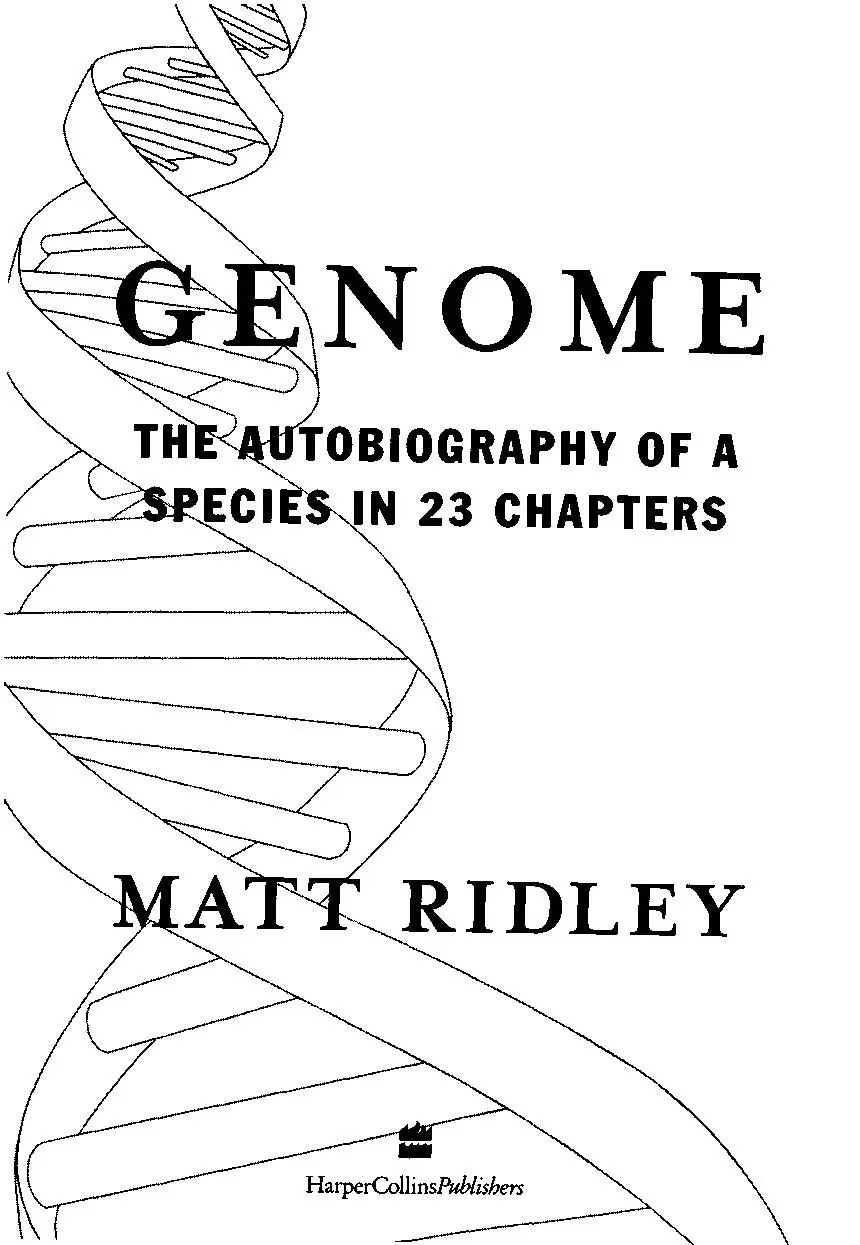
- Название:Matt Ridley
- Автор:
- Жанр:
- Год:неизвестен
- ISBN:нет данных
- Рейтинг книги:5 / 5. Голосов: 1
-
Избранное:Добавить в избранное
- Отзывы:
-
Ваша оценка:
Matt Ridley: краткое содержание, описание и аннотация
Предлагаем к чтению аннотацию, описание, краткое содержание или предисловие (зависит от того, что написал сам автор книги «Matt Ridley»). Если вы не нашли необходимую информацию о книге — напишите в комментариях, мы постараемся отыскать её.
Matt Ridley — читать онлайн ознакомительный отрывок
Ниже представлен текст книги, разбитый по страницам. Система сохранения места последней прочитанной страницы, позволяет с удобством читать онлайн бесплатно книгу «Matt Ridley», без необходимости каждый раз заново искать на чём Вы остановились. Поставьте закладку, и сможете в любой момент перейти на страницу, на которой закончили чтение.
Интервал:
Закладка:
Muller, meanwhile, was out of the picture. In 1932 his fervent socialism and his equally fervent belief in the selective breeding of human beings, eugenics (he wanted to see children carefully bred with the character of Marx or Lenin, though in later editions of his book he judiciously altered this to Lincoln and Descartes), led him across the Atlantic to Europe. He arrived in Berlin just a few months before Hitler came to power. He watched, horrified, as the Nazis smashed the laboratories of his boss, Oscar Vogt, for not expelling the Jews under his charge.
Muller went east once more, to Leningrad, arriving in the laboratory of Nikolay Vavilov just before the anti-Mendelist Trofim Lysenko caught the ear of Stalin and began his persecution of 4 8 G E N O M E
Mendelian geneticists in support of his own crackpot theories that wheat plants, like Russian souls, could be trained rather than bred to new regimes; and that those who believed otherwise should not be persuaded, but shot. Vavilov died in prison. Ever hopeful, Muller sent Stalin a copy of his latest eugenic book, but hearing it had not gone down well, found an excuse to get out of the country just in time. He went to the Spanish Civil War, where he worked in the blood bank of the International Brigade, and thence to Edinburgh, arriving with his usual ill luck just in time for the outbreak of the Second World War. He found it hard to do science in a blacked-out Scottish winter wearing gloves in the laboratory and he tried desperately to return to America. But nobody wanted a belligerent, prickly socialist who lectured ineptly and had been living in Soviet Russia.
Eventually Indiana University gave him a job. The following year he won the Nobel prize for his discovery of artificial mutation.
But still the gene itself remained an inaccessible and mysterious thing, its ability to specify precise recipes for proteins made all the more baffling by the fact that it must itself be made of protein; nothing else in the cell seemed complicated enough to qualify. True, there was something else in chromosomes: that dull little nucleic acid called D N A . It had first been isolated, from the pus-soaked bandages of wounded soldiers, in the German town of Tubingen in 1869 by a Swiss doctor named Friedrich Miescher. Miescher himself guessed that D N A might be the key to heredity, writing to his uncle in 1892 with amazing prescience that D N A might convey the hereditary message 'just as the words and concepts of all languages can find expression in 24—30 letters of the alphabet'. But D N A had few fans; it was known to be a comparatively monotonous substance: how could it convey a message in just four varieties?5
Drawn by the presence of Muller, there arrived in Bloomington, Indiana, a precocious and confident nineteen-year-old, already equipped with a bachelor's degree, named James Watson. He must have seemed an unlikely solution to the gene problem, but the solution he was. Trained at Indiana University by the Italian emigre Salvador Luria (predictably, Watson did not hit it off with Muller), H I S T O R Y 4 9
Watson developed an obsessive conviction that genes were made of D N A , not protein. In search of vindication, he went to Denmark, then, dissatisfied with the colleagues he found there, to Cambridge in October 1951. Chance threw him together in the Cavendish laboratory with a mind of equal brilliance captivated by the same conviction about the importance of D N A , Francis Crick.
The rest is history. Crick was the opposite of precocious. Already thirty-five, he still had no PhD (a German bomb had destroyed the apparatus at University College, London, with which he was supposed to have measured the viscosity of hot water under pressure
- to his great relief), and his sideways lurch into biology from a stalled career in physics was not, so far, a conspicuous success. He had already fled from the tedium of one Cambridge laboratory where he was employed to measure the viscosity of cells forced to ingest particles, and was busy learning crystallography at the Cavendish.
But he did not have the patience to stick to his own problems, or the humility to stick to small questions. His laugh, his confident intelligence and his knack of telling people the answers to their own scientific questions were getting on nerves at the Cavendish. Crick was also vaguely dissatisfied with the prevailing obsession with proteins. The structure of the gene was the big question and D N A , he suspected, was a part of the answer. Lured by Watson, he played truant from his own research to indulge in D N A games. So was born one of the great, amicably competitive and therefore productive collaborations in the history of science: the young, ambitious, supple-minded American who knew some biology and the effortlessly brilliant but unfocused older Briton who knew some physics. It was an exothermic reaction.
Within a few short months, using other people's laboriously gathered but under-analysed facts, they had made possibly the greatest scientific discovery of all time, the structure of D N A . Not even Archimedes leaping from his bath had been granted greater reason to boast, as Francis Crick did in the Eagle pub on 28 February 1953,
'We've discovered the secret of life.' Watson was mortified; he still feared that they might have made a mistake.
5 0 G E N O M E
But they had not. All was suddenly clear: D N A contained a code written along the length of an elegant, intertwined staircase of a double helix, of potentially infinite length. That code copied itself by means of chemical affinities between its letters and spelt out the recipes for proteins by means of an as yet unknown phrasebook linking D N A to protein. The stunning significance of the structure of D N A was how simple it made everything seem and yet how beautiful. As Richard Dawkins has put it,6 'What is truly revolutionary about molecular biology in the post-Watson—Crick era is that it has become digital . . . the machine code of the genes is uncannily computer-like.'
A month after the Watson-Crick structure was published, Britain crowned a new queen and a British expedition conquered Mount Everest on the same day. Apart from a small piece in the News Chronicle, the double helix did not make the newspapers. Today most scientists consider it the most momentous discovery of the century, if not the millennium.
Many frustrating years of confusion were to follow the discovery of D N A ' s structure. The code itself, the language by which the gene expressed itself, stubbornly retained its mystery. Finding the code had been, for Watson and Crick, almost easy — a mixture of guesswork, good physics and inspiration. Cracking the code required true brilliance. It was a four-letter code, obviously: A, C, G and T.
And it was translated into the twenty-letter code of amino acids that make up proteins, almost certainly. But how? Where? And by what means?
Most of the best ideas that led to the answer came from Crick, including what he called the adaptor molecule - what we now call transfer R N A . Independendy of all evidence, Crick arrived at the conclusion that such a molecule must exist. It duly turned up. But Crick also had an idea that was so good it has been called the greatest wrong theory in history. Crick's 'comma-free' code is more elegant than the one Mother Nature uses. It works like this. Suppose that the code uses three letters in each word (if it uses two, that only gives sixteen combinations, which is too few). Suppose that it H I S T O R Y 5 1
has no commas, and nogapsbetweenthewords. Now suppose that it excludes all words that can be misread if you start in the wrong place. So, to take an analogy used by Brian Hayes, imagine all three-letter English words that can be written with the four letters A, S, E and T: ass, ate, eat, sat, sea, see, set, tat, tea and tee. Now eliminate those that can be misread as another word if you start in the wrong place. For example, the phrase ateateat can be misread as 'a tea tea t' or as 'at eat eat' or as 'ate ate at'. Only one of these three words can survive in the code.
Читать дальшеИнтервал:
Закладка:
Похожие книги на «Matt Ridley»
Представляем Вашему вниманию похожие книги на «Matt Ridley» списком для выбора. Мы отобрали схожую по названию и смыслу литературу в надежде предоставить читателям больше вариантов отыскать новые, интересные, ещё непрочитанные произведения.



Обсуждение, отзывы о книге «Matt Ridley» и просто собственные мнения читателей. Оставьте ваши комментарии, напишите, что Вы думаете о произведении, его смысле или главных героях. Укажите что конкретно понравилось, а что нет, и почему Вы так считаете.