Clive Cussler - Plague Ship
Здесь есть возможность читать онлайн «Clive Cussler - Plague Ship» весь текст электронной книги совершенно бесплатно (целиком полную версию без сокращений). В некоторых случаях можно слушать аудио, скачать через торрент в формате fb2 и присутствует краткое содержание. Жанр: Старинная литература, на английском языке. Описание произведения, (предисловие) а так же отзывы посетителей доступны на портале библиотеки ЛибКат.
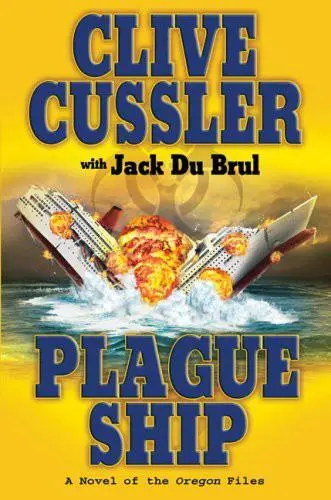
- Название:Plague Ship
- Автор:
- Жанр:
- Год:неизвестен
- ISBN:нет данных
- Рейтинг книги:5 / 5. Голосов: 1
-
Избранное:Добавить в избранное
- Отзывы:
-
Ваша оценка:
Plague Ship: краткое содержание, описание и аннотация
Предлагаем к чтению аннотацию, описание, краткое содержание или предисловие (зависит от того, что написал сам автор книги «Plague Ship»). Если вы не нашли необходимую информацию о книге — напишите в комментариях, мы постараемся отыскать её.
), Capt. Juan Cabrillo, who heads the Corporation, a covert military company for hire, and the multifaceted crew of the
, a high-tech ship disguised to look like a tramp steamer, take on a group known as the Responsivists. The Responsivists publicly espouse a program of global population control, but are secretly planning a devastating attack on the human race utilizing a virulent virus found aboard an ancient ship that may be Noah's Ark. The authors are up to their usual high standards when in fighting mode, though the chief villain, the doctor who heads the Responsivists, falls short of Juan's billing as the single-most-evil human being I have ever met. Readers may wish that next time out the bad guys put up more of a struggle.
Plague Ship — читать онлайн бесплатно полную книгу (весь текст) целиком
Ниже представлен текст книги, разбитый по страницам. Система сохранения места последней прочитанной страницы, позволяет с удобством читать онлайн бесплатно книгу «Plague Ship», без необходимости каждый раз заново искать на чём Вы остановились. Поставьте закладку, и сможете в любой момент перейти на страницу, на которой закончили чтение.
Интервал:
Закладка:
“Hope we have enough warning so we can lay an ambush.”
“Why not wait for them right here?”
“If I was leading that team, I would lob in a bunch of grenades before committing my men. We’d be mincemeat before they needed to fire a single shot. If we hung back out of grenade range, we’d be too exposed in this tunnel. Better to find a more defensible position. On the bright side, if they do bother to come after us it most likely means there’s another way out of here.” Linc considered their options, and with a broad sweep of his arm indicated they should proceed down the subterranean passageway.
One wall of the tunnel was a long, continuous slab of stone, while the other showed signs that it had been worked by tools. The two men could walk comfortably side by side, and there was at least ten feet of headroom.
“This is a natural fissure the Japanese expanded during their occupation,” Cabrillo said as he studied the rock.
“Most likely split open by an earthquake,” Linc agreed. “They built their factory, or whatever the hell it was, where the hole reached the surface.”
Juan pointed out dark splatters on the stone floor. The spray pattern indicated it was blood—copious amounts of blood. “Gunshot.”
“More than one victim, too.”
Juan jerked the light away from the grisly tableau. His mouth was a thin, grim line.
The air temperature dropped and the humidity built as they descended deeper into the earth. It was thinking about the misery that had occurred here rather than the plummeting temperature that made Cabrillo shiver.
The tunnel wasn’t straight, but rather corkscrewed and twisted as it fell away at a gentle angle. After twenty-five minutes and more than two miles, the cave floor leveled out, and they discovered the first side chamber. The entrance was partially blocked by a minor cave-in, and the tunnel’s ceiling was a fractured mess of stone ready to collapse at any moment. This cavern, too, had been a natural geologic feature that the Japanese had expanded. The room was roughly circular, fifty feet across, with a ceiling that was at least fifteen feet high. There was nothing in the cavern except some bolts along the walls that had once carried electrical wiring.
“Administration area?” Linc wondered aloud.
“Makes sense, being the closest room to the surface.” They found two smaller side caves before discovering a fourth in which the Japanese had left artifacts behind. This chamber had a dozen iron bunks bolted to the floor and several flimsy pressed-metal cabinets along one wall. As Juan checked the drawers, Linc examined the bedsteads.
“You wouldn’t think they would have bothered giving their prisoners beds,” Linc said.
“There’s nothing in any of these drawers.” Juan looked at Lincoln. “They needed the beds because they had to restrain their victims. Someone intentionally infected with typhus, cholera, or some type of poison gas is going to thrash around.”
Franklin snapped his hands away from the metal bunk as though he’d been burned.
They found four more side chambers like this one, some large enough to hold forty beds. They also found a small, waist-high cave entrance in the main tunnel. Juan wriggled his head and shoulders into the aperture and saw that the cave beyond dropped precipitously. At the extreme end of his light’s range, he could see the floor of the cavern littered with all sorts of unidentifiable junk. This had been a communal dump, and amid the rubbish were human bones. They had become disjointed over the decades, so Cabrillo couldn’t tell how many there were. Five hundred would be a conservative estimate.
“This place is like a slaughterhouse,” he said when he pulled himself free. “A death factory.”
“And they kept it running for eighteen months.”
“I think the surface facility was used solely to maintain the secret laboratories down here, where they experimented with the really nasty stuff. Using a cave system meant they could isolate it in a hurry if they ever had a viral outbreak.”
“Ruthless and efficient.” There was no admiration in Linc’s voice. “The Japanese could have taught the Nazis a thing or two.”
“I’m sure they did,” Juan said, still a little unsettled by what he’d just seen. “Unit 731 has its roots going back to 1931, two years before Hitler came to power. Just before war’s end, information and technology transfers went the other way. Germany supplied Imperial Japan with jet and rocket engines for suicide aircraft, as well as nuclear materials.”
Linc’s next comment died on his lips.
Deadened by distance and the surrounding rock, they couldn’t hear the explosion at the cave’s entrance.
Rather, both men felt a jolt of air pressure against their bodies, like the windblast of a passing truck. The Responsivists had breached the pile of debris and were now in the tunnel system hunting them.
“They probably know the tunnels and will be coming on fast,” Cabrillo said grimly. “We have maybe a half hour to either find a way out of here or someplace we can defend with a pair of pistols and eleven rounds of ammunition.”
The next medical chamber hadn’t been stripped as much as the others. There were thin mattresses on the beds, and the cabinets were stocked with jars of chemicals. The labels were in German. Juan pointed this out to Linc, as it proved his earlier point.
Linc studied the labels, then read aloud in English: “Chlorine. Distilled alcohol. Hydrogen peroxide. Sulfur dioxide. Hydrochloric acid.”
Cabrillo had forgotten Linc spoke German. “I’ve got an idea. Find me some sodium bicarbonate.”
“I don’t think this is the time to worry about a bellyache.” Linc remarked blandly as he scanned the bottles and jars.
“High school chemistry lessons. I don’t remember too much about the safe stuff, but my teacher delighted in showing us how to make chemical weapons.”
“Lovely.”
“He was this aging hippie who thought we needed to defend ourselves when the government eventually came to seize all private property,” Juan explained. Linc threw him an odd look and passed over the appropriate glass container. “What can I say?” Cabrillo shrugged. “I grew up in California.” Juan asked Linc to find one other jar of chemicals.
“So what do you want to do with this stuff?” Linc handed over a jar containing an amber liquid.
“Chemical warfare.”
They agreed on a spot to lay their ambush in one of the smaller medical wards. Linc bundled up some blankets and mattresses, in the shape of two men huddled under the farthest bedstead. Juan rigged a booby trap using a roll of electrical tape from Linc’s bag, the chemicals, and his canteen. In the uncertain glow of a flashlight, the mannequins were more than sufficient to lure the Responsivists. He placed Linc’s cell phone on walkie-talkie mode between the two inert figures.
Linc and Juan backed off into a room opposite and a little farther down the tunnel to wait.
If Juan had any difficulty with what they were about to do, he only had to think about the victims aboard the Golden Dawn to harden his resolve. The minutes trickled by, the luminous second hand of Cabrillo’s watch moving as if the battery was nearly spent. But he and Linc had lain in countless ambushes, and they remained perfectly still, their eyes open, although they could see nothing in the stygian tunnel. Each leaned against the stone wall with his head cocked, his ears straining to pick up the slightest sound.
After only twenty minutes, they heard them. Juan picked out two, then three distinct footfalls, as the Responsivist gunmen rushed headlong down the tunnel. There were no lights, so he reasoned they carried an infrared lamp and night vision goggles capable of seeing in that spectrum.
Читать дальшеИнтервал:
Закладка:
Похожие книги на «Plague Ship»
Представляем Вашему вниманию похожие книги на «Plague Ship» списком для выбора. Мы отобрали схожую по названию и смыслу литературу в надежде предоставить читателям больше вариантов отыскать новые, интересные, ещё непрочитанные произведения.
Обсуждение, отзывы о книге «Plague Ship» и просто собственные мнения читателей. Оставьте ваши комментарии, напишите, что Вы думаете о произведении, его смысле или главных героях. Укажите что конкретно понравилось, а что нет, и почему Вы так считаете.