W.E.B. Griffin - Retreat, Hell!
Здесь есть возможность читать онлайн «W.E.B. Griffin - Retreat, Hell!» весь текст электронной книги совершенно бесплатно (целиком полную версию без сокращений). В некоторых случаях можно слушать аудио, скачать через торрент в формате fb2 и присутствует краткое содержание. Год выпуска: 0101, Жанр: Старинная литература, на английском языке. Описание произведения, (предисловие) а так же отзывы посетителей доступны на портале библиотеки ЛибКат.
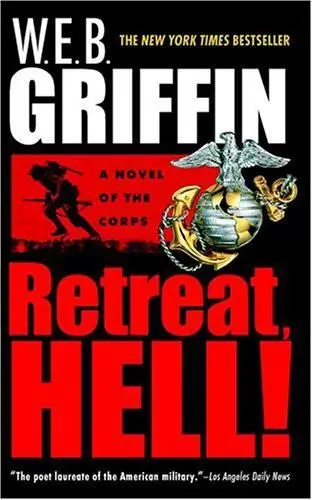
- Название:Retreat, Hell!
- Автор:
- Жанр:
- Год:0101
- ISBN:нет данных
- Рейтинг книги:3 / 5. Голосов: 1
-
Избранное:Добавить в избранное
- Отзывы:
-
Ваша оценка:
Retreat, Hell!: краткое содержание, описание и аннотация
Предлагаем к чтению аннотацию, описание, краткое содержание или предисловие (зависит от того, что написал сам автор книги «Retreat, Hell!»). Если вы не нашли необходимую информацию о книге — напишите в комментариях, мы постараемся отыскать её.
Megaseller Griffin (Honor Bound; Brotherhood of War; Men at War) musters another solid entry in his series chronicling the history of the U.S. Marines, now engaged in the Korean War. Gen. Douglas MacArthur, nicknamed El Supremo by his subordinates, is taken by surprise when the North Korean Army surges south across the 38th parallel. After early losses, he rallies his troops and stems the tide, but not for long. Intertwining stories of literally an army of characters reveal how MacArthur and his sycophantic staff overlook the entire Red Chinese Army, which is massed behind the Yalu River and about to enter the war. Brig. Gen. Fleming Pickering attempts to mediate the ongoing battles between feisty, give-'em-hell Harry Truman and the haughty MacArthur, while worrying about his pilot son, Malcolm "Pick" Pickering, who has been shot down behind enemy lines. The introduction of the Sikorsky H-19A helicopter into the war by Maj. Kenneth "Killer" McCoy and sidekick Master Gunner Ernie Zimmerman details the invention of tactics that will become commonplace in Vietnam. Readers looking for guts and glory military action will be disappointed, as barely a shot is fired in anger, but fans of Griffin's work understand that the pleasures are in the construction of a complex, big-picture history of war down to its smallest details: "There were two men in the rear seat, both of them wearing fur-collared zippered leather jackets officially known as Jacket, Flyers, Intermediate Type G-1." Veterans of the series will enjoy finding old comrades caught up in fresh adventures, while new-guy readers can easily enter here and pick up the ongoing story.
Retreat, Hell! — читать онлайн бесплатно полную книгу (весь текст) целиком
Ниже представлен текст книги, разбитый по страницам. Система сохранения места последней прочитанной страницы, позволяет с удобством читать онлайн бесплатно книгу «Retreat, Hell!», без необходимости каждый раз заново искать на чём Вы остановились. Поставьте закладку, и сможете в любой момент перейти на страницу, на которой закончили чтение.
Интервал:
Закладка:
"If the test run is successful, we can start moving all the heavy vehicles. Obviously, it would be better to have them on the east coast, however close to Wonsan, than sitting on the wharf in Inchon, on the other side of the peninsula." "Obviously," Colonel Kennedy agreed.
"Go see Bob and tell him I said to give you a couple of tanks, and then get your show on the road, Howard." "Right," Colonel Kennedy said.
[SIX]
Andrews Air Force Base
Washington, D.C.
11O5 13 October I95O
There was already a line of limousines parked not far from the Independence, the President's Douglas C-54 transport, when Senator Richardson K. Fowler's Packard limousine was passed by the Secret Service agents and allowed to drive onto the tarmac.
The dignitaries the other limousines had carried to the airport, and some of their aides, were gathered around the movable stairway leading up to the aircraft. Two USAF master sergeants stood at Parade Rest on either side of the stairs.
When Fowler's Packard stopped, Captain George F. Hart, USMCR, got out of the front passenger seat and immediately went to the trunk, opened it, and took out two Valv-Paks and handed them over to another Air Force master sergeant, who was in charge of the luggage.
Fred Delmore, Fowler's chauffeur, got from behind the wheel and opened the rear passenger door. Mrs. Patricia Fleming, in a thigh-length Persian lamb coat, got out first, followed by Senator Fowler and finally Brigadier General Fleming Pickering, USMCR.
Fowler stood by the car, making no effort to join, or even greet, the dignitaries gathered at the stairway. After a moment, one of the dignitaries, a bald Army officer, broke away from the group and walked to the Fowler limousine.
He was wearing an ordinary woolen olive-drab "Ike" jacket-and-trousers uniform, identical to those worn by enlisted men. The only differences were the solid gold piping on his overseas cap and a small circle of five stars pinned to each epaulet. General of the Army Omar Bradley had recently been promoted to the highest rank in the Army by Truman, the first—and, as it turned out, only—such promotion since World War II.
After a moment, several of the others started after him.
"Good morning, Senator," Bradley said, smiling and putting out his hand.
"General Bradley, how are you, sir?" Fowler replied. "I don't think you know General and Mrs. Pickering, do you?"
"I'm afraid I don't," Bradley said. He offered his hand to Patricia Fleming. "An honor, ma'am," he said.
Pickering saluted, and Bradley returned it. They shook hands.
"How do you do, sir?" Pickering said.
"I've been looking forward to meeting you, General," Bradley said. "General Smith has been saying all sorts of nice things about you, and I wanted you to know that I'm really pleased that the two of you will be running the CIA."
"General Smith will be running it, General," Pickering said. "I'm just a temporary hired hand."
Three other men had now walked up to them.
"I don't think you know any of these people, do you, Flem?" Fowler said, then proceeded to introduce him to Secretary of the Army Frank Pace—whose youth surprised Pickering—and two State Department officers, Dean Rusk and Philip Jessup.
There wasn't time to do more than shake hands as the Presidential caravan rolled up.
Harry S Truman got out the black Cadillac first, and a moment later a tall, thin man in what Pickering thought of as a "banker's black" suit joined him. He was Averill Harriman, who was Truman's National Security Adviser. He held the personal rank of Ambassador-at-Large.
Truman headed for the stairway, but then saw Fowler and the Pickerings and turned and walked toward them. After a moment, Harriman followed him.
"Senator," Truman said, smiling. "How nice of you to come to see us off."
"Your Majesty's loyal opposition could do no less," Fowler replied.
Pickering saluted. Truman nodded and smiled at him.
"I'm sorry he didn't have more time at home, Mrs. Pickering," Truman said.
"A little time is better than none, Mr. President," Patricia Fleming replied.
"How nice to see you, Patricia!" Harriman exclaimed, putting out his hand.
Her face was stony, and she ignored the greeting and the hand.
The smile vanished from Harriman's face, and he turned and walked directly toward the stairway.
"Jesus, Pat," Pickering said.
"Mr. President," Patricia Fleming said, "I'm not among Averill Harriman's legion of female admirers. . . ."
"I somehow sensed that," the President said.
"I'm one of those old-fashioned women who think husbands should not sleep with other people's wives, and if they can't manage that level of decency, they should at least not flaunt their infidelity in their wife's face."
"I'm married, oddly enough," Truman said, "to a woman who shares that philosophy. I'm going to have to get you and Bess together, Mrs. Pickering." He paused, and added: "It was nice to see you again."
He started toward the Independence.
Pickering looked at his wife.
"Was that necessary?"
"I thought so," his wife replied.
They looked at each other a moment.
"Bring Pick home, Flem," she said softly.
"I'll damned sure try, honey," he said.
She nodded, then wrapped her arms around him.
She stayed that way a moment, then raised her face to his and kissed him.
Then he walked quickly to the steps to the Independence, where George Hart was waiting for him.
As soon as they had gone through the door, the steps were pulled away and there came the sound of an engine starting.
[SEVEN]
There were no layovers. The Independence stopped at San Francisco, but just long enough to take on fuel and food, and to give the President and his aides time to deal with the messages that had come in for him while they were flying across the country. No one got off the airplane.
There was a Presidential compartment—and two others, one occupied by General Bradley and the other by Ambassador Harriman—on the Independence and there was a steady stream of visitors to both. Pickering did not expect to be summoned to any of the meetings, and he wasn't. He wasn't at all sure why Truman had ordered him to make the trip, and he suspected that Harriman would probably do his best to have the President ignore him.
At San Francisco—not surprisingly, it was Trans-Global's headquarters— there were four Trans-Global Lockheed Constellations, one of which sat, its engines idling, at the end of the runway when the Independence took off for Hawaii.
Pickering thought that not only was it a far more graceful-looking aircraft than the Presidential Douglas, but also a hundred miles an hour faster. He wondered why the President wasn't furnished with the fastest aircraft available, and then he thought, again, how wise Pick had been in insisting that Trans-Global buy the Lockheeds, rather than take advantage of the surplus Air Force Douglas transports available so cheaply.
He then thought that the war was making a good deal of money for Trans-Global. The Air Force had not only contracted for as many contract flights as Trans-Global could make aircraft available for but also was filling every seat made available on the regularly scheduled flights, and there were now far more of those than there had been when the war started.
That was the good news, Pickering thought. The bad news was that Chief Pilot Pickering wasn't around to see how well his airline was doing. Worse than that, Pickering was growing less and less confident that Pick would be found. He refused to allow himself to dwell on the details of why that was likely, even probable, as all of them were unpleasant to contemplate.
Читать дальшеИнтервал:
Закладка:
Похожие книги на «Retreat, Hell!»
Представляем Вашему вниманию похожие книги на «Retreat, Hell!» списком для выбора. Мы отобрали схожую по названию и смыслу литературу в надежде предоставить читателям больше вариантов отыскать новые, интересные, ещё непрочитанные произведения.







Обсуждение, отзывы о книге «Retreat, Hell!» и просто собственные мнения читателей. Оставьте ваши комментарии, напишите, что Вы думаете о произведении, его смысле или главных героях. Укажите что конкретно понравилось, а что нет, и почему Вы так считаете.