W.E.B. Griffin - Retreat, Hell!
Здесь есть возможность читать онлайн «W.E.B. Griffin - Retreat, Hell!» весь текст электронной книги совершенно бесплатно (целиком полную версию без сокращений). В некоторых случаях можно слушать аудио, скачать через торрент в формате fb2 и присутствует краткое содержание. Год выпуска: 0101, Жанр: Старинная литература, на английском языке. Описание произведения, (предисловие) а так же отзывы посетителей доступны на портале библиотеки ЛибКат.
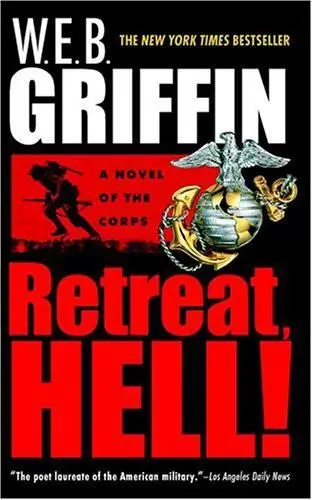
- Название:Retreat, Hell!
- Автор:
- Жанр:
- Год:0101
- ISBN:нет данных
- Рейтинг книги:3 / 5. Голосов: 1
-
Избранное:Добавить в избранное
- Отзывы:
-
Ваша оценка:
Retreat, Hell!: краткое содержание, описание и аннотация
Предлагаем к чтению аннотацию, описание, краткое содержание или предисловие (зависит от того, что написал сам автор книги «Retreat, Hell!»). Если вы не нашли необходимую информацию о книге — напишите в комментариях, мы постараемся отыскать её.
Megaseller Griffin (Honor Bound; Brotherhood of War; Men at War) musters another solid entry in his series chronicling the history of the U.S. Marines, now engaged in the Korean War. Gen. Douglas MacArthur, nicknamed El Supremo by his subordinates, is taken by surprise when the North Korean Army surges south across the 38th parallel. After early losses, he rallies his troops and stems the tide, but not for long. Intertwining stories of literally an army of characters reveal how MacArthur and his sycophantic staff overlook the entire Red Chinese Army, which is massed behind the Yalu River and about to enter the war. Brig. Gen. Fleming Pickering attempts to mediate the ongoing battles between feisty, give-'em-hell Harry Truman and the haughty MacArthur, while worrying about his pilot son, Malcolm "Pick" Pickering, who has been shot down behind enemy lines. The introduction of the Sikorsky H-19A helicopter into the war by Maj. Kenneth "Killer" McCoy and sidekick Master Gunner Ernie Zimmerman details the invention of tactics that will become commonplace in Vietnam. Readers looking for guts and glory military action will be disappointed, as barely a shot is fired in anger, but fans of Griffin's work understand that the pleasures are in the construction of a complex, big-picture history of war down to its smallest details: "There were two men in the rear seat, both of them wearing fur-collared zippered leather jackets officially known as Jacket, Flyers, Intermediate Type G-1." Veterans of the series will enjoy finding old comrades caught up in fresh adventures, while new-guy readers can easily enter here and pick up the ongoing story.
Retreat, Hell! — читать онлайн бесплатно полную книгу (весь текст) целиком
Ниже представлен текст книги, разбитый по страницам. Система сохранения места последней прочитанной страницы, позволяет с удобством читать онлайн бесплатно книгу «Retreat, Hell!», без необходимости каждый раз заново искать на чём Вы остановились. Поставьте закладку, и сможете в любой момент перейти на страницу, на которой закончили чтение.
Интервал:
Закладка:
"None whatever," Smith said, and offered Hart his hand. "I suppose that 'uncanny ability' was useful to you as a policeman. Or is that an acquired skill?" Jesus, he knows all about George.
"I think I got it from my father, sir," Hart said. "He was a cop, too."
"Have you had lunch?" Smith asked.
"No, sir," Pickering said.
"Well, we could go downstairs, but if we ordered a sandwich here—they do a very nice open-faced roast beef, and a chicken club—we could talk while we eat. Your call."
"An open-faced roast beef sandwich sounds fine to me, General," Pickering said.
Captain?
"Roast beef's fine with me, sir."
Smith went to the telephone and ordered the sandwiches and "a very large pot of coffee." Then he turned to Pickering. "To get to the starting line, the President will have a press conference at five o'clock, at which he will announce my appointment as Director of the CIA. I will have to be there, so we have until, say, half past four. That should be enough time, don't you think?"
"Yes, sir," Pickering said.
Smith took an envelope from his jacket pocket and extended it to Pickering.
"The President sent this over," Smith said. "I understand you've seen it."
Pickering opened the envelope. It held the message from General Howe that Truman had shown him earlier.
"Yes, sir, I have," Pickering said.
"Have you?" Smith asked of Hart.
"No, sir."
"I told George what I thought he should know, sir," Pickering said.
"I think it would be useful if you saw the whole thing," Smith said.
Pickering handed Hart the envelope.
"Before the waiter gets here, General," Smith said, "I'd like your opinion of why this war came as a complete surprise not only to General MacArthur but to the CIA as well."
Christ, he goes right for the jugular!
Screw it. When you don't know what to say, try telling the truth.
"When the intelligence gathered by some of MacArthur's intelligence people went against the intelligence conclusions of MacArthur's G-2, it was buried," Pickering said.
"Okay. That explains MacArthur's surprise. But why did the CIA fail so completely?"
"The CIA Tokyo station chief regarded himself as a member of MacArthur's staff," Pickering said. "And was not about to disagree with the conclusions of General Willoughby, as endorsed by General MacArthur."
"And you think he should have disagreed?"
"I think he should have drawn his own conclusions from his own sources and sent them directly to Admiral Hillencoetter without discussing them with—and certainly not allowing them to be censored by—anyone in the Dai Ichi Building."
"What you're saying, General, is that the Tokyo station chief was derelict in the performance of his duties?"
"Yes, sir, I guess I am."
"Then why didn't you relieve him when you went over there and came to this conclusion?"
"There were several reasons, sir," Pickering said. "For one thing, McCoy told me he had developed his own sources—"
"I'm really looking forward to meeting Major 'Killer' McCoy," Smith interrupted. "The President seems very taken with him. Where is he now?"
"Probably in North Korea—or China—looking for General Dean," Pickering replied, and added, "and my son."
Smith met Pickering's eyes for a long moment but did not respond directly.
"You were saying McCoy said he had his own sources?"
"Which had proven to be more reliable than those of General Willoughby," Pickering went on, "so I didn't need the station chief's intel . . . which, presumably, he was already furnishing to Willoughby and Hillencoetter anyway. I didn't know if I had the authority to relieve him, or whether that had to be cleared with the CIA, and the moment I started to relieve him, Willoughby would learn of it, possibly cause trouble here, and certainly make him keep a closer eye on me than he already was."
"The President's right," Smith said. "You do have a loose-cannon tendency, don't you?"
"Is that what he said?" Pickering said.
This is not going well. If I were this man, I would not want me working for me.
So what do I do now?
Ask the Marine Corps to keep me on at least until we find out what happened to Pick?
Ask for immediate release from active duty and just stay in Tokyo? If I do that, I probably wouldn't be able to get permission to go to Korea.
"That's what he said," Smith replied, evenly, with a little smile, then asked: "What do you want to do about the Tokyo Station Chief?" Smith asked.
"If I were to become your deputy for Asia . . ."
"Please don't tell me you're having second thoughts about that," Smith said. "I need you over there."
Jesus, I didn't expect that!
"We don't know how well we would work together," Pickering said.
"I think I'll be considerably easier for you to work with than General Donovan was," Smith said. "I understand that your personal relationship with him . . ."
"Was about as bad as a relationship can be," Pickering said.
"You are taking the job, right?"
"I'm surprised it's still being offered," Pickering said.
"What are you doing, General, fishing for a compliment? Yes, it's still being offered, because both the President and I think you're the best man to do what has to be done."
They locked eyes for a moment.
"Yes, sir, I'll take the job," Pickering said. "Thank you."
"Okay. Now, what do you want to do about the Tokyo station chief?"
"One of the reasons I didn't relieve him when I first got to Tokyo was that I was afraid he'd go to Washington and spend all his time throwing monkey wrenches into my gears."
"He's gone," Smith said. "Or will be as soon as I can order him home. And he will not be sniping at you from the rear. What about his replacement?"
"Off the top of my head, I have no idea," Pickering admitted.
"I thought I was going to hear two names," Smith said. "Major K. R. McCoy and Colonel Edward Banning. I don't think McCoy has the experience, but what's wrong with Banning?"
"Absolutely nothing is wrong with Colonel Banning," Pickering said quickly and firmly.
"Why have you got him sitting around Camp Pendleton doing a job that could be done by a lot of far more junior people who don't have a tenth of his experience as an intelligence officer?" When Pickering didn't immediately reply, Smith added: "I know that he worked for you in the Second War, and what he did."
"I guess the truth, General," Pickering said, "is that while I often thought how much I need Ed Banning in Tokyo, I didn't have the balls to make waves. Either about getting rid of the Tokyo station chief or about asking Admiral Hillencoetter to name Banning in his place."
"It usually helps, if you're going to make waves, to be sure of your authority," Smith said. "Now that that question has been resolved, I take it if I named Colonel Banning as Tokyo station chief, I would have your concurrence?"
"Yes, sir."
"I'll issue the necessary orders tomorrow, as my first order of business. Or maybe even tonight. I thought I would drop by there tonight, unannounced, just to see what I could see. How soon do you want Banning in Tokyo?"
"As soon as possible, sir."
[THREE]
Office of the Chief of Staff
Headquarters X U.S. Corps
Seoul, South Korea
O825 11 October 195O
There were three full colonels sitting on folding chairs facing the folding desk of the chief of staff, who was also a full colonel.
A somewhat irreverent thought occurred to Colonel T. Howard Kennedy, the X Corps Transportation Officer: It's like Orwell said. Some pigs are more equal than other pigs.
Читать дальшеИнтервал:
Закладка:
Похожие книги на «Retreat, Hell!»
Представляем Вашему вниманию похожие книги на «Retreat, Hell!» списком для выбора. Мы отобрали схожую по названию и смыслу литературу в надежде предоставить читателям больше вариантов отыскать новые, интересные, ещё непрочитанные произведения.





Обсуждение, отзывы о книге «Retreat, Hell!» и просто собственные мнения читателей. Оставьте ваши комментарии, напишите, что Вы думаете о произведении, его смысле или главных героях. Укажите что конкретно понравилось, а что нет, и почему Вы так считаете.