W.E.B. Griffin - Retreat, Hell!
Здесь есть возможность читать онлайн «W.E.B. Griffin - Retreat, Hell!» весь текст электронной книги совершенно бесплатно (целиком полную версию без сокращений). В некоторых случаях можно слушать аудио, скачать через торрент в формате fb2 и присутствует краткое содержание. Год выпуска: 0101, Жанр: Старинная литература, на английском языке. Описание произведения, (предисловие) а так же отзывы посетителей доступны на портале библиотеки ЛибКат.
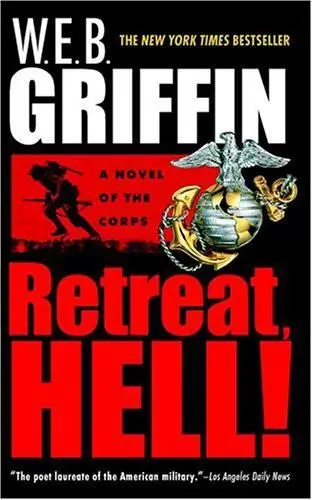
- Название:Retreat, Hell!
- Автор:
- Жанр:
- Год:0101
- ISBN:нет данных
- Рейтинг книги:3 / 5. Голосов: 1
-
Избранное:Добавить в избранное
- Отзывы:
-
Ваша оценка:
Retreat, Hell!: краткое содержание, описание и аннотация
Предлагаем к чтению аннотацию, описание, краткое содержание или предисловие (зависит от того, что написал сам автор книги «Retreat, Hell!»). Если вы не нашли необходимую информацию о книге — напишите в комментариях, мы постараемся отыскать её.
Megaseller Griffin (Honor Bound; Brotherhood of War; Men at War) musters another solid entry in his series chronicling the history of the U.S. Marines, now engaged in the Korean War. Gen. Douglas MacArthur, nicknamed El Supremo by his subordinates, is taken by surprise when the North Korean Army surges south across the 38th parallel. After early losses, he rallies his troops and stems the tide, but not for long. Intertwining stories of literally an army of characters reveal how MacArthur and his sycophantic staff overlook the entire Red Chinese Army, which is massed behind the Yalu River and about to enter the war. Brig. Gen. Fleming Pickering attempts to mediate the ongoing battles between feisty, give-'em-hell Harry Truman and the haughty MacArthur, while worrying about his pilot son, Malcolm "Pick" Pickering, who has been shot down behind enemy lines. The introduction of the Sikorsky H-19A helicopter into the war by Maj. Kenneth "Killer" McCoy and sidekick Master Gunner Ernie Zimmerman details the invention of tactics that will become commonplace in Vietnam. Readers looking for guts and glory military action will be disappointed, as barely a shot is fired in anger, but fans of Griffin's work understand that the pleasures are in the construction of a complex, big-picture history of war down to its smallest details: "There were two men in the rear seat, both of them wearing fur-collared zippered leather jackets officially known as Jacket, Flyers, Intermediate Type G-1." Veterans of the series will enjoy finding old comrades caught up in fresh adventures, while new-guy readers can easily enter here and pick up the ongoing story.
Retreat, Hell! — читать онлайн бесплатно полную книгу (весь текст) целиком
Ниже представлен текст книги, разбитый по страницам. Система сохранения места последней прочитанной страницы, позволяет с удобством читать онлайн бесплатно книгу «Retreat, Hell!», без необходимости каждый раз заново искать на чём Вы остановились. Поставьте закладку, и сможете в любой момент перейти на страницу, на которой закончили чтение.
Интервал:
Закладка:
Still, what street signs remained were in Korean, and it took Raymond about two hours to make it to the house from Kimpo. And even when he blew his jeep's horn in front of the massive steel gates, he wasn't sure he was in the right place.
A moment later, an enormous Korean in U.S. Army fatigues came through a door in the gate, holding the butt of a Thompson submachine gun against his hip.
"Do you speak English?" Raymond asked.
There was no sign, verbal or otherwise, that the Korean had understood him.
"I'm here to see the station chief," Raymond said.
Again there was no response that Raymond could detect.
"I have orders from General Almond," Raymond said.
That triggered a response. The Korean gestured, and the right half of the gate swung inward. The Korean motioned Raymond to drive through it.
Inside, he saw a large stone European-looking house. There was a jeep and a Russian jeep parked to the left of the porte cochere in the center of the building. He remembered seeing a Russian jeep earlier at both the Capitol Building and Kimpo, and wondered if it was the same one. On the roof of the porte cochere an air-cooled .30-caliber machine gun had been set up behind sandbags. It was manned, and trained on the gate and the road from the gate. Raymond wondered if it was manned all the time, or whether his horn-blowing had been the trigger.
He stopped in front of the porte cochere and looked over his shoulder for the enormous Korean. The Korean, who was right behind him, pulled his finger across his throat, a signal to cut the engine, then pointed at the door of the house.
Then the Korean, the Thompson still resting on his hip, beat him to the door and motioned him through it.
Inside was a large marble-floored foyer. Another Korean, much smaller than the one who had been at the gate, sat at the foot of a wide staircase with an automatic carbine on his lap. The large Korean led Raymond to a door off the foyer, rapped on it with his knuckles, and then pushed it open.
Lieutenant Colonel Raymond was interested—perhaps even excited—to see what was in the room behind the door. The only previous contact he had had with the CIA was on paper. He had seen a number of their intelligence assessments, and he had met a number of CIA bureaucrats, some of whom had lectured at the Command & General Staff College when he had been a student there. But he had never before been in a CIA station and met actual CIA field officers.
He walked into the room.
There was a large dining table. On it sat two silver champagne coolers, each holding a liter bottle of Japanese Asahi beer. Two men in clean white T-shirts were sitting at the table, drinking beer, munching on Planters peanuts, and reading Stars and Stripes.
They hurriedly rose to their feet. Those are enlisted men!
"Can I help you, Colonel?" the taller of them asked courteously. "My name is Raymond," he said. "I have a message for the station chief from General Almond."
The taller of them jerked his thumb at the other one, which was apparently a signal for him to get the station chief.
"It'll be a minute, Colonel," the taller one said. "Can I offer you a beer?"
"I'd kill for a cold beer, thank you," Colonel Raymond blurted.
It was not, he instantly realized, what he would have said if he had considered his reply carefully—or, for that matter, at all. He was on duty as the personal messenger of the Corps commander, for one thing, and for another, field-grade officers do not drink with enlisted men.
But it had been a long day, and the beer looked so good.
The tall man found a glass—
That's a highball glass, a crystal highball glass!
Where are they getting all these creature comforts?
—filled it carefully with beer, and handed it to Lieutenant Colonel Raymond.
"There you go, sir."
"Thank you."
Raymond was on his second sip when three other men came into the room. They were also wearing crisp, clean white T-shirts. One was lithe and trim, the second barrel-chested and muscular—Raymond decided he, too, was an enlisted man, probably a senior sergeant—and the third was sort of pudgy and rumpled.
"What can we do for you, Colonel?" the pudgy one asked. He walked to the champagne cooler, poured beer, and handed glasses to the others.
"I have a message for the station chief from General Almond," Raymond said. "Is that you, sir?"
"Who are you, Colonel?" the pudgy one asked.
"Lieutenant Colonel Raymond, sir. I'm the assistant X Corps G-2."
"You work for Colonel Schneider, right?" the pudgy one said.
"No, sir, for Colonel Scott."
The pudgy one nodded at the trim one and confirmed, "That's the name of the X Corps G-2."
"Are you the station chief, sir?" Raymond asked the pudgy one.
The pudgy one pointed at the lithe one, and the lithe one pointed at the pudgy one.
Station Chief William R. Dunston had pointed at Major Kenneth R. McCoy for two reasons. First, he was always reluctant to identify himself to anyone—even an Army G-2 light bird—as the station chief, and second, he considered Ken McCoy to be de facto the senior CIA officer in South Korea.
There was no question in Dunston's mind that if there was an argument between him and McCoy, and General Pickering had to choose between them, McCoy would prevail. He had served under Pickering in the OSS in the Second World War, and they were personal friends as well.
Major McCoy had pointed at Dunston because Dunston was the station chief, even though both of them knew McCoy was calling the shots.
The chunky, muscular enlisted man chuckled when he saw the exchange.
"Mr. Zimmerman, it is not nice to mock your superiors," the lithe one said, which caused the other two enlisted men to laugh.
"May I presume that one of you is the station chief?" Lieutenant Colonel Raymond said. He realized he was smiling.
What did I expect to find in here? A Humphrey Bogart type in a trench coat?
"You may," the lithe one said, and put out his hand. "My name is McCoy. That's Major Dunston," he added, pointing, "and Master Gunner Zimmerman, Technical Sergeant Jennings, and Sergeant Cole."
"What's your message, Colonel?" Dunston asked.
Raymond ran it through his brain first before reciting, " 'Classification Top Secret. As of 1445 hours this date, by order of the Supreme Commander, Allied Powers, two H-19 helicopters, together with their crews, maintenance personnel, and all available supporting equipment, have been transferred to you. The officer-in-charge has been notified and is awaiting your orders in the hangar across from base operations at Kimpo Airfield. Signature, Almond, Major General, Chief of Staff, Allied Powers.' "
"Jesus!" Zimmerman said. "Helos? Two helos?"
"Could you do that again, please, Colonel?" McCoy asked.
Raymond did so.
"Did General Almond say what we're supposed to do with these helicopters?" Dunston asked.
"If these are the two big Sikorskys that flew into Kimpo this morning, I know what we can do with them," McCoy said.
"Yeah," Zimmerman said.
"That's General Almond's entire message, sir," Raymond said.
"Colonel, have you had your supper?" McCoy asked.
"Excuse me?"
"For two reasons, I hope you can have it with us," McCoy said. "The first is to thank you for the helos, and the second is that I think you're just the actor we need for a little amateur theatrical we're staging."
"Yeah," Zimmerman said. "And, Killer, if we can find Howe's stars—and I’ll bet there's a spare set in his luggage—we can pin them on him."
"Even better," McCoy said.
"I have no idea what you're talking about," Lieutenant Colonel Raymond confessed.
"Colonel, we have a prisoner in the basement. A North Korean colonel," McCoy explained. "We're just about convinced (a) he's a high-level intelligence officer and (b) that he knows something about either a planned Chinese Communist intervention or the situation which will trigger such an intervention. We've been working on him without much success. The one thing we do know for sure is that he has an ego. He wants us to know how important he is. What we've got set up for tonight is a dinner—"
Читать дальшеИнтервал:
Закладка:
Похожие книги на «Retreat, Hell!»
Представляем Вашему вниманию похожие книги на «Retreat, Hell!» списком для выбора. Мы отобрали схожую по названию и смыслу литературу в надежде предоставить читателям больше вариантов отыскать новые, интересные, ещё непрочитанные произведения.




Обсуждение, отзывы о книге «Retreat, Hell!» и просто собственные мнения читателей. Оставьте ваши комментарии, напишите, что Вы думаете о произведении, его смысле или главных героях. Укажите что конкретно понравилось, а что нет, и почему Вы так считаете.