W.E.B. Griffin - Retreat, Hell!
Здесь есть возможность читать онлайн «W.E.B. Griffin - Retreat, Hell!» весь текст электронной книги совершенно бесплатно (целиком полную версию без сокращений). В некоторых случаях можно слушать аудио, скачать через торрент в формате fb2 и присутствует краткое содержание. Год выпуска: 0101, Жанр: Старинная литература, на английском языке. Описание произведения, (предисловие) а так же отзывы посетителей доступны на портале библиотеки ЛибКат.
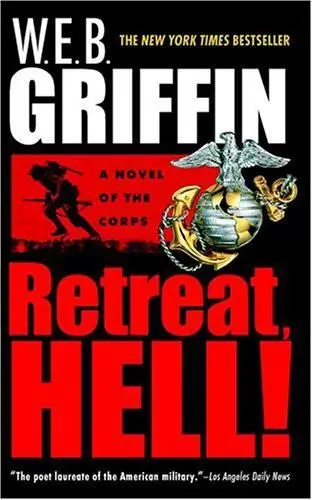
- Название:Retreat, Hell!
- Автор:
- Жанр:
- Год:0101
- ISBN:нет данных
- Рейтинг книги:3 / 5. Голосов: 1
-
Избранное:Добавить в избранное
- Отзывы:
-
Ваша оценка:
Retreat, Hell!: краткое содержание, описание и аннотация
Предлагаем к чтению аннотацию, описание, краткое содержание или предисловие (зависит от того, что написал сам автор книги «Retreat, Hell!»). Если вы не нашли необходимую информацию о книге — напишите в комментариях, мы постараемся отыскать её.
Megaseller Griffin (Honor Bound; Brotherhood of War; Men at War) musters another solid entry in his series chronicling the history of the U.S. Marines, now engaged in the Korean War. Gen. Douglas MacArthur, nicknamed El Supremo by his subordinates, is taken by surprise when the North Korean Army surges south across the 38th parallel. After early losses, he rallies his troops and stems the tide, but not for long. Intertwining stories of literally an army of characters reveal how MacArthur and his sycophantic staff overlook the entire Red Chinese Army, which is massed behind the Yalu River and about to enter the war. Brig. Gen. Fleming Pickering attempts to mediate the ongoing battles between feisty, give-'em-hell Harry Truman and the haughty MacArthur, while worrying about his pilot son, Malcolm "Pick" Pickering, who has been shot down behind enemy lines. The introduction of the Sikorsky H-19A helicopter into the war by Maj. Kenneth "Killer" McCoy and sidekick Master Gunner Ernie Zimmerman details the invention of tactics that will become commonplace in Vietnam. Readers looking for guts and glory military action will be disappointed, as barely a shot is fired in anger, but fans of Griffin's work understand that the pleasures are in the construction of a complex, big-picture history of war down to its smallest details: "There were two men in the rear seat, both of them wearing fur-collared zippered leather jackets officially known as Jacket, Flyers, Intermediate Type G-1." Veterans of the series will enjoy finding old comrades caught up in fresh adventures, while new-guy readers can easily enter here and pick up the ongoing story.
Retreat, Hell! — читать онлайн бесплатно полную книгу (весь текст) целиком
Ниже представлен текст книги, разбитый по страницам. Система сохранения места последней прочитанной страницы, позволяет с удобством читать онлайн бесплатно книгу «Retreat, Hell!», без необходимости каждый раз заново искать на чём Вы остановились. Поставьте закладку, и сможете в любой момент перейти на страницу, на которой закончили чтение.
Интервал:
Закладка:
"Well, then I guess he'll just have to look like the oldest private in the Army," General Howe said, then turned to McCoy. "Ken, I want to hear what you and Ernie think of what this North Korean colonel has to say about the prospects of Chinese intervention."
"I'll go down there right now, sir," McCoy said.
Everyone rose from the table as General Howe and Master Sergeant Rogers walked out of the room.
[FOUR]
Haneda Airfield
Tokyo, Japan
O62O 29 September 195O
One hundred yards away from the Bataan, General of the Army Douglas MacArthur's personal Douglas C-54, a very large MP sergeant, whose impeccable uniform included a chrome-plated steel helmet, a glistening leather Sam Browne belt, and paratrooper boots with white nylon laces, held up his hand to stop the 1950 black Buick Roadmaster.
The Buick had an oblong red plate with a silver star mounted to the bumper, identifying it as a car occupied by a brigadier general of the United States Marine Corps.
The MP bent over to look into the rear seat as the window rolled down.
There were two men in the rear seat, both of them wearing fur-collared zippered leather jackets officially known as Jacket, Flyers, Intermediate Type G-l. The driver was a U.S. Army sergeant.
"General Pickering," the younger of the two men in the backseat said.
There was no insignia on the leather jacket, but the silver railroad tracks of a captain were visible on the collar points of his shirt. The captain, in his early thirties, was built like a circus strong man.
"Good morning, sir," the MP said, courteously, then added, a little uneasily, "Sir, the general is not on my list."
"Then your list is wrong, Sergeant," the captain said reasonably.
"Yes, sir," the MP said, straightened, came to attention, raised his hand in a crisp salute, and said, "Pass."
Both men in the back of the Buick returned the salute.
The Buick drove up to the mobile stairway to the glistening C-54, around which were gathered half a dozen officers and men, including two impeccably and ornately uniformed military policemen, one standing at parade rest at each side the ladder.
The driver of the Buick got out and hurriedly opened the rear door.
Brigadier General Fleming Pickering, a silver-haired man of six feet one, 190 pounds, who thought of himself as being one year past The Big Five Zero, got out of the car. The captain followed a moment later.
Colonel Sidney Huff, a large, somewhat plump fifty-year-old wearing the insignia of an aide-de-camp to a General of the Army, walked up and saluted.
"Good morning, General," he said. "I wasn't aware you were coming along."
Pickering and the captain returned the colonel's salute.
"Good morning, Sid," Pickering said, and added, "Neither was the MP back there."
"May I suggest you board, sir?" Colonel Huff said. "The Supreme Commander's due any moment, and you know he doesn't like to wait to board the Bataan.”
Pickering nodded.
"See you on board, Sid," Pickering said, and started for the ladder, trailed by the captain, who now had a web pistol belt with a holstered Colt Model 1911A1 pistol in his hand.
The MPs at the foot of the stairway saluted as the two Marines climbed the ladder.
There was an Air Force master sergeant standing inside the aircraft at the door.
"Captain Hart will be sitting with me," Pickering said.
The sergeant obviously didn't like to hear that, but sergeants do not argue with brigadier generals.
"Yes, sir," he said. "How about the fourth row back on the left of the aircraft, sir?"
Pickering found the row, slid in, and took the window seat. The captain opened the overhead bin, put the pistol belt in it, then sat down beside Pickering.
Pickering pointed out the window.
An olive-drab 1950 Chevrolet staff car had stopped at the foot of the stairway. One of the Army officers hurried to open the rear door, as Colonel Huff stood by.
A slight, elderly, gray-haired Oriental in a business suit somewhat awkwardly extricated himself from the car, then turned to offer his hand to the other passenger. This was a Caucasian woman in a black dress.
"Rhee?" Captain Hart asked softly.
Pickering nodded.
Colonel Huff saluted, then waved the couple to the stairway.
A moment later they appeared inside the aircraft. The Air Force master sergeant led them to one of the two VIP suites, the one on the right.
"So where does the Palace Guard get to sit?" Hart whispered.
Pickering smiled at him but held his finger in front of his lips, suggesting that further observations of that nature would be inappropriate. Then he pointed out the window again.
The Chevrolet staff car was gone, replaced by a black 1942 Cadillac limousine, which had a small American flag mounted on the right front fender and a small flag with five stars in a circle mounted on the left fender.
Colonel Huff personally opened the passenger door.
General of the Army Douglas MacArthur, Supreme Commander, Allied Powers and United Nations Forces, got out.
MacArthur was wearing well-washed khakis, his famous battered, gold-encrusted uniform cap, and an Air Force A-2 leather flight jacket, not unlike the fur-collared Naval aviator's jackets Pickering and Hart were wearing.
Pickering was reasonably sure that his Naval aviator's jacket was not an authorized item of uniform for Marine officers, but he was equally sure that no one was going to call him on it. So far as he was concerned, his—and El Supremo's—leather jackets were a comfortable, practical garment for senior officers, who were not likely to find themselves rolling around in the dirt. Furthermore, he had heard somewhere that as a privilege of rank, general officers were permitted to select their own uniforms. He thought that if this were true, it probably applied only to Army officers, but had decided on the jacket anyway.
And had extended the privilege to his aide-de-camp (and bodyguard), Captain George F. Hart, as well.
"General, would it be all right if I got one of those leather jackets?" Hart had asked. "It would make hiding these a lot easier."
Hart had shown what he meant by first pulling up his trousers' leg and revealing a Smith & Wesson snub-nosed .38 Special five-shot revolver—his "backup" gun—in an ankle holster, then showing General Pickering his back and the Colt Model 1911-Al semiautomatic .45-ACP-caliber pistol he carried in a skeleton holster in the small thereof.
Captain Hart, who as a civilian commanded the Homicide Bureau of the Saint Louis, Missouri, Police Department, had brought the weapons with him when recalled to the Corps for the Korean Conflict. He was never either without the pistols or very far from Brigadier General Pickering.
It makes sense, and if the Palace Guard doesn't like it, sorry about that.
"Sure, George. Why not?" Pickering had replied.
Hart now carried the .45 in a shoulder holster and the snub-nose in the right side pocket of the leather jacket.
And, predictably, the Palace Guard hadn't liked the sight of Captain Hart in a Naval aviator's leather jacket identical to that of General Pickering's, and had used it to take a shot at what really bothered them—Marine General Pickering wearing a leather jacket much like the one worn by the Supreme Commander, Allied Powers and United Nations Forces.
"General," Colonel Sidney Huff had said, "I'm sure you won't take offense where none is intended, but do you think your aide's leather jacket is appropriate?"
The translation of that, of course, was: "Do you think your leather jacket is appropriate when (a) General MacArthur's leather jacket has become his trademark and (b) General MacArthur has made it plain he would prefer that his staff officers do not wear leather jackets or battered gold-bedecked uniform caps?"
Читать дальшеИнтервал:
Закладка:
Похожие книги на «Retreat, Hell!»
Представляем Вашему вниманию похожие книги на «Retreat, Hell!» списком для выбора. Мы отобрали схожую по названию и смыслу литературу в надежде предоставить читателям больше вариантов отыскать новые, интересные, ещё непрочитанные произведения.







Обсуждение, отзывы о книге «Retreat, Hell!» и просто собственные мнения читателей. Оставьте ваши комментарии, напишите, что Вы думаете о произведении, его смысле или главных героях. Укажите что конкретно понравилось, а что нет, и почему Вы так считаете.