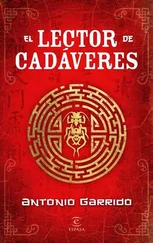
Antonio Garrido - The Corpse Reader
Здесь есть возможность читать онлайн «Antonio Garrido - The Corpse Reader» весь текст электронной книги совершенно бесплатно (целиком полную версию без сокращений). В некоторых случаях можно слушать аудио, скачать через торрент в формате fb2 и присутствует краткое содержание. Год выпуска: 2013, ISBN: 2013, Издательство: Amazon Pub, Жанр: Старинная литература, на английском языке. Описание произведения, (предисловие) а так же отзывы посетителей доступны на портале библиотеки ЛибКат.

- Название:The Corpse Reader
- Автор:
- Издательство:Amazon Pub
- Жанр:
- Год:2013
- ISBN:9781612184364
- Рейтинг книги:5 / 5. Голосов: 1
-
Избранное:Добавить в избранное
- Отзывы:
-
Ваша оценка:
The Corpse Reader: краткое содержание, описание и аннотация
Предлагаем к чтению аннотацию, описание, краткое содержание или предисловие (зависит от того, что написал сам автор книги «The Corpse Reader»). Если вы не нашли необходимую информацию о книге — напишите в комментариях, мы постараемся отыскать её.
The Corpse Reader — читать онлайн бесплатно полную книгу (весь текст) целиком
Ниже представлен текст книги, разбитый по страницам. Система сохранения места последней прочитанной страницы, позволяет с удобством читать онлайн бесплатно книгу «The Corpse Reader», без необходимости каждый раз заново искать на чём Вы остановились. Поставьте закладку, и сможете в любой момент перейти на страницу, на которой закончили чтение.
Интервал:
Закладка:
Cí made his way toward the canals in the pouring rain. Judge Feng came to mind. If Feng had been in the city, he’d have helped, but he wasn’t going to be back for months. Work. He had to get some kind of work.

Cí wanted to get a job as a private tutor at the Imperial University. He’d cleaned himself up as best he could, but the most important thing was to obtain the Certificate of Aptitude, which he needed to demonstrate his qualifications and give proof of his parents’ integrity.
When he reached the university’s main entrance, a vast number of students were milling around. He’d forgotten how busy it could get with students lining up for the documents necessary to take exams.
As he moved through the swarm, he noticed how really nothing had changed: the well-ordered paths through the gardens, the administrators’ bamboo huts, the vendors selling boiled rice and tea, the groups of high-class prostitutes with their immaculate makeup and gowns, the police watching out for pickpockets.
Before Cí got very far, though, he saw signs saying that these huts were only for foreigners. Anyone like him, born in a nearby precinct like Fujian, was directed to the vice chancellor’s office.
Cí knew he had no chance with the vice chancellor. The run-in with Kao was on his mind, and the police presence at the university worried him. But what else could he do?
A while back he’d found the gateway of the Palace of Wisdom inspiring and uplifting. Now, though, the dragons adorning the blood-colored gates unsettled him. They seemed to be there to frighten away those who didn’t belong.
He reached the building where the vice chancellor’s office was housed. Cí made his way to the Great Hall on the first floor, where he was greeted by an official with a friendly face.
“Is it for you?” asked the man, when Cí told him the document he needed.
“It is.”
“You studied here?”
“Law, sir.”
“Very well. And do you need a copy of your grades or just the certificate?”
“Both,” said Cí, before providing his details.
“Wait here; I need to speak to someone in another office.”
When the man came back, his face was hardened, and Cí’s immediate thought was that he was going to be turned away. But the official’s severe look seemed less for Cí than for the documents themselves, which he went through several times.
“I’m very sorry,” said the man at last. “I’m not going to be able to give you the certificate. Your grades are excellent, but in terms of your father’s integrity…” He didn’t seem able to bring himself to say more.
“My father? What happened with my father?”
“Read it for yourself. During a routine inspection six months ago, he was…” The man glanced kindly at Cí before going on. “He was found to have embezzled funds. The gravest crime an official can commit. He was on mourning leave at the time, but he still had to be demoted and dismissed.”
Cí trembled as he tried to make sense of the documents. His father…corrupt! That was why he decided not to return to Lin’an. His change of mind, the change in his attitude—it all stemmed from this.
He felt the shame transferring to him; he was dirty, contaminated by his father’s dishonesty. He’d now have to bear all of this. Feeling he might vomit, he fled from the Great Hall, down the magnificent stairs and out.
He stumbled through the gardens, castigating himself for his own stupidity. He had no idea where he was headed, or what to do with himself. He bumped into students and professors as if they were errant statues; he crashed into a bookstall, knocking it over, and when he tried to help pick up the books, the vendor shoved him away while shouting a few choice insults. A police officer made his way over to see what the commotion was, but Cí was able to disappear into the crowd.
Leaving the university grounds, he was nervous he’d be stopped. He made his way to the nearest canal and took a barge toward the trade square. All he had left was 200 qián . Now it was impossible for him to be a tutor. He had to reconsider.
What jobs could he look for? In a market flooded with farmworkers, his legal education would do no good. He didn’t have more skill than any other peasant in any kind of manual work, he wasn’t a member of any guild, and his injuries limited him. He went to a number of shops anyway, asking if there was anything he could do, anything at all, but had no luck.
He arrived at a salt warehouse and asked there. The man in charge looked at Cí as if he were trying to sell him a lame mule. He prodded Cí’s shoulders to see how strong he was, then winked at his assistant and told Cí to stay right there. From the top of a flight of stairs, the man dropped a sack of salt for Cí to lift; he just about managed it, though his ribs felt like they would crack under the weight. When he tried to lift a second sack, he fell flat on his face. The two men burst out laughing and sent Cí on his way.
Cí dragged himself along, trying to keep his spirits from sinking too low. Though he wasn’t in physical pain, he was sure his injuries were preventing him from making a good impression. But he had to keep trying. He checked all kinds of warehouses, businesses, workshops, the docks, even the municipal excrement collection service, but no one was willing to give him a chance.
He wandered to an area outside the city walls. For a while he drifted aimlessly, but then he heard shouting and headed toward the commotion.
A small crowd had gathered beneath a filthy awning; four or five men were holding down a boy who was kicking and screaming. The boy grew more distressed when another man came toward him brandishing a knife.
Cí realized he was witnessing a castration. There were specialist barbers who were charged with “converting” young homeless boys—usually those deemed to be brimming with vitality—into eunuchs for the emperor’s court. Feng had dealt with numerous corpses of boys who had died following the operation—from fever, gangrene, or blood loss. Judging by this particular barber’s appearance and the condition of his implements, everything pointed to the boy’s becoming one of those corpses.
Cí pushed his way to the front of the group. With a better view, he gasped at what he saw.
The barber, a toothless old man reeking of alcohol, had tried to remove the boy’s testicles but had accidentally cut the small penis. Cutting off the penis entirely, which he was now faced with doing, was clearly well beyond this man’s shaky abilities. The child wailed as if he were being split in two, and his weeping mother was begging her son to try and stay still.
Cí went over to the woman, and though it was risky to say anything, he turned to her and said, “Woman, if you let this man continue, your son is bound to die.”
“Get out of here!” shouted the barber, clumsily taking a swipe at Cí with the rusty knife. Cí sidestepped it easily and held the man’s gaze. The barber’s eyes were wild, and Cí figured he’d probably drunk every last penny from his most recent job.
“And you,” the barber said to the whimpering boy, “you’re still a man, right? So stop all that crying.”
The boy tried to comply, but he was in too much pain.
The barber, muttering that it was the boy’s fault for not keeping still, tried to stanch the blood. Because the incision had reached the urethra, he said he’d have to cut deeper. He took a straw compress from his bag of implements and pressed down. Cí shook his head. The barber twisted the penis and testicles together, and the boy shrieked. The barber paid no attention, but instead turned to the boy’s father and asked if he was absolutely sure. It was part of the rite: according to Confucius, not only would the boy become a “non-man,” but also, after death, his soul would never find peace.
Читать дальшеИнтервал:
Закладка:
Похожие книги на «The Corpse Reader»
Представляем Вашему вниманию похожие книги на «The Corpse Reader» списком для выбора. Мы отобрали схожую по названию и смыслу литературу в надежде предоставить читателям больше вариантов отыскать новые, интересные, ещё непрочитанные произведения.







Обсуждение, отзывы о книге «The Corpse Reader» и просто собственные мнения читателей. Оставьте ваши комментарии, напишите, что Вы думаете о произведении, его смысле или главных героях. Укажите что конкретно понравилось, а что нет, и почему Вы так считаете.