Philippa Gregory - The Kingmaker's Daughter
Здесь есть возможность читать онлайн «Philippa Gregory - The Kingmaker's Daughter» весь текст электронной книги совершенно бесплатно (целиком полную версию без сокращений). В некоторых случаях можно слушать аудио, скачать через торрент в формате fb2 и присутствует краткое содержание. Жанр: Старинная литература, на английском языке. Описание произведения, (предисловие) а так же отзывы посетителей доступны на портале библиотеки ЛибКат.
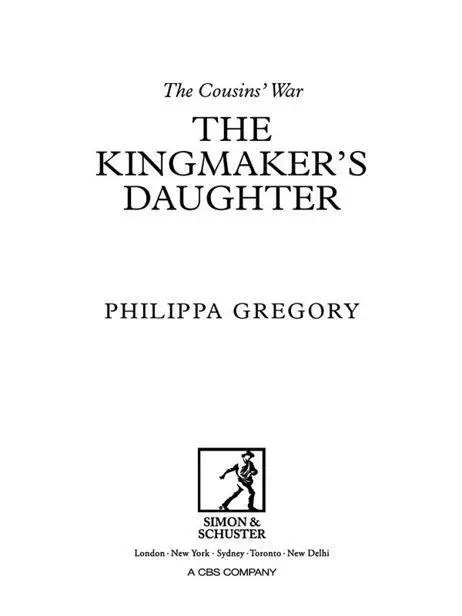
- Название:The Kingmaker's Daughter
- Автор:
- Жанр:
- Год:неизвестен
- ISBN:нет данных
- Рейтинг книги:4 / 5. Голосов: 1
-
Избранное:Добавить в избранное
- Отзывы:
-
Ваша оценка:
The Kingmaker's Daughter: краткое содержание, описание и аннотация
Предлагаем к чтению аннотацию, описание, краткое содержание или предисловие (зависит от того, что написал сам автор книги «The Kingmaker's Daughter»). Если вы не нашли необходимую информацию о книге — напишите в комментариях, мы постараемся отыскать её.
The Kingmaker's Daughter — читать онлайн бесплатно полную книгу (весь текст) целиком
Ниже представлен текст книги, разбитый по страницам. Система сохранения места последней прочитанной страницы, позволяет с удобством читать онлайн бесплатно книгу «The Kingmaker's Daughter», без необходимости каждый раз заново искать на чём Вы остановились. Поставьте закладку, и сможете в любой момент перейти на страницу, на которой закончили чтение.
Интервал:
Закладка:
I am bound to him, by my love, by my submission to his will, by my first passion, and since he is the father of my son and he is my lord. But what am I to him? That is what I want to know and what I can now – thanks to my mother – never confidently ask him.

In May Richard comes to me and says that he wants us to leave Edward at Middleham with his tutor and the lady of his household, and go to York to start the procession to Fotheringhay, for a solemn service: the reburial of his father.
‘Margaret of Anjou’s army beheaded him, and my brother Edmund, and put their heads on stakes above Micklegate Bar at York,’ Richard says grimly. ‘That’s the sort of woman she was, your first mother-in-law.’
‘You know I had no choice in my marriage,’ I say, speaking steadily though I am irritated by the fact that he cannot forget or forgive that part of my life. ‘And I was a child in Calais when that happened, and my father was fighting for York, fighting alongside your brother.’
He gestures with his hand. ‘Yes, well, that doesn’t matter now. What does matter is that I am going to have my father and brother honourably reburied. What d’you think?’
‘I think it would be a very good thing to do,’ I say. ‘They lie at Pontefract now, don’t they?’
‘Yes. My mother would like them buried together in the family vault at Fotheringhay Castle. I should like him to be honoured properly. Edward has trusted me to arrange it all, he prefers me to George for this.’
‘There could be no-one who would do it better,’ I say warmly.
He smiles. ‘Thank you. I know you are right. Edward is too careless and George has no love of chivalry and honour. But I shall take pride in doing it well. I shall be glad to see my father and brother properly buried.’
For a moment only I think of my own father’s body dragged off the battlefield at Barnet, the blood pouring from his helmet, his head lolling, his great black horse lying down in the field, as if he were asleep. But Edward was a good enemy; he never abused the bodies of his foe. He showed them in public so that the people would know that they were dead, and then he allowed them to be buried. My father’s corpse lies in Bisham Abbey, in the family vault, buried in honour but without ceremony. Isabel and I have never gone to pay our respects. My mother has never visited his grave, and now she never will. Bisham Abbey will not see her, till I bury her there, beside him: a better wife than she was a mother. ‘What can I do to help?’ is all I say.
He thinks. ‘You can help me plan the route, and the ceremonies at each place. And you can advise me as to what people should wear and the ceremonies we should order. Nothing like this has ever been done before. I want it to go off perfectly.’
Richard, his Master of Horse and I plan the journey together, while our priest at Middleham advises as to the ceremonies of walking with the body and the prayers that should be said at each halt. Richard commissions a carved model of his father, to lie on top of his coffin, so that everyone can see the great man that he was, and adds a silver statue of an angel holding a golden crown over the effigy’s head. This symbolises that the duke was a king by right, dying in his fight for his throne. It shows also how wise Edward was, to trust only Richard with this ceremony and not his brother George. When George joined my father he denied that the duke was a king by right, and that his son Edward was legitimate. Only Richard and I know that George still says this, but now he speaks in secret.
Richard makes a beautiful procession to bring the body of his father and his brother from Pontefract to their home. The cortege travels south from York for seven days and at every stop it goes into great churches on the way to lie in state. Thousands of people file silently past it to pay their respects to the king who was never crowned, and are reminded of the glorious history of the House of York.
Six horses draped in black pull the carriages, and ahead of them rides a knight, quite alone, carrying the duke’s banner as if he were going into battle. Behind him rides Richard, his head bowed, and behind him come the great men of the realm, all honouring our house, all honouring our fallen father.
For Richard this is more than a proper reburial of his father; this is a re-stating of his father’s right to be King of England, King of France. His father was a great soldier who fought for his country, a greater commander, a greater strategist even than his son Edward. In this lengthy procession Richard honours his father, claims his kingship, reminds the country of the greatness and nobility of the House of York. We are everything the Rivers are not, and Richard shows this in the wealth and grace of this remembrance service.
Richard keeps watch by the coffins every night that they are on the road, rides before them every day on a black horse with dark blue trappings, his standard lowered before him. It is as if for the first time in his life he allows himself to grieve for the father he lost and for the world of nobility and honour that went with him.
I meet him at Fotheringhay and find him thoughtful and tender with me. He remembers that his dead father and mine were allies, kinsmen. His father died before my father’s disastrous alliance with the bad queen, died even before he saw his son come to the throne, died before Richard had fought his first battle. That night, before Richard goes out for his last vigil by his father’s coffin, we kneel in prayer together, side by side in the beautiful family church. ‘He would have been glad of our marriage,’ Richard says quietly as he rises to his feet. ‘He would have been glad to know that we were married, despite everything else.’
For a moment, as he stands and I look up to him, the question And is our marriage valid? is on the tip of my tongue. But I see the grave sadness in his face, and then he turns and takes his place as one of the four knightly watchers who will stand all night around the coffin until dawn releases them from their vigil.
George and Isabel come to the funeral at Fotheringhay and she and I stand next to each other, both wearing beautiful gowns of the royal mourning colour of dark blue as the king and the queen and their family receive the two coffins at the cemetery at Fotheringhay church. Edward kisses the effigy’s hand and I see George and then Richard follow suit. George is especially tender and pious in this scene, but nobody takes the eye more than the little princesses. The ten-year-old Princess Elizabeth, exquisitely beautiful, is in the forefront; she leads her sister Princess Mary by the hand, and behind them come ambassadors from all the countries in Christendom to honour the head of the royal family of York.
It is a masque – a performance rich in symbols as well as an act of mourning. Nobody can see the royal family burying their forebear as if he were a king without reflecting how kingly is Edward, and his brothers, how reverent is the little prince, and how enchanting and queenly are Elizabeth and her daughters. I cannot help but think that they are more like actors than real kings and queens. Elizabeth the queen is so poised and beautiful, and her girls – especially the Princess Elizabeth – so conscious of themselves and their place in the procession. At her age I was frightened that I might step on my mother’s train, but little Princess Elizabeth walks with her head up, looking neither to left nor right, a little queen in the making.
I should admire her – everyone else seems to adore her, and perhaps if I had a daughter I would point to the princess and tell my little girl that she must learn the poise of her cousin. But since I don’t have a little girl, though I pray for one, I cannot look at the Princess Elizabeth without irritation, and think her spoiled and artificial – a precocious pet who would be better confined to the schoolroom rather than walking through a serious ceremonial as if she were taking the steps of a dance, revelling in all the eyes on her.
Читать дальшеИнтервал:
Закладка:
Похожие книги на «The Kingmaker's Daughter»
Представляем Вашему вниманию похожие книги на «The Kingmaker's Daughter» списком для выбора. Мы отобрали схожую по названию и смыслу литературу в надежде предоставить читателям больше вариантов отыскать новые, интересные, ещё непрочитанные произведения.


Обсуждение, отзывы о книге «The Kingmaker's Daughter» и просто собственные мнения читателей. Оставьте ваши комментарии, напишите, что Вы думаете о произведении, его смысле или главных героях. Укажите что конкретно понравилось, а что нет, и почему Вы так считаете.