Robert Galbraith - The Silkworm
Здесь есть возможность читать онлайн «Robert Galbraith - The Silkworm» весь текст электронной книги совершенно бесплатно (целиком полную версию без сокращений). В некоторых случаях можно слушать аудио, скачать через торрент в формате fb2 и присутствует краткое содержание. Год выпуска: 2014, ISBN: 2014, Издательство: Mulholland Books, Жанр: Старинная литература, на английском языке. Описание произведения, (предисловие) а так же отзывы посетителей доступны на портале библиотеки ЛибКат.
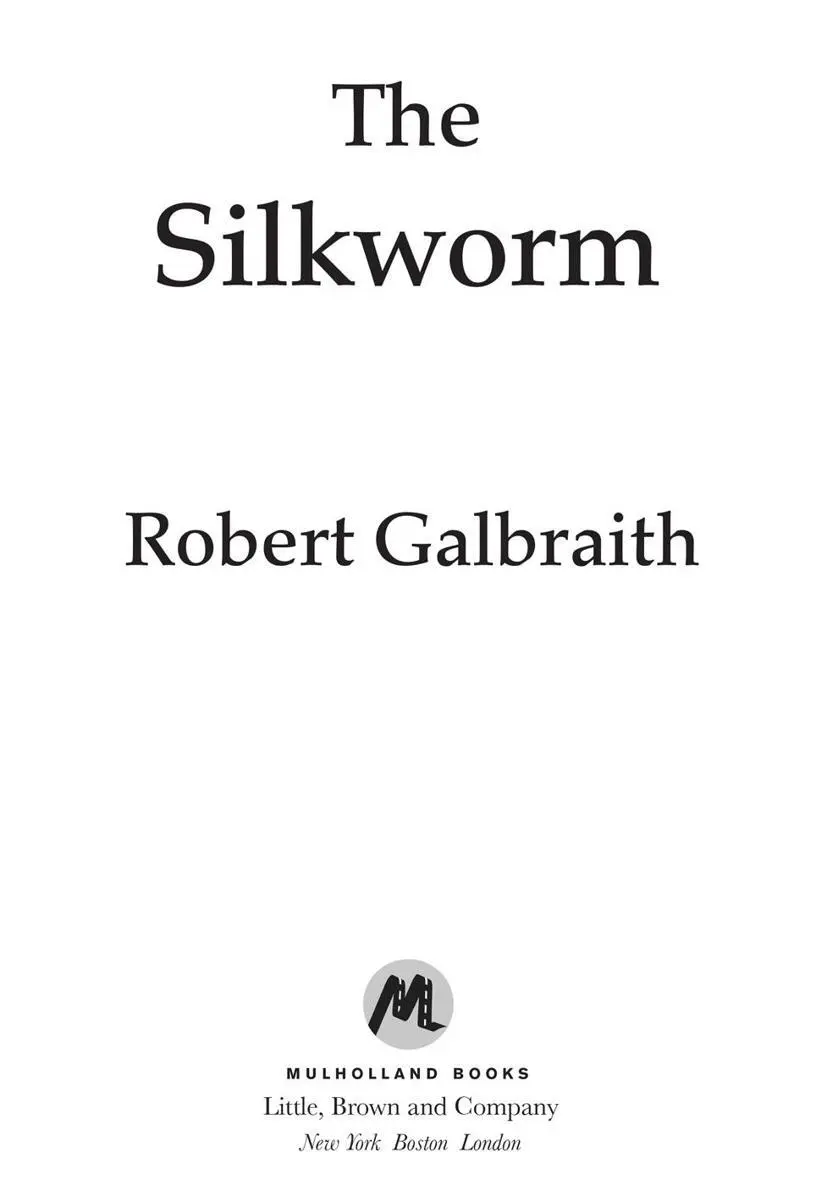
- Название:The Silkworm
- Автор:
- Издательство:Mulholland Books
- Жанр:
- Год:2014
- ISBN:9780316206877
- Рейтинг книги:3 / 5. Голосов: 2
-
Избранное:Добавить в избранное
- Отзывы:
-
Ваша оценка:
The Silkworm: краткое содержание, описание и аннотация
Предлагаем к чтению аннотацию, описание, краткое содержание или предисловие (зависит от того, что написал сам автор книги «The Silkworm»). Если вы не нашли необходимую информацию о книге — напишите в комментариях, мы постараемся отыскать её.
The Silkworm — читать онлайн бесплатно полную книгу (весь текст) целиком
Ниже представлен текст книги, разбитый по страницам. Система сохранения места последней прочитанной страницы, позволяет с удобством читать онлайн бесплатно книгу «The Silkworm», без необходимости каждый раз заново искать на чём Вы остановились. Поставьте закладку, и сможете в любой момент перейти на страницу, на которой закончили чтение.
Интервал:
Закладка:
He saw his quarry immediately he stepped into a second wooden-floored bar, where sofas in primary colors were set along the wall beneath paintings by modern artists. Fancourt was sitting slantwise on a bright red couch, one arm along its back, a leg a little raised in an exaggerated pose of ease. A Damien Hirst spot painting hung right behind his overlarge head, like a neon halo.
The writer had a thick thatch of graying dark hair, his features were heavy and the lines beside his generous mouth deep. He smiled as Strike approached. It was not, perhaps, the smile he would have given someone he considered an equal (impossible not to think in those terms, given the studied affectation of ease, the habitually sour expression), but a gesture to one whom he wished to be gracious.
“Mr. Strike.”
Perhaps he considered standing up to shake hands, but Strike’s height and bulk often dissuaded smaller men from leaving their seats. They shook hands across the small wooden table. Unwillingly, but left with no choice unless he wanted to sit on the sofa with Fancourt—a far too cozy situation, particularly with the author’s arm lying along the back of it—Strike sat down on a solid round pouffe that was unsuited both to his size and his sore knee.
Beside them was a shaven-headed ex-soap star who had recently played a soldier in a BBC drama. He was talking loudly about himself to two other men. Fancourt and Strike ordered drinks, but declined menus. Strike was relieved that Fancourt was not hungry. He could not afford to buy anyone else lunch.
“How long’ve you been a member of this place?” he asked Fancourt, when the waiter had left.
“Since it opened. I was an early investor,” said Fancourt. “Only club I’ve ever needed. I stay overnight here if I need to. There are rooms upstairs.”
Fancourt fixed Strike with a consciously intense stare.
“I’ve been looking forward to meeting you. The hero of my next novel is a veteran of the so-called war on terror and its military corollaries. I’d like to pick your brains once we’ve got Owen Quine out of the way.”
Strike happened to know a little about the tools available to the famous when they wished to manipulate. Lucy’s guitarist father, Rick, was less famous than either Strike’s father or Fancourt, but still celebrated enough to cause a middle-aged woman to gasp and tremble at the sight of him queuing for ice creams in St. Mawes—“ohmigod— what are you doing here? ” Rick had once confided in the adolescent Strike that the one sure way to get a woman into bed was to tell her you were writing a song about her. Michael Fancourt’s pronouncement that he was interested in capturing something of Strike in his next novel felt like a variation on the same theme. He had clearly not appreciated that seeing himself in print was neither a novelty to Strike, nor something he had ever chased. With an unenthusiastic nod to acknowledge Fancourt’s request, Strike took out a notebook.
“D’you mind if I use this? Helps me remember what I want to ask you.”
“Feel free,” said Fancourt, looking amused. He tossed aside the copy of the Guardian that he had been reading. Strike saw the picture of a wizened but distinguished-looking old man who was vaguely familiar even upside down. The caption read: Pinkelman at Ninety .
“Dear old Pinks,” said Fancourt, noticing the direction of Strike’s gaze. “We’re giving him a little party at the Chelsea Arts Club next week.”
“Yeah?” said Strike, hunting for a pen.
“He knew my uncle. They did their national service together,” said Fancourt. “When I wrote my first novel, Bellafront —I was fresh out of Oxford—my poor old Unc, trying to be helpful, sent a copy to Pinkelman, who was the only writer he’d ever met.”
He spoke in measured phrases, as though some invisible third party were taking down every word in shorthand. The story sounded prerehearsed, as though he had told it many times, and perhaps he had; he was an oft-interviewed man.
“Pinkelman—at that time author of the seminal Bunty’s Big Adventure series—didn’t understand a word I’d written,” Fancourt went on, “but to please my uncle he forwarded it to Chard Books, where it landed, most fortuitously, on the desk of the only person in the place who could understand it.”
“Stroke of luck,” said Strike.
The waiter returned with wine for Fancourt and a glass of water for Strike.
“So,” said the detective, “were you returning a favor when you introduced Pinkelman to your agent?”
“I was,” said Fancourt, and his nod held the hint of patronage of a teacher glad to note that one of his pupils had been paying attention. “In those days Pinks was with some agent who kept ‘forgetting’ to hand on his royalties. Whatever you say about Elizabeth Tassel, she’s honest—in business terms, she’s honest,” Fancourt amended, sipping his wine.
“She’ll be at Pinkelman’s party too, won’t she?” said Strike, watching Fancourt for his reaction. “She still represents him, doesn’t she?”
“It doesn’t matter to me if Liz is there. Does she imagine that I’m still burning with malice towards her?” asked Fancourt, with his sour smile. “I don’t think I give Liz Tassel a thought from one year’s end to the next.”
“Why did she refuse to ditch Quine when you asked her to?” asked Strike.
Strike did not see why he should not deploy the direct attack to a man who had announced an ulterior motive for meeting within seconds of their first encounter.
“It was never a question of me asking her to drop Quine,” said Fancourt, still in measured cadences for the benefit of that invisible amanuensis. “I explained that I could not remain at her agency while he was there, and left.”
“I see,” said Strike, who was well used to the splitting of hairs. “Why d’you think she let you leave? You were the bigger fish, weren’t you?”
“I think it’s fair to say that I was a barracuda compared to Quine’s stickleback,” said Fancourt with a smirk, “but, you see, Liz and Quine were sleeping together.”
“Really? I didn’t know that,” said Strike, clicking out the nib of his pen.
“Liz arrived at Oxford,” said Fancourt, “this strapping great girl who’d been helping her father castrate bulls and the like on sundry northern farms, desperate to get laid, and nobody fancied the job much. She had a thing for me, a very big thing—we were tutorial partners, juicy Jacobean intrigue calculated to get a girl going—but I never felt altruistic enough to relieve her of her virginity. We remained friends,” said Fancourt, “and when she started her agency I introduced her to Quine, who notoriously preferred to plumb the bottom of the barrel, sexually speaking. The inevitable occurred.”
“Very interesting,” said Strike. “Is this common knowledge?”
“I doubt it,” said Fancourt. “Quine was already married to his—well, his murderess, I suppose we have to call her now, don’t we?” he said thoughtfully. “I’d imagine ‘murderess’ trumps ‘wife’ when defining a close relationship? And Liz would have threatened him with dire consequences if he’d been his usual indiscreet self about her bedroom antics, on the wild off-chance that I might yet be persuaded to sleep with her.”
Was this blind vanity, Strike wondered, a matter of fact, or a mixture of both?
“She used to look at me with those big cow eyes, waiting, hoping…” said Fancourt, a cruel twist to his mouth. “After Ellie died she realized that I wasn’t going to oblige her even when grief-stricken. I’d imagine she was unable to bear the thought of decades of future celibacy, so she stood by her man.”
Читать дальшеИнтервал:
Закладка:
Похожие книги на «The Silkworm»
Представляем Вашему вниманию похожие книги на «The Silkworm» списком для выбора. Мы отобрали схожую по названию и смыслу литературу в надежде предоставить читателям больше вариантов отыскать новые, интересные, ещё непрочитанные произведения.



Обсуждение, отзывы о книге «The Silkworm» и просто собственные мнения читателей. Оставьте ваши комментарии, напишите, что Вы думаете о произведении, его смысле или главных героях. Укажите что конкретно понравилось, а что нет, и почему Вы так считаете.