Robert Galbraith - The Silkworm
Здесь есть возможность читать онлайн «Robert Galbraith - The Silkworm» весь текст электронной книги совершенно бесплатно (целиком полную версию без сокращений). В некоторых случаях можно слушать аудио, скачать через торрент в формате fb2 и присутствует краткое содержание. Год выпуска: 2014, ISBN: 2014, Издательство: Mulholland Books, Жанр: Старинная литература, на английском языке. Описание произведения, (предисловие) а так же отзывы посетителей доступны на портале библиотеки ЛибКат.
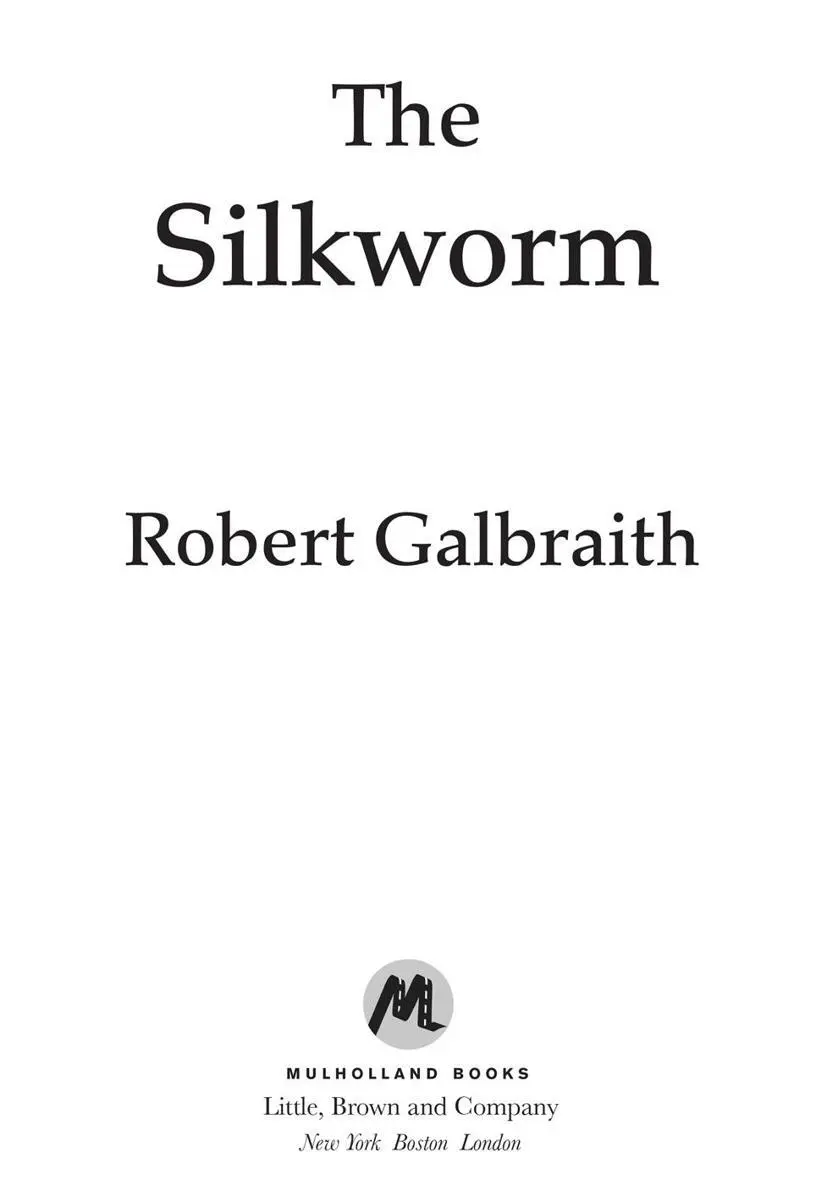
- Название:The Silkworm
- Автор:
- Издательство:Mulholland Books
- Жанр:
- Год:2014
- ISBN:9780316206877
- Рейтинг книги:3 / 5. Голосов: 2
-
Избранное:Добавить в избранное
- Отзывы:
-
Ваша оценка:
The Silkworm: краткое содержание, описание и аннотация
Предлагаем к чтению аннотацию, описание, краткое содержание или предисловие (зависит от того, что написал сам автор книги «The Silkworm»). Если вы не нашли необходимую информацию о книге — напишите в комментариях, мы постараемся отыскать её.
The Silkworm — читать онлайн бесплатно полную книгу (весь текст) целиком
Ниже представлен текст книги, разбитый по страницам. Система сохранения места последней прочитанной страницы, позволяет с удобством читать онлайн бесплатно книгу «The Silkworm», без необходимости каждый раз заново искать на чём Вы остановились. Поставьте закладку, и сможете в любой момент перейти на страницу, на которой закончили чтение.
Интервал:
Закладка:
He sat up late with the Quine file that night, reviewing the notes he had made of interviews, examining again the photographs he had printed off his phone. The mangled body of Owen Quine seemed to signal to him in the silence as corpses often did, exhaling mute appeals for justice and pity. Sometimes the murdered carried messages from their killers like signs forced into their stiff dead hands. Strike stared for a long time at the burned and gaping chest cavity, the ropes tight around ankles and wrists, the carcass trussed and gutted like a turkey, but try as he might, he could glean nothing from the pictures that he did not already know. Eventually he turned off all the lights and headed upstairs to bed.
It was a bittersweet relief to have to spend Thursday morning at the offices of his brunet client’s exorbitantly expensive divorce lawyers in Lincoln’s Inn Fields. Strike was glad to have something to while away time that could not be spent investigating Quine’s murder, but he still felt that he had been lured to the meeting under false pretenses. The flirtatious divorcée had given him to understand that her lawyer wanted to hear from Strike in person how he had collected the copious evidence of her husband’s duplicity. He sat beside her at a highly polished mahogany table with room for twelve while she referred constantly to “what Cormoran managed to find out” and “as Cormoran witnessed, didn’t you?,” occasionally touching his wrist. It did not take Strike long to deduce from her suave lawyer’s barely concealed irritation that it had not been his idea to have Strike in attendance. Nevertheless, as might have been expected when the hourly fee ran to over five hundred pounds, he showed no disposition to hurry matters along.
On a trip to the bathroom Strike checked his phone and saw, in tiny thumbnail pictures, Leonora being led in and out of Wood Green Crown Court. She had been charged and driven away in a police van. There had been plenty of press photographers but no members of the public baying for her blood; she was not supposed to have murdered anyone that the public much cared about.
A text from Robin arrived just as he was about to reenter the conference room:
Could get you in to see Leonora at 6 this evening?
Great, he texted back.
“I thought,” said his flirtatious client, once he had sat back down, “that Cormoran might be rather impressive on the witness stand.”
Strike had already shown her lawyer the meticulous notes and photographs he had compiled, detailing Mr. Burnett’s every covert transaction, the attempted sale of the apartment and the palming of the emerald necklace included. To Mrs. Burnett’s evident disappointment, neither man saw any reason for Strike to attend court in person given the quality of his records. Indeed, the lawyer could barely conceal his resentment of the reliance she seemed to place upon the detective. No doubt he thought this wealthy divorcée’s discreet caresses and batted eyelashes might be better directed towards him, in his bespoke pinstripe suit, with his distinguished salt-and-pepper hair, instead of a man who looked like a limping prize fighter.
Relieved to quit the rarefied atmosphere, Strike caught the Tube back to his office, glad to take off his suit in his flat, happy to think that he would soon be rid of that particular case and in possession of the fat check that had been the only reason he had taken it. He was free now to focus on that thin, gray-haired fifty-year-old woman in Holloway who was touted as WRITER’S MOUSY WIFE EXPERT WITH CLEAVER on page two of the Evening Standard he had picked up on the journey.
“Was her lawyer happy?” Robin asked when he reappeared in the office.
“Reasonably,” said Strike, staring at the miniature tinsel Christmas tree she had placed on her tidy desk. It was decorated with tiny baubles and LED lights.
“Why?” he asked succinctly.
“Christmas,” said Robin, with a faint grin but without apology. “I was going to put it up yesterday, but after Leonora was charged I didn’t feel very festive. Anyway, I’ve got you an appointment to see her at six. You’ll need to take photo ID—”
“Good work, thanks.”
“—and I got you sandwiches and I thought you might like to see this,” she said. “Michael Fancourt’s given an interview about Quine.”
She passed him a pack of cheese and pickle sandwiches and a copy of The Times , folded to the correct page. Strike lowered himself onto the farting leather sofa and ate while reading the article, which was adorned with a split photograph. On the left-hand side was a picture of Fancourt standing in front of an Elizabethan country house. Photographed from below, his head looked less out of proportion than usual. On the right-hand side was Quine, eccentric and wild-eyed in his feather-trimmed trilby, addressing a sparse audience in what seemed to be a small marquee.
The writer of the piece made much of the fact that Fancourt and Quine had once known each other well, had even been considered equivalent talents.
Few now remember Quine’s breakout work, Hobart’s Sin , although Fancourt touts it still as a fine example of what he calls Quine’s magical-brutalism. For all Fancourt’s reputation of a man who nurses his grudges, he brings a surprising generosity to our discussion of Quine’s oeuvre.
“Always interesting and often underrated,” he says. “I suspect that he will be treated more kindly by future critics than our contemporaries.”
This unexpected generosity is the more surprising when one considers that 25 years ago Fancourt’s first wife, Elspeth Kerr, killed herself after reading a cruel parody of her first novel. The spoof was widely attributed to Fancourt’s close friend and fellow literary rebel: the late Owen Quine.
“One mellows almost without realizing it—a compensation of age, because anger is exhausting. I unburdened myself of many of the feelings about Ellie’s death in my last novel, which should not be read as autobiographical, although…”
Strike skimmed the next two paragraphs, which appeared to be promoting Fancourt’s next book, and resumed reading at the point where the word “violence” jumped out at him.
It is difficult to reconcile the tweed-jacketed Fancourt in front of me with the one-time self-described literary punk who drew both plaudits and criticism for the inventive and gratuitous violence of his early work.
“If Mr. Graham Greene was correct,” wrote critic Harvey Bird of Fancourt’s first novel, “and the writer needs a chip of ice in his heart, then Michael Fancourt surely has what it takes in abundance. Reading the rape scene in one starts to imagine that this young man’s innards must be glacial. In fact, there are two ways of looking at , which is undoubtedly accomplished and original. The first possibility is that Mr. Fancourt has written an unusually mature first novel, in which he has resisted the neophyte tendency to insert himself into the (anti-)heroic role. We may wince at its grotesqueries or its morality, but nobody could deny the power or artistry of the prose. The second, more disturbing, possibility is that Mr. Fancourt does not possess much of an organ in which to place a chip of ice and his singularly inhuman tale corresponds to his own inner landscape. Time—and further work—will tell.”
Fancourt hailed originally from Slough, the only son of an unwed nurse. His mother still lives in the house in which he grew up.
“She’s happy there,” he says. “She has an enviable capacity for enjoying the familiar.”
His own home is a long way from a terraced house in Slough. Our conversation takes place in a long drawing room crammed with Meissen knick-knacks and Aubusson rugs, its windows overlooking the extensive grounds of Endsor Court.
Читать дальшеИнтервал:
Закладка:
Похожие книги на «The Silkworm»
Представляем Вашему вниманию похожие книги на «The Silkworm» списком для выбора. Мы отобрали схожую по названию и смыслу литературу в надежде предоставить читателям больше вариантов отыскать новые, интересные, ещё непрочитанные произведения.





Обсуждение, отзывы о книге «The Silkworm» и просто собственные мнения читателей. Оставьте ваши комментарии, напишите, что Вы думаете о произведении, его смысле или главных героях. Укажите что конкретно понравилось, а что нет, и почему Вы так считаете.