Robert Galbraith - The Silkworm
Здесь есть возможность читать онлайн «Robert Galbraith - The Silkworm» весь текст электронной книги совершенно бесплатно (целиком полную версию без сокращений). В некоторых случаях можно слушать аудио, скачать через торрент в формате fb2 и присутствует краткое содержание. Год выпуска: 2014, ISBN: 2014, Издательство: Mulholland Books, Жанр: Старинная литература, на английском языке. Описание произведения, (предисловие) а так же отзывы посетителей доступны на портале библиотеки ЛибКат.
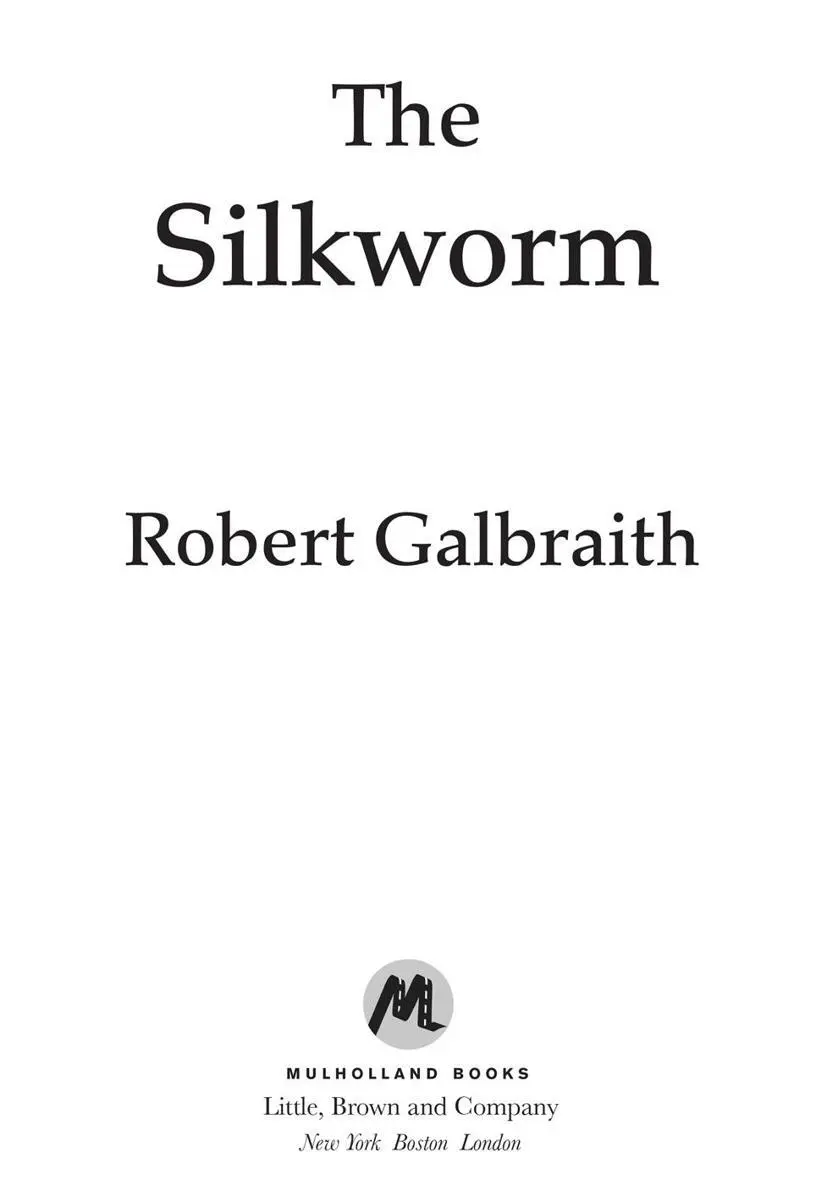
- Название:The Silkworm
- Автор:
- Издательство:Mulholland Books
- Жанр:
- Год:2014
- ISBN:9780316206877
- Рейтинг книги:3 / 5. Голосов: 2
-
Избранное:Добавить в избранное
- Отзывы:
-
Ваша оценка:
The Silkworm: краткое содержание, описание и аннотация
Предлагаем к чтению аннотацию, описание, краткое содержание или предисловие (зависит от того, что написал сам автор книги «The Silkworm»). Если вы не нашли необходимую информацию о книге — напишите в комментариях, мы постараемся отыскать её.
The Silkworm — читать онлайн бесплатно полную книгу (весь текст) целиком
Ниже представлен текст книги, разбитый по страницам. Система сохранения места последней прочитанной страницы, позволяет с удобством читать онлайн бесплатно книгу «The Silkworm», без необходимости каждый раз заново искать на чём Вы остановились. Поставьте закладку, и сможете в любой момент перейти на страницу, на которой закончили чтение.
Интервал:
Закладка:
There was a short pause.
“We were under no legal obligation to publish Owen’s next book,” said Chard. “We had a first-look option. That was all.”
“So you think Jerry Waldegrave told Quine that he was about to be dropped, to keep Fancourt happy?”
“Yes,” said Chard, staring at his own fingernails. “I do. Also, I had offended Owen the last time I saw him, so the news that I might be about to drop him no doubt swept away any last vestige of loyalty he might once have felt towards me, because I took him on when every other publisher in Britain had given up on—”
“How did you offend him?”
“Oh, it was when he last came into the office. He brought his daughter with him.”
“Orlando?”
“Named, he told me, for the eponymous protagonist of the novel by Virginia Woolf.” Chard hesitated, his eyes flickering to Strike and then back to his nails. “She’s—not quite right, his daughter.”
“Really?” said Strike. “In what way?”
“Mentally,” mumbled Chard. “I was visiting the art department when they came in. Owen told me he was showing her around—something he had no business doing, but Owen always made himself at home…great sense of entitlement and self-importance, always…
“His daughter grabbed at a mock-up cover—grubby hands—I seized her wrist to stop her ruining it—” He mimed the action in midair; with the remembrance of this act of near desecration came a look of distaste. “It was instinctive, you know, a desire to protect the image, but it upset her very much. There was a scene. Very embarrassing and uncomfortable,” mumbled Chard, who seemed to suffer again in retrospect. “She became almost hysterical. Owen was furious. That, no doubt, was my crime. That, and bringing Michael Fancourt back to Roper Chard.”
“Who,” Strike asked, “would you think had most reason to be upset at their depiction in Bombyx Mori ?”
“I really don’t know,” said Chard. After a short pause he said, “Well, I doubt Elizabeth Tassel was delighted to see herself portrayed as parasitic, after all the years of shepherding Owen out of parties to stop him making a drunken fool of himself, but I’m afraid,” said Chard coldly, “I haven’t got much sympathy for Elizabeth. She allowed that book to go out unread. Criminal carelessness.”
“Did you contact Fancourt after you’d read the manuscript?” asked Strike.
“He had to know what Quine had done,” said Chard. “Better by far that he heard it from me. He was just home from receiving the Prix Prévost in Paris. I did not make that call with relish.”
“How did he react?”
“Michael’s resilient,” muttered Chard. “He told me not to worry, said that Owen had done himself more harm than he had done us. Michael rather enjoys his enmities. He was perfectly calm.”
“Did you tell him what Quine had said, or implied, about him in the book?”
“Of course,” said Chard. “I couldn’t let him hear it from anyone else.”
“And he didn’t seem upset?”
“He said, ‘The last word will be mine, Daniel. The last word will be mine.’”
“What did you understand by that?”
“Oh, well, Michael’s a famous assassin,” said Chard, with a small smile. “He can flay anyone alive in five well-chosen—when I say ‘assassin,’” said Chard, suddenly and comically anxious, “naturally, I’m talking in literary—”
“Of course,” Strike reassured him. “Did you ask Fancourt to join you in legal action against Quine?”
“Michael despises the courts as a means of redress in such matters.”
“You knew the late Joseph North, didn’t you?” asked Strike conversationally.
The muscles in Chard’s face tightened: a mask beneath the darkening skin.
“A very—that was a very long time ago.”
“North was a friend of Quine’s, wasn’t he?”
“I turned down Joe North’s novel,” said Chard. His thin mouth was working. “ That’s all I did. Half a dozen other publishers did the same. It was a mistake, commercially speaking. It had some success, posthumously. Of course,” he added dismissively, “I think Michael largely rewrote it.”
“Quine resented you turning his friend’s book down?”
“Yes, he did. He made a lot of noise about it.”
“But he came to Roper Chard anyway?”
“There was nothing personal in my turning down Joe North’s book,” said Chard, with heightened color. “Owen came to understand that, eventually.”
There was another uncomfortable pause.
“So…when you’re hired to find a—a criminal of this type,” said Chard, changing subject with palpable effort, “do you work with the police on that, or—?”
“Oh yeah,” said Strike, with a wry remembrance of the animosity he had recently encountered from the force, but delighted that Chard had played so conveniently into his hands. “I’ve got great contacts at the Met. Your movements don’t seem to be giving them any cause for concern,” he said, with faint emphasis on the personal pronoun.
The provocative, slippery phrasing had its full effect.
“The police have looked into my movements?”
Chard spoke like a frightened boy, unable to muster even a pretense of self-protective sangfroid.
“Well, you know, everyone depicted in Bombyx Mori was bound to come in for scrutiny from the police,” said Strike casually, sipping his tea, “and everything you people did after the fifth, when Quine walked out on his wife, taking the book with him, will be of interest to them.”
And to Strike’s great satisfaction, Chard began at once to review his own movements aloud, apparently for his own reassurance.
“Well, I didn’t know anything about the book at all until the seventh,” he said, staring at his bound-up foot again. “I was down here when Jerry called me…I headed straight back up to London—Manny drove me. I spent the night at home, Manny and Nenita can confirm that…on the Monday I met with my lawyers at the office, talked to Jerry…I was at a dinner party that night—close friends in Notting Hill—and again Manny drove me home…I turned in early on Tuesday because on Wednesday morning I was going to New York. I was there until the thirteenth…home all day the fourteenth…on the fifteenth…”
Chard’s mumbling deteriorated into silence. Perhaps he had realized that there was not the slightest need for him to explain himself to Strike. The darting look he gave the detective was suddenly cagey. Chard had wanted to buy an ally; Strike could tell that he had suddenly awoken to the double-edged nature of such a relationship. Strike was not worried. He had gained more from the interview than he had expected; to be unhired now would cost him only money.
Manny came padding back across the floor.
“You want lunch?” he asked Chard curtly.
“In five minutes,” Chard said, with a smile. “I must say good-bye to Mr. Strike first.”
Manny stalked away on rubber-soled shoes.
“He’s sulking,” Chard told Strike, with an uncomfortable half-laugh. “They don’t like it down here. They prefer London.”
He retrieved his crutches from the floor and pushed himself back up into a standing position. Strike, with more effort, imitated him.
“And how is—er—Mrs. Quine?” Chard said, with an air of belatedly ticking off the proprieties as they swung, like strange three-legged animals, back towards the front door. “Big redheaded woman, yes?”
“No,” said Strike. “Thin. Graying hair.”
“Oh,” said Chard, without much interest. “I met someone else.”
Strike paused beside the swing doors that led to the kitchen. Chard halted too, looking aggrieved.
“I’m afraid I need to get on, Mr. Strike—”
Читать дальшеИнтервал:
Закладка:
Похожие книги на «The Silkworm»
Представляем Вашему вниманию похожие книги на «The Silkworm» списком для выбора. Мы отобрали схожую по названию и смыслу литературу в надежде предоставить читателям больше вариантов отыскать новые, интересные, ещё непрочитанные произведения.





Обсуждение, отзывы о книге «The Silkworm» и просто собственные мнения читателей. Оставьте ваши комментарии, напишите, что Вы думаете о произведении, его смысле или главных героях. Укажите что конкретно понравилось, а что нет, и почему Вы так считаете.