Robert Galbraith - The Silkworm
Здесь есть возможность читать онлайн «Robert Galbraith - The Silkworm» весь текст электронной книги совершенно бесплатно (целиком полную версию без сокращений). В некоторых случаях можно слушать аудио, скачать через торрент в формате fb2 и присутствует краткое содержание. Год выпуска: 2014, ISBN: 2014, Издательство: Mulholland Books, Жанр: Старинная литература, на английском языке. Описание произведения, (предисловие) а так же отзывы посетителей доступны на портале библиотеки ЛибКат.
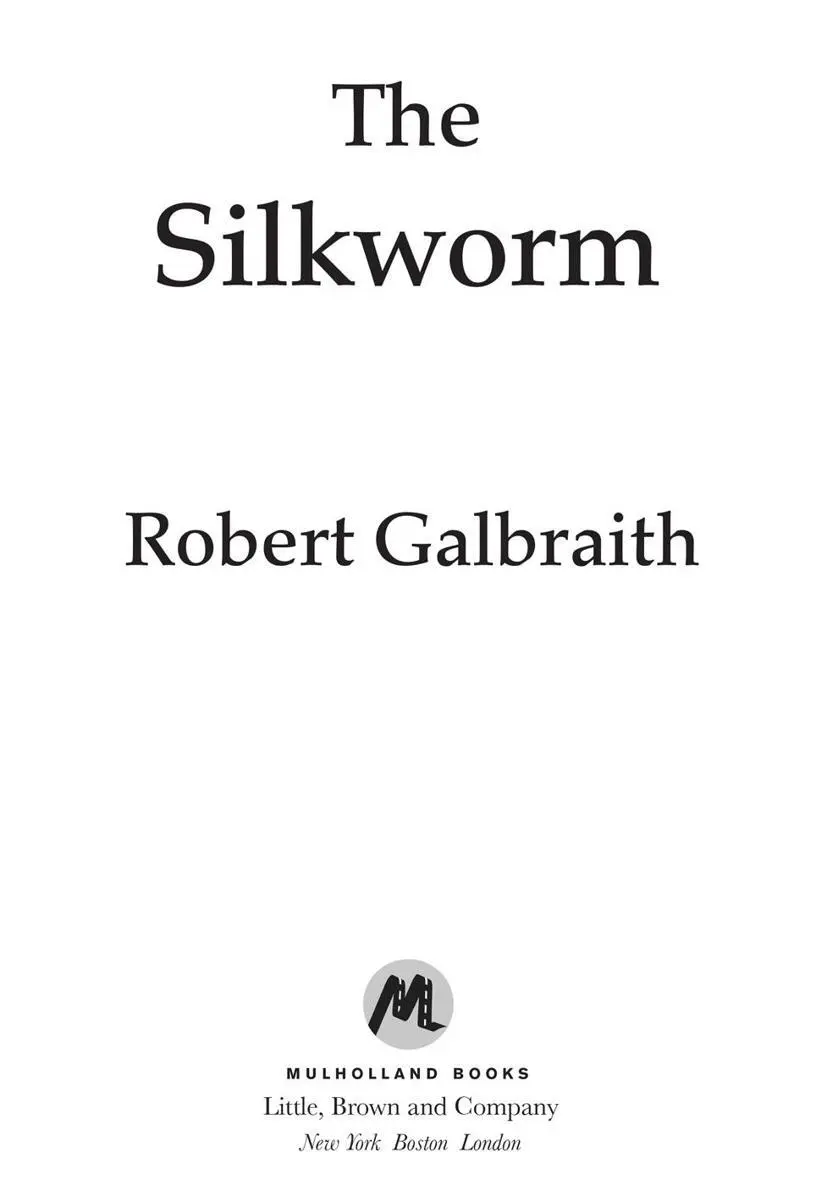
- Название:The Silkworm
- Автор:
- Издательство:Mulholland Books
- Жанр:
- Год:2014
- ISBN:9780316206877
- Рейтинг книги:3 / 5. Голосов: 2
-
Избранное:Добавить в избранное
- Отзывы:
-
Ваша оценка:
The Silkworm: краткое содержание, описание и аннотация
Предлагаем к чтению аннотацию, описание, краткое содержание или предисловие (зависит от того, что написал сам автор книги «The Silkworm»). Если вы не нашли необходимую информацию о книге — напишите в комментариях, мы постараемся отыскать её.
The Silkworm — читать онлайн бесплатно полную книгу (весь текст) целиком
Ниже представлен текст книги, разбитый по страницам. Система сохранения места последней прочитанной страницы, позволяет с удобством читать онлайн бесплатно книгу «The Silkworm», без необходимости каждый раз заново искать на чём Вы остановились. Поставьте закладку, и сможете в любой момент перейти на страницу, на которой закончили чтение.
Интервал:
Закладка:
“I’m not explaining any more of the wretched book!”
“Do you know if Quine knew a woman called Pippa?”
“I never met a Pippa. But he taught creative writing courses; middle-aged women trying to find their raison d’être . That’s where he picked up Kathryn Kent.”
She sipped her coffee and glanced at her watch.
“What can you tell me about Joe North?” Strike asked.
She glanced at him suspiciously.
“Why?”
“Curious,” said Strike.
He did not know why she chose to answer; perhaps because North was long dead, or because of that streak of sentimentality he had first divined back in her cluttered office.
“He was from California,” she said. “He’d come over to London to find his English roots. He was gay, a few years younger than Michael, Owen and me, and writing a very frank first novel about the life he’d led in San Francisco.
“Michael introduced him to me. Michael thought his stuff was first class, and it was, but he wasn’t a fast writer. He was partying hard, and also, which none of us knew for a couple of years, he was HIV-positive and not looking after himself. There came a point when he developed full-blown AIDS.” Elizabeth cleared her throat. “Well, you’ll remember how much hysteria there was about HIV when it first emerged.”
Strike was inured to people thinking that he was at least ten years older than he was. In fact, he had heard from his mother (never one to guard her tongue in deference to a child’s sensibilities) about the killer disease that was stalking those who fucked freely and shared needles.
“Joe fell apart physically and all the people who’d wanted to know him when he was promising, clever and beautiful melted away, except—to do them credit—” said Elizabeth grudgingly, “Michael and Owen. They rallied round Joe, but he died with his novel unfinished.
“Michael was ill and couldn’t go to Joe’s funeral, but Owen was a pallbearer. In gratitude for the way they’d looked after him, Joe left the pair of them that rather lovely house, where they’d once partied and sat up all night discussing books. I was there for a few of those evenings. They were…happy times,” said Elizabeth.
“How much did they use the house after North died?”
“I can’t answer for Michael, but I’d doubt he’s been there since he fell out with Owen, which was not long after Joe’s funeral,” said Elizabeth with a shrug. “Owen never went there because he was terrified of running into Michael. The terms of Joe’s will were peculiar: I think they call it a restrictive covenant. Joe stipulated that the house was to be preserved as an artists’ refuge. That’s how Michael’s managed to block the sale all these years; the Quines have never managed to find another artist, or artists, to sell to. A sculptor rented it for a while, but that didn’t work out. Of course, Michael’s always been as picky as possible about tenants to stop Owen benefiting financially, and he can afford lawyers to enforce his whims.”
“What happened to North’s unfinished book?” asked Strike.
“Oh, Michael abandoned work on his own novel and finished Joe’s posthumously. It’s called Towards the Mark and Harold Weaver published it: it’s a cult classic, never been out of print.”
She checked her watch again.
“I need to go,” she said. “I’ve got a meeting at two thirty. My coat, please,” she called to a passing waiter.
“Somebody told me,” said Strike, who remembered perfectly well that it had been Anstis, “that you supervised work on Talgarth Road a while back?”
“Yes,” she said indifferently, “just one more of the unusual jobs Quine’s agent ended up doing for him. It was a matter of coordinating repairs, putting in workmen. I sent Michael a bill for half and he paid up through his lawyers.”
“You had a key?”
“Which I passed to the foreman,” she said coldly, “then returned to the Quines.”
“You didn’t go and see the work yourself?”
“Of course I did; I needed to check it had been done. I think I visited twice.”
“Was hydrochloric acid used in any of the renovation, do you know?”
“The police asked me about hydrochloric acid,” she said. “Why?”
“I can’t say.”
She glowered. He doubted that people often refused Elizabeth Tassel information.
“Well, I can only tell you what I told the police: it was probably left there by Todd Harkness.”
“Who?”
“The sculptor I told you about who rented the studio space. Owen found him and Fancourt’s lawyers couldn’t find a reason to object. What nobody realized was that Harkness worked mainly in rusted metal and used some very corrosive chemicals. He did a lot of damage in the studio before being asked to leave. Fancourt’s side did that cleanup operation and sent us the bill.”
The waiter had brought her coat, to which a few dog hairs clung. Strike could hear a faint whistle from her laboring chest as she stood up. With a peremptory shake of the hand, Elizabeth Tassel left.
Strike took another taxi back to the office with the vague intention of being conciliatory to Robin; somehow they had rubbed each other up the wrong way that morning and he was not quite sure how it had happened. However, by the time he had finally reached the outer office he was sweating with the pain in his knee and Robin’s first words drove all thought of propitiation from his mind.
“The car hire company just called. They haven’t got an automatic, but they can give you—”
“It’s got to be an automatic!” snapped Strike, dropping onto the sofa in an eruption of leathery flatulence that irritated him still further. “I can’t bloody drive a manual in this state! Have you rung—?”
“Of course I’ve tried other places,” said Robin coldly. “I’ve tried everywhere. Nobody can give you an automatic tomorrow. The weather forecast’s atrocious, anyway. I think you’d do better to—”
“I’m going to interview Chard,” said Strike.
Pain and fear were making him angry: fear that he would have to give up the prosthesis and resort to crutches again, his trouser leg pinned up, staring eyes, pity. He hated hard plastic chairs in disinfected corridors; hated his voluminous notes being unearthed and pored over, murmurs about changes to his prosthesis, advice from calm medical men to rest, to mollycoddle his leg as though it were a sick child he had to carry everywhere with him. In his dreams he was not one-legged; in his dreams he was whole.
Chard’s invitation had been an unlooked-for gift; he intended to seize it. There were many things he wanted to ask Quine’s publisher. The invitation itself was glaringly strange. He wanted to hear Chard’s reason for dragging him to Devon.
“Did you hear me?” asked Robin.
“What?”
“I said, ‘I could drive you.’”
“No, you can’t,” said Strike ungraciously.
“Why not?”
“You’ve got to be in Yorkshire.”
“I’ve got to be at King’s Cross tomorrow night at eleven.”
“The snow’s going to be terrible.”
“We’ll set out early. Or,” said Robin with a shrug, “you can cancel Chard. But the forecast for next week’s awful too.”
It was difficult to reverse from ingratitude to the opposite with Robin’s steely gray-blue eyes upon him.
“All right,” he said stiffly. “Thanks.”
“Then I need to go and pick up the car,” said Robin.
“Right,” said Strike through gritted teeth.
Owen Quine had not thought women had any place in literature: he, Strike, had a secret prejudice, too—but what choice did he have, with his knee screaming for mercy and no automatic car for hire?
28
Интервал:
Закладка:
Похожие книги на «The Silkworm»
Представляем Вашему вниманию похожие книги на «The Silkworm» списком для выбора. Мы отобрали схожую по названию и смыслу литературу в надежде предоставить читателям больше вариантов отыскать новые, интересные, ещё непрочитанные произведения.





Обсуждение, отзывы о книге «The Silkworm» и просто собственные мнения читателей. Оставьте ваши комментарии, напишите, что Вы думаете о произведении, его смысле или главных героях. Укажите что конкретно понравилось, а что нет, и почему Вы так считаете.