Robert Galbraith - The Silkworm
Здесь есть возможность читать онлайн «Robert Galbraith - The Silkworm» весь текст электронной книги совершенно бесплатно (целиком полную версию без сокращений). В некоторых случаях можно слушать аудио, скачать через торрент в формате fb2 и присутствует краткое содержание. Год выпуска: 2014, ISBN: 2014, Издательство: Mulholland Books, Жанр: Старинная литература, на английском языке. Описание произведения, (предисловие) а так же отзывы посетителей доступны на портале библиотеки ЛибКат.
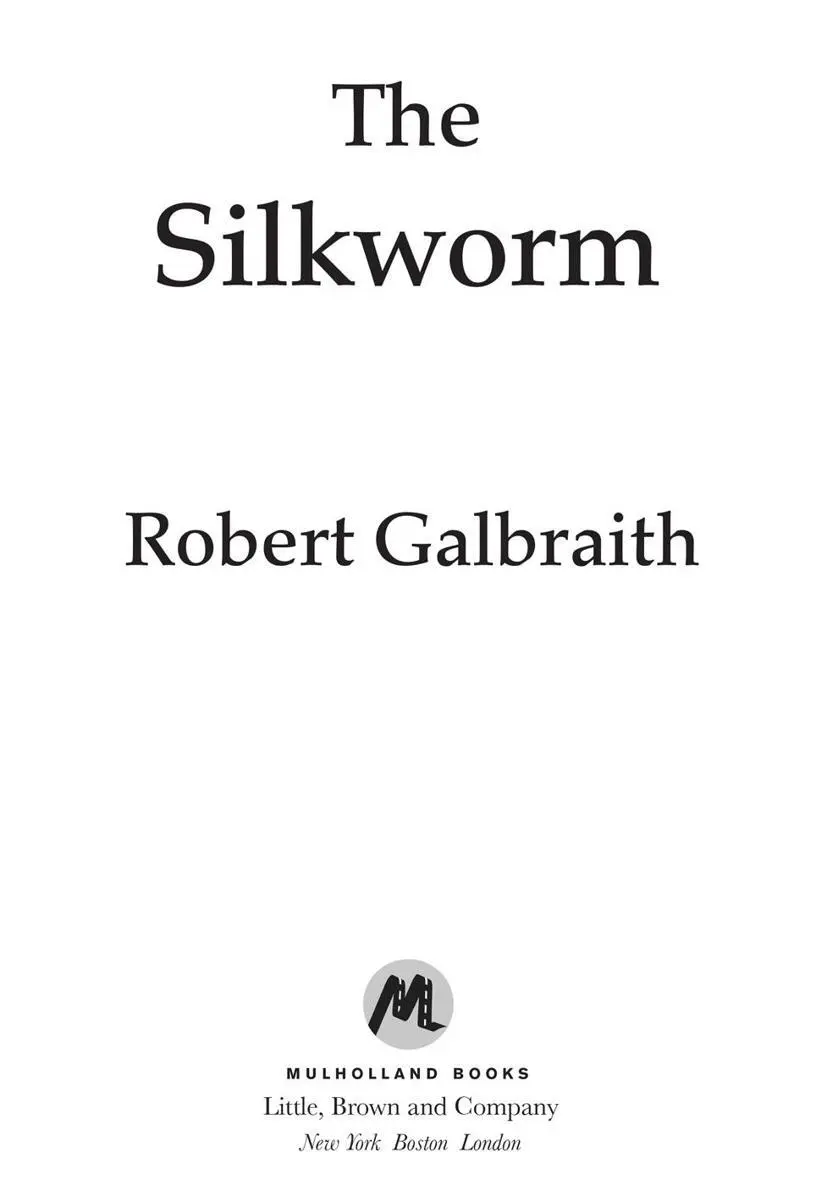
- Название:The Silkworm
- Автор:
- Издательство:Mulholland Books
- Жанр:
- Год:2014
- ISBN:9780316206877
- Рейтинг книги:3 / 5. Голосов: 2
-
Избранное:Добавить в избранное
- Отзывы:
-
Ваша оценка:
The Silkworm: краткое содержание, описание и аннотация
Предлагаем к чтению аннотацию, описание, краткое содержание или предисловие (зависит от того, что написал сам автор книги «The Silkworm»). Если вы не нашли необходимую информацию о книге — напишите в комментариях, мы постараемся отыскать её.
The Silkworm — читать онлайн бесплатно полную книгу (весь текст) целиком
Ниже представлен текст книги, разбитый по страницам. Система сохранения места последней прочитанной страницы, позволяет с удобством читать онлайн бесплатно книгу «The Silkworm», без необходимости каждый раз заново искать на чём Вы остановились. Поставьте закладку, и сможете в любой момент перейти на страницу, на которой закончили чтение.
Интервал:
Закладка:
“If you want to do this, we need a taxi,” Robin said firmly. “It’s a long walk up Lillie Road from here. Haven’t—”
She hesitated. They never mentioned Strike’s disability except obliquely.
“Haven’t you got a stick or something?”
“Wish I had,” he said through numb lips. What was the point in pretending? He was dreading having to walk even to the end of the bridge.
“We can get one,” said Robin. “Chemists sometimes sell them. We’ll find one.”
And then, after another momentary hesitation, she said:
“Lean on me.”
“I’m too heavy.”
“To balance. Use me like a stick. Do it,” she said firmly.
He put his arm around her shoulders and they made their way slowly over the bridge and paused beside the exit. The snow had temporarily passed, but the cold was, if anything, worse than it had been.
“Why aren’t there seats anywhere?” asked Robin, glaring around.
“Welcome to my world,” said Strike, who had withdrawn his arm from around her shoulders the instant they had stopped.
“What d’you think’s happened?” Robin asked, looking down at his right leg.
“I dunno. It was all puffed up this morning. I probably shouldn’t have put the prosthesis on, but I hate using crutches.”
“Well, you can’t go traipsing up Lillie Road in the snow like this. We’ll get a cab and you can go back to the office—”
“No. I want to do something,” he said angrily. “Anstis is convinced it’s Leonora. It isn’t.”
Everything was pared down to the essential when you were in this degree of pain.
“All right,” said Robin. “We’ll split up and you can go in a cab. OK? OK? ” she said insistently.
“All right,” he said, defeated. “You go up to Clem Attlee Court.”
“What am I looking for?”
“Cameras. Hiding places for clothing and intestines. Kent can’t have kept them in her flat if she took them; they’d stink. Take pictures on your phone—anything that seems useful…”
It seemed pathetically little to him as he said it, but he had to do something. For some reason, he kept remembering Orlando, with her wide, vacant smile and her cuddly orangutan.
“And then?” asked Robin.
“Sussex Street,” said Strike after a few seconds’ thought. “Same thing. And then give me a ring and we’ll meet up. You’d better give me the numbers of Tassel’s and Waldegrave’s houses.”
She gave him a piece of paper.
“I’ll get you a taxi.”
Before he could thank her she had marched away onto the cold street.
26
I must look to my footing:
In such slippery ice-pavements men had need
To be frost-nail’d well, they may break their necks
else…
John Webster, The Duchess of Malfi
It was fortunate that Strike still had the five hundred pounds in cash in his wallet that had been given him to cut up a teenage boy. He told the taxi driver to take him to Fulham Palace Road, home of Elizabeth Tassel, took note of the route as he traveled and would have arrived at her house in a mere four minutes had he not spotted a Boots. He asked the driver to pull up and wait, and reemerged from the chemists shortly afterwards, walking much more easily with the aid of an adjustable stick.
He estimated that a fit woman might make the journey on foot in less than half an hour. Elizabeth Tassel lived further from the murder scene than Kathryn Kent but Strike, who knew the area reasonably well, was sure that she could have made her way through most residential backstreets while avoiding the attention of cameras, and that she might have avoided detection even with a car.
Her home looked drab and dingy on this bleak winter’s day. Another redbrick Victorian house, but with none of the grandeur or whimsy of Talgarth Road, it stood on a corner, fronted by a dank garden overshadowed by overgrown laburnum bushes. Sleet fell again as Strike stood peering over the garden gate, trying to keep his cigarette alight by cupping it in his hand. There were gardens front and back, both well shielded from the public view by the dark bushes quivering with the weight of the icy downpour. The upper windows of the house looked out over the Fulham Palace Road Cemetery, a depressing view one month from midwinter, with bare trees reaching bony arms silhouetted into a white sky, old tombstones marching into the distance.
Could he imagine Elizabeth Tassel in her smart black suit, with her scarlet lipstick and her undisguised fury at Owen Quine, returning here under cover of darkness, stained with blood and acid, carrying a bag full of intestines?
The cold was nipping viciously at Strike’s neck and fingers. He ground out the stub of his cigarette and asked the taxi driver, who had watched with curiosity tinged with suspicion as he scrutinized Elizabeth Tassel’s house, to take him to Hazlitt Road in Kensington. Slumped in the backseat he gulped down painkillers with a bottle of water that he had bought in Boots.
The cab was stuffy and smelled of stale tobacco, ingrained dirt and ancient leather. The windscreen wipers swished like muffled metronomes, rhythmically clearing the blurry view of broad, busy Hammersmith Road, where small office blocks and short rows of terraced houses sat side by side. Strike looked out at Nazareth House Care Home: more red brick, church-like and serene, but with security gates and a lodge keeping a firm separation between those cared for and those who were not.
Blythe House came into view through the misty windows, a grand palace-like structure with white cupolas, looking like a large pinkish cake in the gray sleet. Strike had a vague notion that it was used as a store for one of the big museums these days. The taxi turned right into Hazlitt Road.
“What number?” asked the driver.
“I’ll get out here,” said Strike, who did not wish to descend directly in front of the house, and had not forgotten that he still had to pay back the money he was squandering. Leaning heavily on the stick and grateful for its rubber-coated end, which gripped the slippery pavement well, he paid the driver and walked along the street to take a closer look at the Waldegrave residence.
These were real town houses, four stories high including the basements, golden brick with classical white pediments, carved wreaths beneath the upper windows and wrought-iron balustrades. Most of them had been converted into flats. There were no front gardens, only steps descending to the basements.
A faintly ramshackle flavor had permeated the street, a gentle middle-class dottiness that expressed itself in the random collections of potted plants on one balcony, a bicycle on another and, on a third, limp, wet and possibly soon-to-be-frozen washing forgotten in the sleet.
The house that Waldegrave shared with his wife was one of the very few that had not been converted into flats. As he stared up at it, Strike wondered how much a top editor earned and remembered Nina’s statement that Waldegrave’s wife “came from money.” The Waldegraves’ first-floor balcony (he had to cross the street to see it clearly) sported two sodden deck chairs printed with the covers of old Penguin paperbacks, flanking a tiny iron table of the kind found in Parisian bistros.
He lit another cigarette and recrossed the road to peer down at the basement flat where Waldegrave’s daughter lived, considering as he did so whether Quine might have discussed the contents of Bombyx Mori with his editor before delivering the manuscript. Could he have confided to Waldegrave how he envisaged the final scene of Bombyx Mori ? And could that amiable man in horn-rimmed glasses have nodded enthusiastically and helped hone the scene in all its ludicrous gore, knowing that he would one day enact it?
Читать дальшеИнтервал:
Закладка:
Похожие книги на «The Silkworm»
Представляем Вашему вниманию похожие книги на «The Silkworm» списком для выбора. Мы отобрали схожую по названию и смыслу литературу в надежде предоставить читателям больше вариантов отыскать новые, интересные, ещё непрочитанные произведения.







Обсуждение, отзывы о книге «The Silkworm» и просто собственные мнения читателей. Оставьте ваши комментарии, напишите, что Вы думаете о произведении, его смысле или главных героях. Укажите что конкретно понравилось, а что нет, и почему Вы так считаете.