Upton Sinclair - Love's pilgrimage
Здесь есть возможность читать онлайн «Upton Sinclair - Love's pilgrimage» весь текст электронной книги совершенно бесплатно (целиком полную версию без сокращений). В некоторых случаях можно слушать аудио, скачать через торрент в формате fb2 и присутствует краткое содержание. Год выпуска: 1911, Издательство: New York : M. Kennerley, Жанр: Старинная литература, на английском языке. Описание произведения, (предисловие) а так же отзывы посетителей доступны на портале библиотеки ЛибКат.
- Название:Love's pilgrimage
- Автор:
- Издательство:New York : M. Kennerley
- Жанр:
- Год:1911
- ISBN:нет данных
- Рейтинг книги:4 / 5. Голосов: 1
-
Избранное:Добавить в избранное
- Отзывы:
-
Ваша оценка:
Love's pilgrimage: краткое содержание, описание и аннотация
Предлагаем к чтению аннотацию, описание, краткое содержание или предисловие (зависит от того, что написал сам автор книги «Love's pilgrimage»). Если вы не нашли необходимую информацию о книге — напишите в комментариях, мы постараемся отыскать её.
Love's pilgrimage — читать онлайн бесплатно полную книгу (весь текст) целиком
Ниже представлен текст книги, разбитый по страницам. Система сохранения места последней прочитанной страницы, позволяет с удобством читать онлайн бесплатно книгу «Love's pilgrimage», без необходимости каждый раз заново искать на чём Вы остановились. Поставьте закладку, и сможете в любой момент перейти на страницу, на которой закончили чтение.
Интервал:
Закладка:
loaded up some more buckshot "shells", and before dawn of the next day was out upon the hunt. The snow was gone now; and with soft shoes on his feet he wandered all day through the wilderness—and was rewarded by two chances to shoot at the white tails of flying deer.
And then came night, and he rigged up a "jack", a forbidden apparatus made of a soap-box and a lantern and a tin-plate for a reflector. He had an ingenious arrangement of straps and cords, whereby he could fasten this upon his head; and he had found an old lumber-trail where the deer came to feed upon the soft grass. Down this he crept like a thief in the night, with the light gleaming ahead, and the deer tramping in the thickets and whistling their alarms. Now and then one would stand and stare, his eye-balls gleaming like coals of fire; and at last came the roar of the gun, and the jacklight tumbled to the ground. When Thyr-sis lighted up again and went to examine, there were spots of blood upon the leaves—but no deer.
So the next day he was up again at dawn, watching by one of the runways to the lake. And then came another tramp, through the thickets and over the mountains—and more shots at the "flags" of the elusive enemy. Thyrsis' back ached, and his feet were as if weighted with lead, but still he plodded on and on—it was his life against a deer's.
If only he had had a boat, so that he could have set up his "jack" in that! But he had no boat—and so he wrapped himself in blankets and sat to watch another runway at sunset; and when no deer came he decided to stay on until the moon rose. It was a bitterly cold night, and his hands almost froze to the gun-barrel
when he touched it. And the moon rose, and forthwith went behind a cloud—and then came a deer!
There was hardly a trace of motion in the air, but somehow the creature half-scented Thyrsis; and so it stood and trumpeted to the night. Oh, the wildness of that sound—and the thumping of the heart of the hunter, and the breathless suspense, and the burning desire. The deer would take a step, and a twig would crack; and then it would stand still again, and Thyrsis would listen, crouching like a statue, clutching his weapon and striving to penetrate the darkness. And then the deer would take two or three more steps, and stand again; and then, in sudden alarm, bound away; and then come back again, step by step—fascinated by this mysterious thing there in the darkness. For three mortal hours that creature pranced and cavorted about Thyrsis, while he waited with chattering teeth; then in the end it took a sudden fright, and went bounding away through the thicket.
So came another day's hunting; and at sundown another watch by a runway; and another deer, that approached from the wrong direction, and came upon a man, worn out by three days and nights of effort, lying sound asleep at his post!
But there could be only one ending to this adventure. Thyrsis was out for a deer, and he would never quit until he got one. All his planning and wandering had availed him nothing; but now, the next morning, as he stepped out from his camp with a bucket in his hand—behold, at the edge of a thicket, a deer! Thyrsis stood rooted to the spot, staring blankly; and the deer stood staring at him.
It was a time of agony. Should he try to creep back to his gun, or should he make a sudden dash? He started
to try the latter, and had a pang of despair as the deer whirled and bolted away. He leaped to the camp and grabbed his gun and sprang out into sight again— and there, off to the right, was another deer. It was a huge buck, with wide-spreading antlers, rising out of the bushes where it stood. It saw Thyrsis, and started away; and in a flash he raised his gun and fired. He saw the deer stumble, and he fired the other barrel; and then he started in wild pursuit.
He had been warned to beware of a wounded deer; but he forgot that—he forgot also that he had no more shells upon him. He ran madly through the forest, springing over fallen logs, plunging through thickets —he would have seized hold of the animal with his bare hands, if only he could have caught up with it.
The deer was badly hurt. It would leap ahead, and then stumble, half falling, and then leap again. Even in this way, the distance it covered was amazing; Thyrsis was appalled at the power of the creature, its tremendous bounds, the shock of its fall, and the crashing of the underbrush before it. It seemed like a huge boulder, leaping down a precipice; and Thyrsis stood at a safe distance and watched it. According to the poetry-books he should have been ashamed—perhaps moved to tears by the reproachful look in the great creature's eyes. But assuredly the makers of the poetry-books had never needed the price of a railroad-ticket as badly as Thyrsis did!
He only realized that night how desperate his need had been. He lay in his berth on board a train for the city—while back at his "open-camp" a wild blizzard was raging, and the thermometer stood at forty degrees below zero. But Thyrsis was warm and comfortable; and also he was brown and rugged, once more full
of health and eagerness for life. All night he listened to the pounding of the flying train; and fast as the music of it went, it was not fast enough for his imagination. It seemed as if the rails were speaking— saying to him, over and over and over again, "Ethelynda Lewis ! Ethelynda Lewis ! Ethelynda Lewis!"
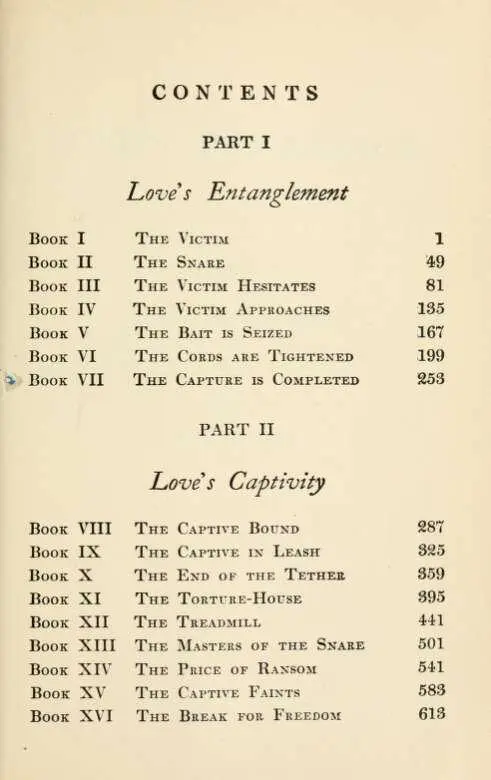
BOOK X THE END OF THE TETHER
They sat still watching upon the hill-top, drinking in the scent of the clover.
"Ah, if only we might have come back here!" she sighed. "If only we had never had to leave!"
"That way lies unhappiness" he said.
"Perhaps" she answered; and then quotec
'Yet, Thyrsis, let me give my grief its hour
In the old haunt, and find our tree-topped hill! Who, if not I, for questing here hath power?"
"I wonder," said he, "if the poet put as much mto these stanzas as we find in them!"
§ 1. THROUGH the summer Cory don had been living week by week upon the hope that her husband would be able to send for her; all through the fall she had been dreaming of the arrangements they would make for the winter. But by now it had become clear that they would have to be separated for a part of the winter as well. She had sent him long letters, full of hopes and yearnings, anxieties and rebellions; but in the end she had brought herself to face the inevitable. And then it transpired that even a greater sacrifice was required of her—she was to be forbidden to see Thyrsis at all! If a man did not support his wife, said the world, it was common-sense that he should not have any wife; that was the quickest way to bring him to his senses. And so the two had threshed out that problem, and chosen their course; they would live in the same city, and yet confine themselves to writing letters!
A curious feeling it gave Thyrsis, to know that she was so near to him, and yet not to be going to meet her! He could not endure any part of the city where he had been with her, and got himself a hall bedroom on the edge of a tenement-district far up town. Then he had his shoes shined, and purchased a clean collar, and wrote Miss Ethelynda Lewis that he was ready to call. While he was waiting to hear from her, there came to him a strange adventure; assuredly one of the strangest that ever befell a struggling poet, in a world where many strange adventures have befallen struggling poets.
For six months Thyrsis had not seen his baby; and
there had come in the meantime so many letters, telling so many miraculous things about that baby! So many dreams he had dreamed about it, so many hopes and so many prayers were centered in it! Twenty-two hours had he sat by the bedside when it was born; and through all the trials that had come afterwards, how he had suffered and wept for it! Now his heart was wrung with longing to see it, to touch it—his child. He wrote Corydon that he could not stand it; and Corydon wrote back that he was right—he should surely see the baby. And so it was arranged between them that Thyrsis was to be at a certain place in the park, and she would send the nurse-girl there with little Cedric.
Читать дальшеИнтервал:
Закладка:
Похожие книги на «Love's pilgrimage»
Представляем Вашему вниманию похожие книги на «Love's pilgrimage» списком для выбора. Мы отобрали схожую по названию и смыслу литературу в надежде предоставить читателям больше вариантов отыскать новые, интересные, ещё непрочитанные произведения.












Обсуждение, отзывы о книге «Love's pilgrimage» и просто собственные мнения читателей. Оставьте ваши комментарии, напишите, что Вы думаете о произведении, его смысле или главных героях. Укажите что конкретно понравилось, а что нет, и почему Вы так считаете.