Алан Милн - Once a Week
Здесь есть возможность читать онлайн «Алан Милн - Once a Week» весь текст электронной книги совершенно бесплатно (целиком полную версию без сокращений). В некоторых случаях можно слушать аудио, скачать через торрент в формате fb2 и присутствует краткое содержание. Год выпуска: 2014, Издательство: epubBooks Classics, Жанр: Юмористическая проза, на английском языке. Описание произведения, (предисловие) а так же отзывы посетителей доступны на портале библиотеки ЛибКат.
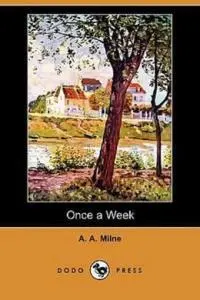
- Название:Once a Week
- Автор:
- Издательство:epubBooks Classics
- Жанр:
- Год:2014
- ISBN:нет данных
- Рейтинг книги:5 / 5. Голосов: 1
-
Избранное:Добавить в избранное
- Отзывы:
-
Ваша оценка:
Once a Week: краткое содержание, описание и аннотация
Предлагаем к чтению аннотацию, описание, краткое содержание или предисловие (зависит от того, что написал сам автор книги «Once a Week»). Если вы не нашли необходимую информацию о книге — напишите в комментариях, мы постараемся отыскать её.
Once a Week — читать онлайн бесплатно полную книгу (весь текст) целиком
Ниже представлен текст книги, разбитый по страницам. Система сохранения места последней прочитанной страницы, позволяет с удобством читать онлайн бесплатно книгу «Once a Week», без необходимости каждый раз заново искать на чём Вы остановились. Поставьте закладку, и сможете в любой момент перейти на страницу, на которой закончили чтение.
Интервал:
Закладка:
"And after that the parrot goes on repeating it over and over again until you've got sick of it," said Reggie.
"Then we shall have to be very careful what word we choose," said Mrs. Atherley.
"What is your favourite word?"
"Well, really―"
"Animal, vegetable, or mineral?" asked Archie.
"This is quite impossible. Every word by itself seems so silly."
"Not 'home' and 'mother,'" I said reproachfully.
"You shall recite your little piece in the drawing–room afterwards," said Miss Atherley to me. "Think of something sensible now."
"Yes," said Mrs. Atherley. "What's the latest word from London?"
"Kikuyu."
"What?"
"I can't say it again," I protested.
"If you can't even say it twice, it's no good for Evangeline."
A thoughtful silence fell upon us.
"Have you fixed on a name for her yet?" Miss Atherley asked her mother.
"Evangeline, of course."
"No, I mean a name for her to call you . Because if she's going to call you 'Auntie' or 'Darling,' or whatever you decide on, you'd better start by teaching her that."
And then I had a brilliant idea.
"I've got the very word," I said. "It's 'hallo.' You see, it's a pleasant form of greeting to any stranger, and it will go perfectly with the next word that she's taught, whatever it may be."
"Supposing it's 'wardrobe,'" suggested Reggie, "or 'sardine'?"
"Why not? 'Hallo, Sardine' is the perfect title for a revue . Witty, subtle, neat—probably the great brain of the Revue King has already evolved it, and is planning the opening scene."
"Yes, 'hallo' isn't at all bad," said Mr. Atherley. "Anyway, it's better than 'Poor Polly,' which is simply morbid. Let's fix on 'hallo.'"
"Good," said Mrs. Atherley.
Evangeline said nothing, being asleep under her blanket.
I was down first next morning, having forgotten to wind up my watch overnight. Longing for company, I took the blanket off Evangeline's cage and introduced her to the world again. She stirred sleepily, opened her eyes and blinked at me.
"Hallo, Evangeline," I said.
She made no reply.
Suddenly a splendid scheme occurred to me. I would teach Evangeline her word now. How it would surprise the others when they came down and said "Hallo" to her, to find themselves promptly answered back!
"Evangeline," I said, "listen. Hallo, hallo, hallo, hallo." I stopped a moment and went on more slowly. "Hallo—hallo—hallo."
It was dull work.
"Hallo," I said, "hallo—hallo—hallo," and then very distinctly, "Hal– lo ."
Evangeline looked at me with an utterly bored face.
"Hallo," I said, "hallo—hallo."
She picked up a monkey–nut and ate it languidly.
"Hallo," I went on, "hallo, hallo … hallo, hallo , HALLO, HALLO … hallo, hallo―"
She dropped her nut and roused herself for a moment.
"Number engaged," she snapped, and took another nut.
You needn't believe this. The others didn't when I told them.
The Spreading Walnut Tree
We were having breakfast in the garden with the wasps, and Peter was enlarging on the beauties of the country round his new week–end cottage.
"Then there's Hilderton," he said; "that's a lovely little village, I'm told. We might explore it to–morrow."
Celia woke up suddenly.
"Is Hilderton near here?" she asked in surprise. "But I often stayed there when I was a child."
"This was years ago, when Edward the Seventh was on the throne," I explained to Mrs. Peter.
"My grandfather," went on Celia, "lived at Hilderton Hall."
There was an impressive silence.
"You see the sort of people you're entertaining," I said airily to Peter. "My wife's grandfather lived at Hilderton Hall. Celia, you should have spoken about this before. It would have done us a lot of good in Society." I pushed my plate away. "I can't go on eating bacon after this. Bring me peaches."
"I should love to see it again."
"If I'd had my rights," I said, "I should be living there now. I must put my solicitor on to this. There's been foul play somewhere."
Peter looked up from one of the maps which, being new to the country, he carries with him.
"I can't find Hilderton Hall here," he said. "It's six inches to the mile, so it ought to be marked."
"Celia, our grandfather's name is being aspersed. Let us look into this."
We crowded round the map and studied it anxiously. Hilderton was there, and Hilderton House, but no Hilderton Hall.
"But it's a great big place," protested Celia.
"I see what it is," I said regretfully. "Celia, you were young then."
"Ten."
"Ten. And naturally it seemed big to you, just as Yarrow seemed big to Wordsworth, and a shilling seems a lot to a baby. But really―"
"Really," said Peter, "it was semi–detached."
"And your side was called Hilderton Hall and the other side Hilderton Castle."
"I don't believe it was even called Hilderton Hall," said Peter. "It was Hilderton Villa."
"I don't believe she ever had a grandfather at all," said Mrs. Peter.
"She must have had a grandfather," I pointed out. "But I'm afraid he never lived at Hilderton Hall. This is a great blow to me, and I shall now resume my bacon."
I drew my plate back and Peter returned his map to his pocket.
"You're all very funny," said Celia, "but I know it was Hilderton Hall. I've a good mind to take you there this morning and show it to you."
"Do," said Peter and I eagerly.
"It's a great big place―"
"That's what we're coming to see," I reminded her.
"Of course they may have sold some of the land, or—I mean, I know when I used to stay there it was a—a great big place. I can't promise that it―"
"It's no good now, Celia," I said sternly. "You shouldn't have boasted."
Hilderton was four miles off, and we began to approach it—Celia palpably nervous—at about twelve o'clock that morning.
"Are you recognizing any of this?" asked Peter.
"N–no. You see I was only about eight―"
"You must recognise the church," I said, pointing to it. "If you don't, it proves either that you never lived at Hilderton or that you never sang in the choir. I don't know which thought is the more distressing. Now what about this place? Is this it?"
Celia peered up the drive.
"N–no; at least I don't remember it. I know there was a walnut tree in front of the house."
"Is that all you remember?"
"Well, I was only about six―"
Peter and I both had a slight cough at the same time.
"It's nothing," said Peter, finding Celia's indignant eye upon him. "Let's go on."
We found two more big houses, but Celia, a little doubtfully, rejected them both.
"My grandfather–in–law was very hard to please," I apologized to Peter. "He passed over place after place before he finally fixed on Hilderton Hall. Either the heronry wasn't ventilated properly, or the decoy ponds had the wrong kind of mud, or―"
There was a sudden cry from Celia.
"This is it," she said.
She stood at the entrance to a long drive. A few chimneys could be seen in the distance. On either side of the gates was a high wall.
"I don't see the walnut tree," I said.
"Of course not, because you can't see the front of the house. But I feel certain that this is the place."
"We want more proof than that," said Peter. "We must go in and find the walnut tree."
"We can't all wander into another man's grounds looking for walnut trees," I said, "with no better excuse than that Celia's great–grandmother was once asked down here for the week–end and stayed for a fortnight. We―"
"My grandfather ," said Celia coldly, " lived here."
Читать дальшеИнтервал:
Закладка:
Похожие книги на «Once a Week»
Представляем Вашему вниманию похожие книги на «Once a Week» списком для выбора. Мы отобрали схожую по названию и смыслу литературу в надежде предоставить читателям больше вариантов отыскать новые, интересные, ещё непрочитанные произведения.

Обсуждение, отзывы о книге «Once a Week» и просто собственные мнения читателей. Оставьте ваши комментарии, напишите, что Вы думаете о произведении, его смысле или главных героях. Укажите что конкретно понравилось, а что нет, и почему Вы так считаете.