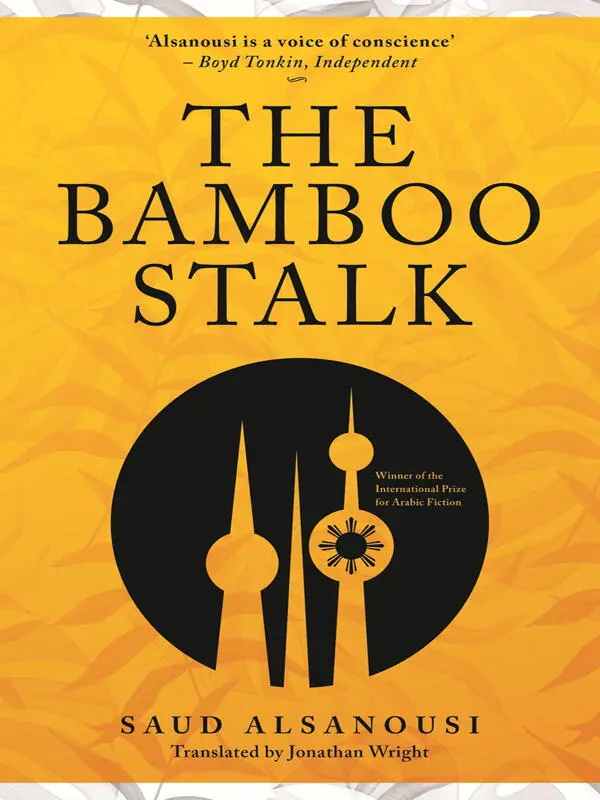
Saud Alsanousi - The Bamboo Stalk
Здесь есть возможность читать онлайн «Saud Alsanousi - The Bamboo Stalk» весь текст электронной книги совершенно бесплатно (целиком полную версию без сокращений). В некоторых случаях можно слушать аудио, скачать через торрент в формате fb2 и присутствует краткое содержание. Год выпуска: 2015, Издательство: Bloomsbury Qatar Foundation Publishing, Жанр: Современная проза, на английском языке. Описание произведения, (предисловие) а так же отзывы посетителей доступны на портале библиотеки ЛибКат.
- Название:The Bamboo Stalk
- Автор:
- Издательство:Bloomsbury Qatar Foundation Publishing
- Жанр:
- Год:2015
- ISBN:нет данных
- Рейтинг книги:5 / 5. Голосов: 1
-
Избранное:Добавить в избранное
- Отзывы:
-
Ваша оценка:
The Bamboo Stalk: краткое содержание, описание и аннотация
Предлагаем к чтению аннотацию, описание, краткое содержание или предисловие (зависит от того, что написал сам автор книги «The Bamboo Stalk»). Если вы не нашли необходимую информацию о книге — напишите в комментариях, мы постараемся отыскать её.
takes an unflinching look at the universal struggles of identity, race, and class as they intersect between two disparate societies: Kuwait and the Philippines.
Josephine comes to Kuwait from the Philippines to work as a maid, where she meets Rashid, a spoiled but kind-hearted only son. Josephine, with all the wide-eyed naivety of youth, believes she has found true love. But when she becomes pregnant, and with the rumble of the Gulf War growing ever louder, Rashid abandons her and sends her back home with their baby son José.
Brought up struggling with his dual identity in the Philippines, José clings to the hope of returning to his father's country when he turns eighteen. But will Kuwait be any more welcoming to him? Will his Kuwaiti family live up to his expectations and alleviate his sense of alienation? Jose’s coming of age tale draws in readers as he explores his own questions about identity and estrangement.
Masterfully written,
is the winner of the 2013 International Prize for Arab Fiction, chosen both for its literary qualities and for “its social and humanitarian content.” Through his complex characters, Alsanousi crafts a captivating saga that boldly deals with issues of identity, alienation, and the phenomenon of foreign workers in Arab countries.
The Bamboo Stalk — читать онлайн бесплатно полную книгу (весь текст) целиком
Ниже представлен текст книги, разбитый по страницам. Система сохранения места последней прочитанной страницы, позволяет с удобством читать онлайн бесплатно книгу «The Bamboo Stalk», без необходимости каждый раз заново искать на чём Вы остановились. Поставьте закладку, и сможете в любой момент перейти на страницу, на которой закончили чтение.
Интервал:
Закладка:
In Grandmother’s house, my sister was Khawla, the daughter of Rashid, and nothing she asked for was withheld. She was Grandmother’s precious darling. Grandmother was anxious to protect her from both other people and from the djinn . Ghassan said that every night Grandmother put her hand on Khawla’s forehead and recited verses from the Qur’an. She prayed to God to protect Khawla and keep her safe from envious people. In the morning she gave her holy water to drink — water over which she had recited Qur’anic verses.
Ghassan often talked to me about Khawla. He was fond of her, and she of him. She saw him as a substitute for the father she had never seen. ‘She’s a wonderful girl,’ Ghassan said of her. ‘She’s intelligent. Make friends with her, Isa. She needs a brother as much as you need a sister.’
Khawla had her problems too. She was fatherless, of course, and her mother had abandoned her for her new husband. These things didn’t seem to have had a negative effect on her however. She wasn’t like other girls of her generation. She was almost a copy of her father in the way she spent hours reading his books in his study. She dreamed of finishing off the novel my father had started writing but hadn’t finished when he died. She didn’t have many friends. Ghassan and her aunt Hind were her closest friends.
‘I’m proud of her. She’s like a daughter to me,’ said Ghassan.
What Ghassan said about me being the only person who could ensure the survival of the family name made me feel like a legitimate king who had just come back from a long journey to reclaim his kingdom. But legitimacy alone wasn’t enough to secure recognition. Should I fight for it? Kings lose legitimacy when people reject them and I had been rejected, and I wasn’t even a king.
I didn’t understand what continuing the family name meant. What would happen if the family name didn’t continue? And what did the way I looked have to do with it?
I later found out that Grandmother didn’t know what to do the night after her meeting with Ghassan. I was her grandson — Isa Rashid Isa al-Tarouf, a name that brought honour. But I had a face that brought shame. I was Isa, the son of Rashid who died defending his country, but at the same time I was Isa, the son of the Filipina maid.
7
It was thanks to Khawla, Grandmother’s favourite, that I was accepted into the Tarouf household, albeit under duress. My sister told Grandmother that she insisted I be allowed to visit.
‘It would just be a visit, Grandmother, please,’ she said. ‘And afterwards you can decide.’
Grandmother gave in to Khawla’s entreaties. ‘I don’t know why, but I’ve been pressing Grandmother to let you visit our house,’ Khawla told me at our first meeting. ‘Maybe it was curiosity, or maybe because I was happy to have a new brother suddenly appear in my life.’
Ghassan and I had been in the sitting room in his flat when the phone rang. Ghassan had picked it up, and after a short conversation put it down again. ‘You’re lucky,’ he said. ‘You have a brave sister.’
* * *
Everything happens for a reason, and for a purpose. I like my mother’s faith. Her saying reminds me day after day that chance has no place in our destiny. My father married Iman to pave the way for Khawla, who spoke up for me in the Tarouf household. If it hadn’t been for her I would never have had a chance to come close to that house. But what if Khawla had been born a boy — a boy who had his grandfather’s name, Isa, and the family name that was about to die out, and who could pass it on to his children, who could then reproduce and act as an extension of generations that carried the name many years ago, people who built walls around their ancient city and who were no less proud of having built them than the Chinese were to have built the Great Wall of China?
Thank God for Khawla.
* * *
After sunset on the day after Khawla’s phone call, Ghassan rang the bell at Grandmother’s house, while I stood in fear behind him — in fear of being thrown out, of being humiliated and of not being accepted.
The door opened. ‘Welcome,’ said a female voice. The voice and the accent aroused my curiosity. I stood on tiptoes to look over Ghassan’s shoulder, and there was a young Filipina maid dressed in white from head to toe — the headscarf, the uniform, the apron and the shoes. She looked like a nurse. I squeezed Ghassan’s shoulder with my hand. I was overjoyed to see a face that looked like mine.
‘Filipina?’ I asked her.
Ghassan turned around and gave me a disapproving look. ‘Isa, she’s the maid!’ he said.
‘Luza, Luza, who is it?’ asked a voice from inside, speaking in perfect English.
‘It’s Mr Ghassan,’ said the maid, waving us in. As soon as we were through the door, we were warmly welcomed.
‘ Salamuuu alekooom ,’ someone said.
I looked around to see who was speaking and found a parrot in a beautiful gilt cage fixed to the wall opposite the door. Ghassan laughed. The parrot raised its voice and started repeating the maid’s name: ‘Luza, Luza.’ Then it shouted a word I couldn’t make out. The maid came towards the cage, waved her arms in the air and said, ‘Shhhhh.’ The parrot shut up and Ghassan went on laughing.
‘Come in, come in,’ said Khawla, who was waiting for us. I knew who she was at first sight. She looked older than her sixteen years. She was brown-skinned and taller than me. She had covered her hair with a black hijab . She had a sharp and prominent nose, thin lips and white teeth that were strikingly regular. She was pretty and she looked charming when she smiled. She spoke with Ghassan in Arabic, then turned to me. ‘So you’re Isa,’ she said cheerfully.
I smiled at her and nodded.
‘Come on in, come on in,’ she continued.
We followed her in, and she kept turning to me with a broad smile that showed how pleased she was. She invited us inside and asked us to sit down and wait. Then she went upstairs, looking back at me all the way up. Nice house , I said to myself. But I wondered how people found time to deal with all the details — matching the colours, the furniture, the marble floors, the fine rugs, the decorative touches on the walls, the chandeliers, the plush velvet curtains, the little wooden tables with tablecloths decorated with shiny beads that looked like pearls or precious stones, the vases of various sizes holding bamboo stalks. I loved the place even though I was cowering in my seat for fear of damaging something unintentionally. The Filipino face that met us at the door and the bamboo stalks made me feel more at home, even if the bamboo looked out of place in those expensive vases, rather like me in the Tarouf household.
Another maid came in, older than the first, wearing the same white uniform. She looked Indian. She offered us some fruit juice, then withdrew. Then a woman came down from the first floor, apparently in her late thirties. She looked serious and practical. She had black hair, cut short like a boy’s. She put out her hand to shake Ghassan’s hand, then she shook mine and sat down opposite us with her legs crossed.
‘This is your youngest aunt, Hind,’ said Ghassan as he introduced me to her.
I nodded and said, ‘Pleased to meet you, madam.’
She nodded but didn’t quite smile. She and Ghassan spoke in Arabic, while I watched their expressions and noticed how serious they looked. She raised her eyebrows when she was speaking to Ghassan. She snatched a glance at me, adjusted her glasses with her finger, then went back to chatting with Ghassan. I noticed that he didn’t look at her when they were talking. I was silent, looking from one to the other. I felt like I was watching a film in a language I didn’t understand, with no subtitles. Although Ghassan and my aunt gave nothing away through their facial expressions, I interpreted their conversation the way I wanted it to be. I imagined her saying, ‘We promise him a private room when he comes to live here with us’ or ‘We’re very happy he’s come back to his country and his family.’
Читать дальшеИнтервал:
Закладка:
Похожие книги на «The Bamboo Stalk»
Представляем Вашему вниманию похожие книги на «The Bamboo Stalk» списком для выбора. Мы отобрали схожую по названию и смыслу литературу в надежде предоставить читателям больше вариантов отыскать новые, интересные, ещё непрочитанные произведения.












Обсуждение, отзывы о книге «The Bamboo Stalk» и просто собственные мнения читателей. Оставьте ваши комментарии, напишите, что Вы думаете о произведении, его смысле или главных героях. Укажите что конкретно понравилось, а что нет, и почему Вы так считаете.