Viet Nguyen - The Sympathizer
Здесь есть возможность читать онлайн «Viet Nguyen - The Sympathizer» весь текст электронной книги совершенно бесплатно (целиком полную версию без сокращений). В некоторых случаях можно слушать аудио, скачать через торрент в формате fb2 и присутствует краткое содержание. Год выпуска: 2015, Издательство: Grove/Atlantic, Inc., Жанр: Современная проза, на английском языке. Описание произведения, (предисловие) а так же отзывы посетителей доступны на портале библиотеки ЛибКат.
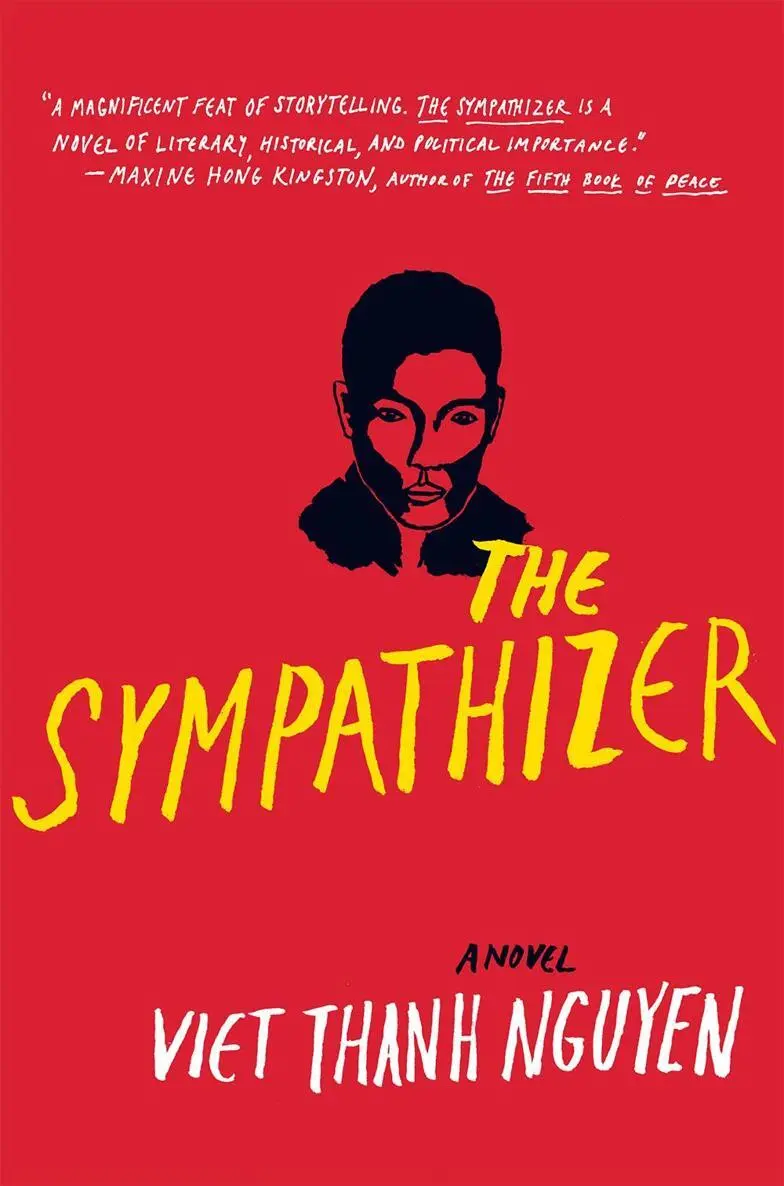
- Название:The Sympathizer
- Автор:
- Издательство:Grove/Atlantic, Inc.
- Жанр:
- Год:2015
- ISBN:нет данных
- Рейтинг книги:4 / 5. Голосов: 2
-
Избранное:Добавить в избранное
- Отзывы:
-
Ваша оценка:
The Sympathizer: краткое содержание, описание и аннотация
Предлагаем к чтению аннотацию, описание, краткое содержание или предисловие (зависит от того, что написал сам автор книги «The Sympathizer»). Если вы не нашли необходимую информацию о книге — напишите в комментариях, мы постараемся отыскать её.
is the story of a man of two minds, someone whose political beliefs clash with his individual loyalties.
It is April 1975, and Saigon is in chaos. At his villa, a general of the South Vietnamese army is drinking whiskey and, with the help of his trusted captain, drawing up a list of those who will be given passage aboard the last flights out of the country. The general and his compatriots start a new life in Los Angeles, unaware that one among their number, the captain, is secretly observing and reporting on the group to a higher-up in the Viet Cong.
is the story of this captain: a man brought up by an absent French father and a poor Vietnamese mother, a man who went to university in America, but returned to Vietnam to fight for the Communist cause. A gripping spy novel, an astute exploration of extreme politics, and a moving love story,
explores a life between two worlds and examines the legacy of the Vietnam War in literature, film, and the wars we fight today.
The Sympathizer — читать онлайн бесплатно полную книгу (весь текст) целиком
Ниже представлен текст книги, разбитый по страницам. Система сохранения места последней прочитанной страницы, позволяет с удобством читать онлайн бесплатно книгу «The Sympathizer», без необходимости каждый раз заново искать на чём Вы остановились. Поставьте закладку, и сможете в любой момент перейти на страницу, на которой закончили чтение.
Интервал:
Закладка:
Or, to put it more accurately, the actors playing the Vietnamese. My notes to the Auteur had actually effected some change in how we were represented, and more than simply how the screams were now all rendered as AIEYAAHHH!!! The most crucial change was the addition of three Vietnamese characters with actual speaking parts, an older brother, a younger sister, and a little brother whose parents had been slaughtered by King Cong. Older brother Binh, nicknamed Benny by the Green Berets, was filled with hatred of King Cong. He loved his American rescuers and served as their translator. Along with the one black Green Beret, he would meet the grisliest of deaths at the hands of King Cong. As for the sister, Mai, she would fall in love with the young, handsome, idealistic Sergeant Jay Bellamy. She would then be kidnapped and raped by King Cong, which served as the justification for the Green Berets utterly annihilating every last trace of King Cong. As for the little boy, he would be crowned with a Yankees cap in the final scene and airlifted into the heavens, his ultimate destination being Jay Bellamy’s family in St. Louis, where he would be given a golden retriever and the nickname Danny Boy.
This was better than nothing, right?
In my naïveté, I had simply assumed that once roles were created for Vietnamese people, Vietnamese actors would be found. But no. We looked, Violet told me yesterday, when we had found time to sip iced tea together on the hotel veranda. Frankly, there just weren’t any qualified Vietnamese actors. Most of them were amateurs and the handful of professionals all overacted. It must be the way they were trained. You’ll see. Just withhold judgment until you see these actors act. Unfortunately, withholding judgment was not one of my strong suits. What Violet was telling me was that we could not represent ourselves; we must be represented, in this case by other Asians. The little one playing Danny Boy was the scion of a venerable Filipino acting family, but if he looked Vietnamese, then I could pass for the pope. He was simply too round and well fed to be a boy living in a hamlet, the typical such stripling having been raised without the benefit of any milk except his mother’s. No doubt the young actor was talented. He had won the hearts of everyone on set when, on first being introduced, he had rendered a high-pitched version of “Feelings” at the bidding of his mother, who was sitting with him now and fanning him as he nursed a soda. During his performance, the maternal affection of this Venus was so strong I was pulled into her orbit, convinced by her that one day, mark her words, he would be on Broadway. You hear how he says feelings and not peelings ? she whispered. Lessons in elocution! He does not speak like a Filipino at all. Modeling himself on the Thespian, Danny Boy insisted on inhabiting his role and demanded to be called Danny Boy instead of his name, which I could not remember anyway.
The actor playing his older brother could not stand the child, mostly because Danny Boy stole the show with malicious ease whenever the two appeared next to each other. This was especially galling for James Yoon, the best-known performer on the set after the Thespian and the Idol. Yoon was the Asian Everyman, a television actor whose face most people would know but whose name they could not recall. They would say, Oh, that’s the Chinese guy on that cop show, or That’s the Japanese gardener in that comedy, or That’s the Oriental guy, what’s his name. Yoon was, in fact, a Korean American in his midthirties who could play a decade older or a decade younger and assume the mask of any Asian ethnicity, so malleable were his generically handsome features. Despite his many television roles, however, he would most likely go down in history for a highly popular recurring television commercial selling Sheen, a brand of dishwashing soap. In each commercial, a different housewife would be confronted by a different kind of sticky dishwashing challenge that could only be solved by the appearance of her chuckling, knowing houseboy, who offered her not his manhood but his ever-ready bottle of Sheen. Relieved and amazed, the housewife would inquire as to how he had come across such cleaning wisdom, whereon he would turn to the camera, wink, smile, and utter the slogan now famous across the nation: Confucius say, Clean with Sheen!
Not surprisingly, Yoon was an alcoholic. His face was an accurate thermometer of his condition, the mercurial redness an indicator that the liquor had worked its way up from his toes to his vision, tongue, and brain, for he was flirting with the actress playing his sister even though neither was heterosexual. Yoon had made his intentions known to me over a dozen raw oysters at the hotel bar, their moist, open ears cocked upward to eavesdrop on his attempted seduction. No offense, I said, his hand on my knee, but I’ve never been so inclined. Yoon shrugged and removed his hand. I always assume a man is at least a latent homosexual until proven otherwise. In any case, you can’t blame a gay for trying, he said, smiling a smile utterly unlike my own. Having studied my smile and its effect on people, I knew it had the value of a second-rate global currency like the franc or the mark. But Yoon’s smile was the gold standard, so bright it was the only thing you could see or look at, so utterly overpowering in person it was understandable how he had won the role of the Sheen actor. I was happy to buy him a drink to show that I was not bothered by his advances, and he in turn bought me another, and we bonded that night and almost every night that followed.
As Yoon had tried with me, I had tried with Asia Soo, the actress. Like me, she was of mixed-race descent, although of a much more refined pedigree, in her case a British fashion designer mother and a Chinese hotelier father. Her given name really was Asia, her parents foreseeing that any progeny of their unlikely union would surely be blessed with sufficient attributes to live up to the name of an entire ill-defined continent. She had three unfair advantages over any man on the set, with the exception of James Yoon: she was in her early twenties, was a high-end fashion model, and was a lesbian. Every man on the set, myself included, was convinced that he possessed the magic wand that could convert her back to heterosexuality. If that was not achievable, then he would settle for convincing her that he was the kind of liberated man so open to female homosexuality he would not be offended, not at all, in watching her have sex with another woman. Some of us confidently declared that all high-end fashion models did was have sex with each other. If we were high-end fashion models, so the reasoning went, with whom would we rather have sex, men like us or women like them? Such a question was a little deflating to the masculine ego, and it was with some trepidation that I had approached her at the hotel pool. Hi, I said. Perhaps it was my body language, or something in my eyes, for before I could go any further she laid down her copy of Jonathan Livingston Seagull and said, You’re lovely, but just not my type. It’s not your fault. You’re a man. Yet again flabbergasted, all I could say was, You can’t blame a guy for trying. She did not, so we, too, were friends.
These, then, were the major dramatis personae of The Hamlet , all recorded in the letter I sent to my aunt, along with glazed Polaroids of myself and the cast, even one with the reluctant Auteur. Also included were Polaroids of the refugee camp and its denizens, as well as newspaper clippings that the General had provided me before my departure. Drowning! Pillage! Rape! Cannibalism? So went the headlines. The General had read them to me with alternating and escalating notes of horror and triumph, about how refugees were reporting that only one in two boats was surviving the crossing from the beaches and inlets of our homeland to the nearest semifriendly shores in Hong Kong, Indonesia, Malaysia, and the Philippines, storms and pirates sinking the rest. Here it is, the General said, shaking a newspaper at me. The evidence that those communist bastards are purging the country! To Man’s aunt, I wrote visibly in my letter about how sad it was to see these stories. Invisibly, I wrote, Is this really happening? Or propaganda? As for you, Commandant, what dream do you think compelled these refugees to escape, taking to the sea in leaky little boats that would have terrified Christopher Columbus? If our revolution served the people, why were some of these people voting by fleeing? At the time, I had no answers to these questions. Only now am I beginning to understand.
Читать дальшеИнтервал:
Закладка:
Похожие книги на «The Sympathizer»
Представляем Вашему вниманию похожие книги на «The Sympathizer» списком для выбора. Мы отобрали схожую по названию и смыслу литературу в надежде предоставить читателям больше вариантов отыскать новые, интересные, ещё непрочитанные произведения.









Обсуждение, отзывы о книге «The Sympathizer» и просто собственные мнения читателей. Оставьте ваши комментарии, напишите, что Вы думаете о произведении, его смысле или главных героях. Укажите что конкретно понравилось, а что нет, и почему Вы так считаете.