Caleb Crain - Necessary Errors
Здесь есть возможность читать онлайн «Caleb Crain - Necessary Errors» весь текст электронной книги совершенно бесплатно (целиком полную версию без сокращений). В некоторых случаях можно слушать аудио, скачать через торрент в формате fb2 и присутствует краткое содержание. Год выпуска: 2013, Издательство: Penguin Books, Жанр: Современная проза, на английском языке. Описание произведения, (предисловие) а так же отзывы посетителей доступны на портале библиотеки ЛибКат.
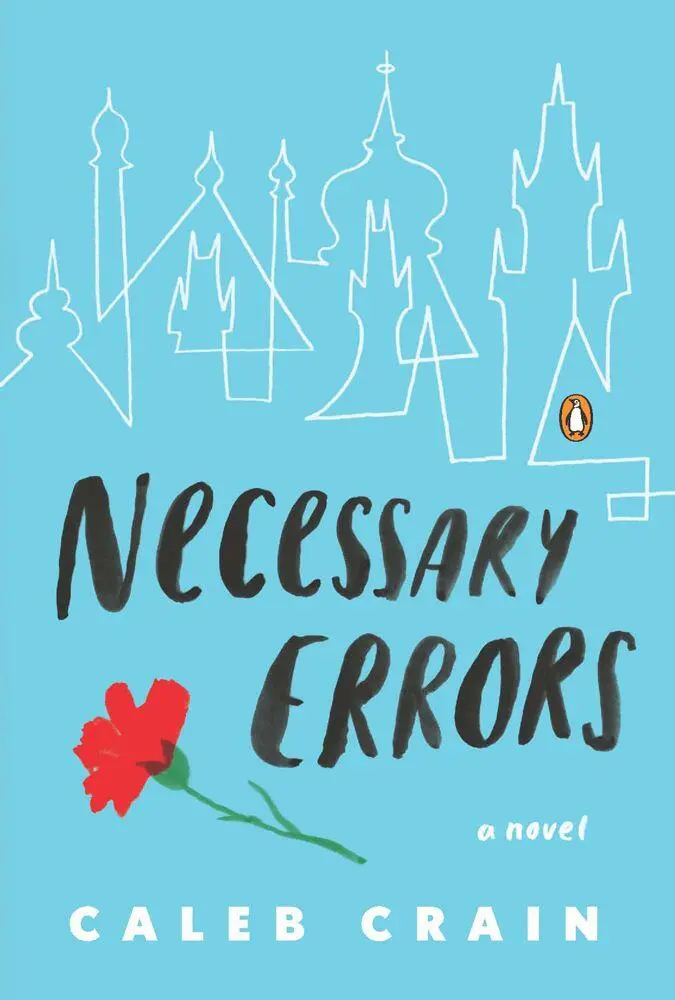
- Название:Necessary Errors
- Автор:
- Издательство:Penguin Books
- Жанр:
- Год:2013
- ISBN:нет данных
- Рейтинг книги:4 / 5. Голосов: 1
-
Избранное:Добавить в избранное
- Отзывы:
-
Ваша оценка:
Necessary Errors: краткое содержание, описание и аннотация
Предлагаем к чтению аннотацию, описание, краткое содержание или предисловие (зависит от того, что написал сам автор книги «Necessary Errors»). Если вы не нашли необходимую информацию о книге — напишите в комментариях, мы постараемся отыскать её.
Necessary Errors
Necessary Errors — читать онлайн бесплатно полную книгу (весь текст) целиком
Ниже представлен текст книги, разбитый по страницам. Система сохранения места последней прочитанной страницы, позволяет с удобством читать онлайн бесплатно книгу «Necessary Errors», без необходимости каждый раз заново искать на чём Вы остановились. Поставьте закладку, и сможете в любой момент перейти на страницу, на которой закончили чтение.
Интервал:
Закладка:
“How’d you hear about it?”
“Your man Vincent mentioned it. In his way. ‘Rather urban, compared to punting on the Cam, you know.’ Or some such dreadful thing. What is it you fancy about him, anyway? His lips? He does have nice lips.”
“His hair.”
“His curls. I like curls on a man as well. But he’s not worth it, Jacob. He’s not worth putting up with the rest of him. Mind where you’re taking us.”
“I was going to go through.”
“Through? You mean under?”
“There are boats on the other side.” The plain shadow of the Mánes Bridge fell over them, cooling them.
Annie craned her neck to look between the bridge’s piers. “So there are. I hadn’t seen them. I suppose it’s all right then.”
They passed through. The sun returned to them while the broad, slow-sloping stones of the bridge’s underside were still overhead. On the right bank the sun was hitting the bleached faces and orange roofs of Malá Strana’s old riverside palaces.
“Anyway I’m seeing someone again,” Jacob volunteered. “A Czech.”
“Are you, then.”
It was not as easy to tell Annie as it would have been to tell Melinda. Annie resisted hearing confessions. “We’re having a good time,” Jacob continued.
“Am I to congratulate you?”
“I’m just telling you about myself.”
“I suppose I am to congratulate you. Do you speak Czech with him?”
“I spoke it with Luboš.”
“I don’t know as I realized that.”
“But this isn’t like with Luboš. It isn’t serious.”
“That is the way, now,” she said, as if a little disappointed in him.
“I don’t mean I don’t like him. He’s nicer than Luboš. What I mean is there isn’t any mystery about it.”
He needed to catch his breath. He shipped the oars. Annie wasn’t looking at him. What he didn’t say was that he was beginning to wonder if this was the way one always ought to go to bed with people: as if it weren’t so meaningful, as if it were to one side of the story one was in.
“I don’t know as I should mind that, if I were you.”
“I don’t mind it. Maybe I’m not saying it right.”
“It might be quite pleasant, to be able to have that,” she said, speculatively. “To be unencumbered, as it were. Though I find in my own case there’s always a mystery, as you call it, if I’m soft on a person.”
The current was turning the skiff again. Jacob pulled on the oars to straighten it. He watched Annie’s eyes as she watched the Charles Bridge approach, and over his shoulder, every few strokes, he took a glimpse of the tall, jagged, two-story piers himself, so as to be able to aim the boat between two of them.
“Is it quite safe? With the current, I mean.”
“I’ll just have to row a little harder.”
They passed into the black water of the shade of the bridge. Out of the corner of either eye, Jacob watched the gray, triangular battlements slide up from behind and widen, approaching them on either side, in embrace. Then the bridge itself crossed overhead with its water-blackened stones. While it covered them, hands seemed cupped over their ears; all they could hear was the water’s eager lapping against the heavy walls beside them.
“Are you fair to him?” Annie asked.
The black stones lifted off, and the air was free and empty again around them. “It’s not like that.” He watched recede the semicircular — circular, in the water’s haphazard mirroring — portal through which they had passed.
“Isn’t it.”
“He’s going to Karlovy Vary himself, at the end of the summer.”
“Not quite to the other end of the world.”
“Are you going to stay past the summer?” Jacob asked.
“I might do,” she answered. She glanced at him. “Don’t you want to see how it comes out?”
Jacob slowed the pace of his rowing. The triangle of water that they were now drifting in had been smoothed by a weir just upriver. From a distance the river’s weirs could look decorative, like narrow cuffs sewn into the fabric of the water’s surface, but as their skiff came up to this one, which blocked any further headway, they were able to appreciate the mass and power of the water shoving itself over. The uniformity of the flow contributed to the impression that it gave of implacability; at every point, the same force was insistently pouring its heavy self downstream.
“It’s like that between Henry and me, too, now, I suppose,” Annie continued. She had to speak over the churn of the water. “Do you know, I thought I could persuade him to come boating, they give him an hour for lunch, but he wouldn’t do. I think he feared I might get ideas —that it would be too romantic like. But I only asked for the lark.”
Jacob let the current turn the skiff around. He told himself that while rowing back he would think about Annie’s question, the one about seeing how things came out, but a boat travels faster with the current than against it.
* * *
Once or twice a week, Milo spent the night, after having let his father know that he would be staying over at his new American friend’s place. Jacob always woke up early the next morning, eager for them to make love again in the new day. It was as if there were a contest between Jacob and the sun to see who could rise earlier. Spring was blowing into summer, and the sun was racing deeper and deeper into the mornings, but sometimes he managed to wake up into a half-light not unlike the half-light in which he had lived out so much of the winter, gray, tender, and general, though now it belonged not to dusk but dawn. The slate through the window was so even that from the bed it wasn’t possible to tell whether it colored a clear sky or one that was uniformly cloudy: the ambiguous color itself seemed to be its only real quality. Milo would be lying in bed beside him at a slant, faintly radiant in his pallor and nakedness, sheets and blanket twisted almost into ropes around and sometimes between his legs. Jacob watched the rise and fall of his ribs until he couldn’t watch peacefully any more and woke him.
There was never any recoil in Jacob, afterward. Because Jacob thought lovemaking was supposed to be free of such reaction, he didn’t wonder much about how he had got free of it. Once, though, when he was feeling pessimistic about himself, it occurred to him that any need he might feel to withdraw from Milo might be sufficiently expressed by the foreknowledge that he was soon going to leave Milo for good, and Prague, too.
A moment later, such a speculation seemed too cynical. The truth was that there was no need to pull back from Milo, who hopped into sex like a duck into a pond — dunked his head vigorously in, swam about happily, briskly shook his feathers clean afterward. He didn’t act as if the pleasure implied anything about what the two of them were going to do next, though it was clear he wasn’t likely to be averse to repeating it. With regard to the future, he seemed to consider Jacob, as an American, to belong to an order of being set somewhat apart — the order of those who don’t stay, who are a little comical in fact in their transience, an order in which he himself to some degree participated, in that at the end of the summer he was going to move to Karlovy Vary, a town full of tourists, and work for a casino, a cartoonishly capitalist enterprise.
Jacob wasn’t returning to America for the sake of school or any career that school might lead to. He was returning for the most part because it upset him that in Prague he had written so little — just one fragmentary story about Meredith. He was impatient with his lack of progress (it was to be a long time before he was able to reason with this kind of impatience, let alone resist it), and he hoped that America would force him to prove himself, rank himself. As a measure of self-discipline he was volunteering to give up the exemption that Prague had seemed to offer. It was only on account of having given it up, of having set himself a postponed reckoning, that he was able to let himself enjoy the summer that remained.
Читать дальшеИнтервал:
Закладка:
Похожие книги на «Necessary Errors»
Представляем Вашему вниманию похожие книги на «Necessary Errors» списком для выбора. Мы отобрали схожую по названию и смыслу литературу в надежде предоставить читателям больше вариантов отыскать новые, интересные, ещё непрочитанные произведения.




![Jakob Wassermann - Issue Does Not Exist],errors:{](/books/585068/jakob-wassermann-issue-does-not-exist-errors-thumb.webp)



Обсуждение, отзывы о книге «Necessary Errors» и просто собственные мнения читателей. Оставьте ваши комментарии, напишите, что Вы думаете о произведении, его смысле или главных героях. Укажите что конкретно понравилось, а что нет, и почему Вы так считаете.