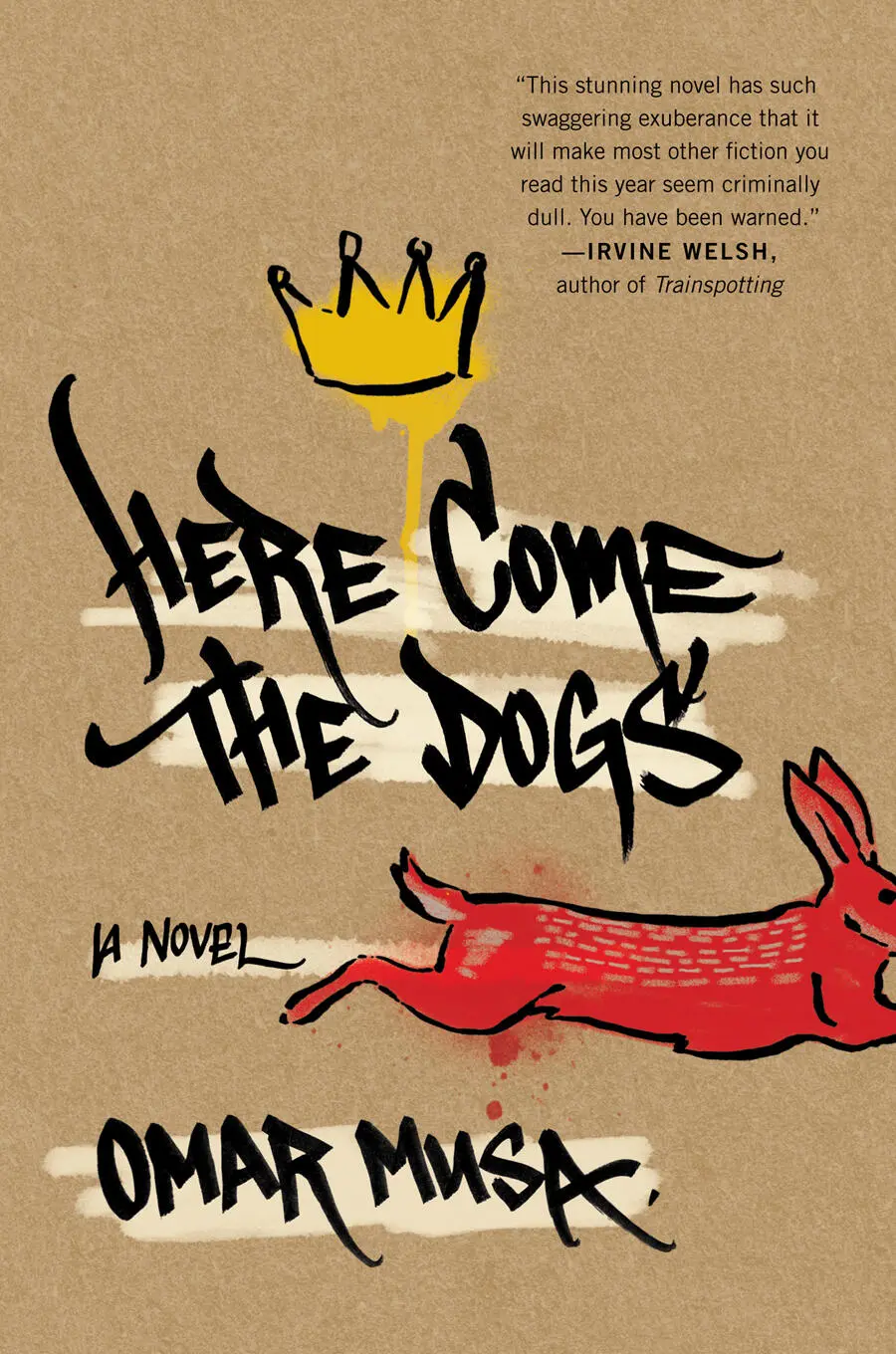
Omar Musa - Here Come the Dogs
Здесь есть возможность читать онлайн «Omar Musa - Here Come the Dogs» весь текст электронной книги совершенно бесплатно (целиком полную версию без сокращений). В некоторых случаях можно слушать аудио, скачать через торрент в формате fb2 и присутствует краткое содержание. Год выпуска: 2016, Издательство: The New Press, Жанр: Современная проза, на английском языке. Описание произведения, (предисловие) а так же отзывы посетителей доступны на портале библиотеки ЛибКат.
- Название:Here Come the Dogs
- Автор:
- Издательство:The New Press
- Жанр:
- Год:2016
- ISBN:нет данных
- Рейтинг книги:4 / 5. Голосов: 1
-
Избранное:Добавить в избранное
- Отзывы:
-
Ваша оценка:
Here Come the Dogs: краткое содержание, описание и аннотация
Предлагаем к чтению аннотацию, описание, краткое содержание или предисловие (зависит от того, что написал сам автор книги «Here Come the Dogs»). Если вы не нашли необходимую информацию о книге — напишите в комментариях, мы постараемся отыскать её.
Solomon, Jimmy, and Aleks are way out on the fringe of Australia, looking for a way in. Hip hop, basketball, and graffiti give them a voice. Booze, women, and violence pass the time while they wait for their chance. Under the oppressive summer sun, their town has turned tinder-dry. All it’ll take is a spark.
As the surrounding hills roar with flames, the change storms in. But it’s not what they were waiting for. It never is.
Here Come the Dogs — читать онлайн бесплатно полную книгу (весь текст) целиком
Ниже представлен текст книги, разбитый по страницам. Система сохранения места последней прочитанной страницы, позволяет с удобством читать онлайн бесплатно книгу «Here Come the Dogs», без необходимости каждый раз заново искать на чём Вы остановились. Поставьте закладку, и сможете в любой момент перейти на страницу, на которой закончили чтение.
Интервал:
Закладка:
but with gunpowder in his step now.
His jump shot like a heatseeker —
everything I taught him working at once.
Muhammad stops acting cocky for a moment
and seems pleased to see his mate so happy.
Some Sudanese kids have turned up,
one who’s nearly six-foot-three tall
at fifteen years old.
Diamond in the rough,
mad potential to be a good centre.
Word-of-mouth, ay?
I set up the cones
and I’m running drills with em
and finish with a proper five-on-five game.
I make sure to play music the whole time.
Most of kids are into Kerser,
but I play older shit
they mightn’t have ever heard.
Each one, teach one, ay?
The point of it all
Every point
a toe, heel or ball touches,
is a point on a map.
And the map
points to something.
When the kids leave
I put on my favourite album,
‘A Long Hot Summer’ by Masta Ace.
Something melancholy but resilient
about the rhymes and the chopped samples.
I dribble to the beats,
and for a moment it feels
as if my muscles and bone have sheared off
and I am one with the wind, the music.
I think about Aleks again
and feel guilty.
He’ll feel betrayed
that I haven’t visited him.
Sometimes I think his presence
is rupture to the music,
that negativity only breeds more of the same.
Shared history, though –
you can’t just let it off
a leash like a dog.
The ethereal synths of ‘Beautiful’
come on.
I tilt my head,
sniff the air –
the dusty, sherbet sky enters my nostrils,
my mouth, ears, skin.
A sign of rain?
I square up to the hoop,
jump straight up,
and flick the ball in a blazing arc
from the sideline.
Swish.
13
High winds and willy willies.
Summer marches through the trees, a giant headhunter, taking off skulls. Jimmy has drawn the blinds against it. He’s chopping weed in a bowl, watching Mercury as he sleeps. The room is dark but for an intermittent red light blink-blink blink-blinking from a computer screen. He lays the sticky scissors down, carefully rolls a joint on his knees and holds it up as one might an ancient conical shell found on a beach.
His eyes grow red as the orchids of smoke sink upwards and pancake on the ceiling.
He imagines optical fibre connecting him and the dog. It is taut, glowing, perfectly straight like a laser. He now tries to send shapes down the fibre with his mind — bones, balls, love hearts, race tracks, rabbits. As the smoke turns and uncoils, he stares, and images pulse down the invisible filament, growing bigger and bigger until they envelope the dog’s sleeping head and soak into it.
After half an hour, the dog opens its eye and raises its head. They stare at each other.
Hello, little dog. Hello, my friend, Jimmy says in his mind.
The dog raises its head further, nose up, sniffing the air. It doesn’t open its mouth, but the reply comes. ‘Hello, Jimmy. Hello, Jimmy, my master.’
Jimmy goes for a walk to get food and Mercury trots at his side, the points of its hipbones visible behind the skinny waist. An old bloke yells from across the street, ‘Give him the chilli finger, mate! He’ll run faster.’ Jimmy whispers to the dog, ‘Ignore him, Mercury.’
The air is dense and smokey. At the foot of a telephone pole, Jimmy sees a dead yellow-crested cockatoo. He hunkers down and stares at it for a full minute — its outstretched wings, its open beak, claws, eyes swirling with ants, feathers a subtle grade of yellow and white. Its fellow birds, arranged evenly on the powerlines, look down in silent vigil like worshippers on a pew.
The dead bird is huge, as long as his forearm, and has already begun to stink. He resists the urge to pick it up and weigh it in his arms. He tries to send it messages and shapes with his mind, but the filament is frayed halfway and the shapes dissipate in the air. He peers down the street and can see the red sun setting across the wild ridge that borders the edge of town.
That night he sketches the cockatoo in his torn blackbook. Its wings are spread, about to land on the powerlines. Behind it he imagines a fierce blue sky. MTN 94 Azure maybe? Aspen white and Pineapple Park yellow? He sits back and admires his work. He’ll get Aleks to paint it when he gets out.
He goes back the next day to see the dead cockatoo. There are now ten of them. All of them are strangely flattened, two-dimensional. Jimmy assumes it’s a combination of ants and the heat that has eaten them from the inside and collapsed them. He sits for a long time, looking at them. Hello, birds, he thinks. Hello, little birds, my friends.
No reply.
Trudging back to towards home, he passes the fire station, where trucks are polished to a high red, and the orange and silver firefighting gear is bunched on the wall. He walks inside and begins to touch it, running both hands over a helmet like a phrenologist. He then takes out a marker and tags up the side of the truck. He has only done several letters when he hears a man’s voice and Jimmy goes running.
The next day, the dead cockatoos are all gone.
14
‘Mr Crawford, I’m a volunteer fireman.’
‘Good for you, mate.’
‘Mr Crawford, err, our job has got harder over the last few years. I personally believe climate change has something to do with it. Surely this current spate of bushfires is as much the fault of climate change as firebugs. I mean, the fires started in early spring, six weeks out from summer. What do you say to that?’
‘I thank you for your question and applaud your good work. But let’s be real about climate change. This hysteria about its authenticity has been largely manufactured. This is an economic question, not an environmental one. Fires have been a part of the Australian landscape from time immemorial.’
15
Solomon is trying on clothes and jewellery in Scarlett’s room. He already has several sets of clothes there, neatly folded in the corner. There’s a look of stress in his eyes as he meticulously tries on different combos. Scarlett goes to say something but instead lets the cool air from a cheap fan run over her. She checks Facebook and stares at the endless parade of social media: friends back home offering opinions about Teina Pora, something about a missing plane and Jimmy, as usual, posting graff pics and photos of the dog. She puts on the Hermitude album ‘Hyperparadise’ and, as the chunky beats bump, she starts to sketch. Solomon eventually decides on a black-and-white checkered shirt, dark jeans and a pair of cool grey, black and infrared Jordans.
When they get to the City, they walk hand in hand past the merry-go-round, past the restaurants with ironic menus and pink lemonade in jam jars, past the bus interchange and straight to the noodle house. Scarlett’s surprised when Solomon ushers her towards a table where a woman is already sitting. She’s half lit, middle-aged, her profile leonine. She turns and her dark-brown eyes rest on Scarlett’s teardrop tattoo. Then she smiles broadly, shaking Scarlett’s hand and patting it with the other.
‘You must be Scarlett. I’m Grace — Solomon’s mum. So lovely to finally meet you. Solomona hasn’t stopped going on about you,’ she says.
Solomon looks down and smooths the front of his shirt.
‘And here I was thinking he took all this time to get ready for me. I knew it — such a mama’s boy,’ says Scarlett.
Solomon’s nervous, as if sharing a secret. He had mentioned in passing that he’d never introduced Georgie to his mother. The waiter comes over and he and Grace are soon engaged in banter about whether laksa is still Australia’s Asian noodle soup of choice, or pho. ‘That is not the question,’ he says with a wink, ‘the question is whether laksa is still Australia’s national dish or not.’
Читать дальшеИнтервал:
Закладка:
Похожие книги на «Here Come the Dogs»
Представляем Вашему вниманию похожие книги на «Here Come the Dogs» списком для выбора. Мы отобрали схожую по названию и смыслу литературу в надежде предоставить читателям больше вариантов отыскать новые, интересные, ещё непрочитанные произведения.






Обсуждение, отзывы о книге «Here Come the Dogs» и просто собственные мнения читателей. Оставьте ваши комментарии, напишите, что Вы думаете о произведении, его смысле или главных героях. Укажите что конкретно понравилось, а что нет, и почему Вы так считаете.