Chimamanda Adichie - Americanah
Здесь есть возможность читать онлайн «Chimamanda Adichie - Americanah» весь текст электронной книги совершенно бесплатно (целиком полную версию без сокращений). В некоторых случаях можно слушать аудио, скачать через торрент в формате fb2 и присутствует краткое содержание. Год выпуска: 2013, Издательство: Knopf, Жанр: Современная проза, на английском языке. Описание произведения, (предисловие) а так же отзывы посетителей доступны на портале библиотеки ЛибКат.
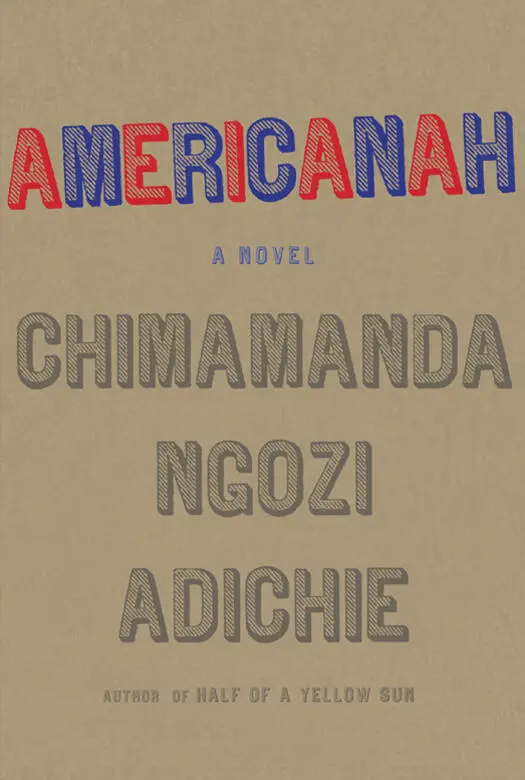
- Название:Americanah
- Автор:
- Издательство:Knopf
- Жанр:
- Год:2013
- ISBN:нет данных
- Рейтинг книги:4 / 5. Голосов: 1
-
Избранное:Добавить в избранное
- Отзывы:
-
Ваша оценка:
Americanah: краткое содержание, описание и аннотация
Предлагаем к чтению аннотацию, описание, краткое содержание или предисловие (зависит от того, что написал сам автор книги «Americanah»). Если вы не нашли необходимую информацию о книге — напишите в комментариях, мы постараемся отыскать её.
, a dazzling new novel: a story of love and race centered around a young man and woman from Nigeria who face difficult choices and challenges in the countries they come to call home.
As teenagers in a Lagos secondary school, Ifemelu and Obinze fall in love. Their Nigeria is under military dictatorship, and people are leaving the country if they can. Ifemelu — beautiful, self-assured — departs for America to study. She suffers defeats and triumphs, finds and loses relationships and friendships, all the while feeling the weight of something she never thought of back home: race. Obinze — the quiet, thoughtful son of a professor — had hoped to join her, but post-9/11 America will not let him in, and he plunges into a dangerous, undocumented life in London.
Years later, Obinze is a wealthy man in a newly democratic Nigeria, while Ifemelu has achieved success as a writer of an eye-opening blog about race in America. But when Ifemelu returns to Nigeria, and she and Obinze reignite their shared passion — for their homeland and for each other — they will face the toughest decisions of their lives.
Fearless, gripping, at once darkly funny and tender, spanning three continents and numerous lives,
is a richly told story set in today’s globalized world: Chimamanda Ngozi Adichie’s most powerful and astonishing novel yet.
Americanah — читать онлайн бесплатно полную книгу (весь текст) целиком
Ниже представлен текст книги, разбитый по страницам. Система сохранения места последней прочитанной страницы, позволяет с удобством читать онлайн бесплатно книгу «Americanah», без необходимости каждый раз заново искать на чём Вы остановились. Поставьте закладку, и сможете в любой момент перейти на страницу, на которой закончили чтение.
Интервал:
Закладка:
“If she married Obama then he can’t be that bad,” she joked often with Blaine, and Blaine would say, “True that, true that.”

SHE GOT an e-mail from a princeton.edu address and before she read it, her hands shook from excitement. The first word she saw was “pleased.” She had received the research fellowship. The pay was good, the requirements easy: she was expected to live in Princeton and use the library and give a public talk at the end of the year. It seemed too good to be true, an entry into a hallowed American kingdom. She and Blaine took the train to Princeton to look for an apartment, and she was struck by the town itself, the greenness, the peace and grace of it. “I got into Princeton for undergrad,” Blaine told her. “It was almost bucolic then. I visited and thought it was beautiful but I just couldn’t see myself actually going there.”
Ifemelu knew what he meant, even now that it had changed and become, in Blaine’s words, when they walked past the rows of shiny stores, “aggressively consumer capitalist.” She felt admiration and disorientation. She liked her apartment, off Nassau Street; the bedroom window looked out to a grove of trees, and she walked the empty room thinking of a new beginning for herself, without Blaine, and yet unsure if this was truly the new beginning she wanted.
“I’m not moving here until after the election,” she said.
Blaine nodded before she finished speaking; of course she would not move until they had seen Barack Obama through to his victory. He became a volunteer for the Obama campaign and she absorbed all of his stories about the doors he knocked on and the people behind them. One day he came home and told her about an old black woman, face shriveled like a prune, who stood holding on to her door as though she might fall otherwise, and told him, “I didn’t think this would happen even in my grandbaby’s lifetime.”
Ifemelu blogged about this story, describing the silver streaks in the woman’s gray hair, the fingers quivering from Parkinson’s, as though she herself had been there with Blaine. All of his friends were Obama supporters, except for Michael, who always wore a Hillary Clinton pin on his breast, and at their gatherings, Ifemelu no longer felt excluded. Even that nebulous unease when she was around Paula, part churlishness and part insecurity, had melted away. They gathered at bars and apartments, discussing details of the campaign, mocking the silliness of the news stories. Will Hispanics vote for a black man? Can he bowl? Is he patriotic?
“Isn’t it funny how they say ‘blacks want Obama’ and ‘women want Hillary,’ but what about black women?” Paula said.
“When they say ‘women,’ they automatically mean ‘white women,’ of course,” Grace said.
“What I don’t understand is how anybody can say that Obama is benefiting because he’s a black man,” Paula said.
“It’s complicated, but he is, and also to the extent that Clinton is benefiting because she’s a white woman,” Nathan said, leaning forward and blinking even more quickly. “If Clinton were a black woman, her star would not shine so brightly. If Obama were a white man, his star might or might not shine so brightly, because some white men have become president who had no business being president, but that doesn’t change the fact that Obama doesn’t have a lot of experience and people are excited by the idea of a black candidate who has a real chance.”
“Although if he wins, he will no longer be black, just as Oprah is no longer black, she’s Oprah,” Grace said. “So she can go where black people are loathed and be fine. He’ll no longer be black, he’ll just be Obama.”
“To the extent that Obama is benefiting, and that idea of benefiting is very problematic, by the way, but to the extent that he is, it’s not because he’s black, it’s because he’s a different kind of black,” Blaine said. “If Obama didn’t have a white mother and wasn’t raised by white grandparents and didn’t have Kenya and Indonesia and Hawaii and all of the stories that make him somehow a bit like everyone, if he was just a plain black guy from Georgia, it would be different. America will have made real progress when an ordinary black guy from Georgia becomes president, a black guy who got a C average in college.”
“I agree,” Nathan said. And it struck Ifemelu anew, how much everyone agreed. Their friends, like her and Blaine, were believers. True believers.
ON THE DAY Barack Obama became the nominee of the Democratic Party, Ifemelu and Blaine made love, for the first time in weeks, and Obama was there with them, like an unspoken prayer, a third emotional presence. She and Blaine drove hours to hear him speak, holding hands in a thick crowd, raising placards, CHANGE written on them in a bold white print. A black man nearby had hoisted his son onto his shoulders, and the son was laughing, his mouth full of milky teeth, one missing from the upper row. The father was looking up, and Ifemelu knew that he was stunned by his own faith, stunned to find himself believing in things he did not think he ever would. When the crowd exploded in applause, clapping and whistling, the man could not clap, because he was holding his son’s legs, and so he just smiled and smiled, his face suddenly young with joyfulness. Ifemelu watched him, and the other people around them, all glowing with a strange phosphorescence, all treading a single line of unbroken emotion. They believed. They truly believed. It often came to her as a sweet shock, the knowledge that there were so many people in the world who felt exactly as she and Blaine did about Barack Obama.
On some days their faith soared. On other days, they despaired.
“This is not good,” Blaine muttered as they went back and forth between different television channels, each showing the footage of Barack Obama’s pastor giving a sermon, and his words “God Damn America” seared their way into Ifemelu’s dreams.
SHE FIRST READ, on the Internet, the breaking news that Barack Obama would give a speech on race, in response to the footage of his pastor, and she sent a text to Blaine, who was teaching a class. His reply was simple: Yes! Later, watching the speech, seated between Blaine and Grace on their living room couch, Ifemelu wondered what Obama was truly thinking and what he would feel as he lay in bed that night, when all was quiet and empty. She imagined him, the boy who knew his grandmother was afraid of black men, now a man telling that story to the world to redeem himself. She felt a small sadness at this thought. As Obama spoke, compassionate and cadenced, American flags fluttering behind him, Blaine shifted, sighed, leaned back on the couch. Finally, Blaine said, “It’s immoral to equate black grievance and white fear like this. It’s just immoral .”
“This speech was not done to open up a conversation about race but actually to close it. He can win only if he avoids race. We all know that,” Grace said. “But the important thing is to get him into office first. The guy’s gotta do what he’s gotta do. At least now this pastor business is closed.”
Ifemelu, too, felt pragmatic about the speech, but Blaine took it personally. His faith cracked, and for a few days he lacked his bounce, coming back from his morning run without his usual sweaty high, walking around heavy-footed. It was Shan who unknowingly pulled him out of his slump.
“I have to go to the city for a few days to be with Shan,” he told Ifemelu. “Ovidio just called me. She’s not functioning.”
Читать дальшеИнтервал:
Закладка:
Похожие книги на «Americanah»
Представляем Вашему вниманию похожие книги на «Americanah» списком для выбора. Мы отобрали схожую по названию и смыслу литературу в надежде предоставить читателям больше вариантов отыскать новые, интересные, ещё непрочитанные произведения.








Обсуждение, отзывы о книге «Americanah» и просто собственные мнения читателей. Оставьте ваши комментарии, напишите, что Вы думаете о произведении, его смысле или главных героях. Укажите что конкретно понравилось, а что нет, и почему Вы так считаете.