Chimamanda Adichie - Americanah
Здесь есть возможность читать онлайн «Chimamanda Adichie - Americanah» весь текст электронной книги совершенно бесплатно (целиком полную версию без сокращений). В некоторых случаях можно слушать аудио, скачать через торрент в формате fb2 и присутствует краткое содержание. Год выпуска: 2013, Издательство: Knopf, Жанр: Современная проза, на английском языке. Описание произведения, (предисловие) а так же отзывы посетителей доступны на портале библиотеки ЛибКат.
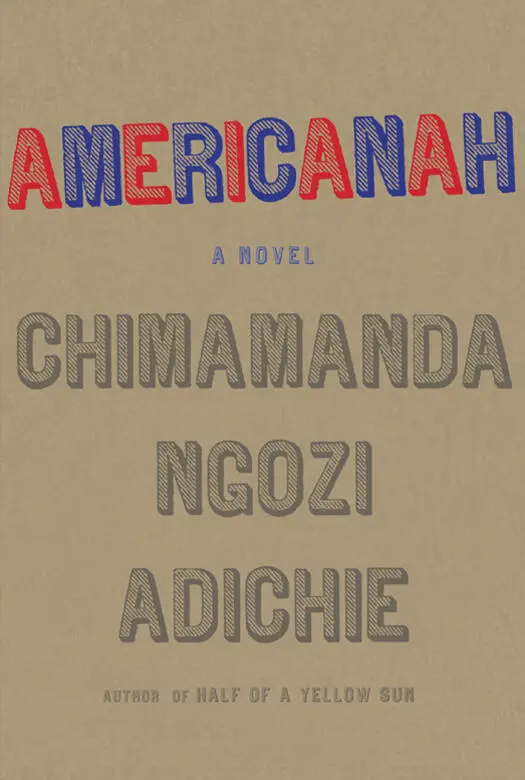
- Название:Americanah
- Автор:
- Издательство:Knopf
- Жанр:
- Год:2013
- ISBN:нет данных
- Рейтинг книги:4 / 5. Голосов: 1
-
Избранное:Добавить в избранное
- Отзывы:
-
Ваша оценка:
Americanah: краткое содержание, описание и аннотация
Предлагаем к чтению аннотацию, описание, краткое содержание или предисловие (зависит от того, что написал сам автор книги «Americanah»). Если вы не нашли необходимую информацию о книге — напишите в комментариях, мы постараемся отыскать её.
, a dazzling new novel: a story of love and race centered around a young man and woman from Nigeria who face difficult choices and challenges in the countries they come to call home.
As teenagers in a Lagos secondary school, Ifemelu and Obinze fall in love. Their Nigeria is under military dictatorship, and people are leaving the country if they can. Ifemelu — beautiful, self-assured — departs for America to study. She suffers defeats and triumphs, finds and loses relationships and friendships, all the while feeling the weight of something she never thought of back home: race. Obinze — the quiet, thoughtful son of a professor — had hoped to join her, but post-9/11 America will not let him in, and he plunges into a dangerous, undocumented life in London.
Years later, Obinze is a wealthy man in a newly democratic Nigeria, while Ifemelu has achieved success as a writer of an eye-opening blog about race in America. But when Ifemelu returns to Nigeria, and she and Obinze reignite their shared passion — for their homeland and for each other — they will face the toughest decisions of their lives.
Fearless, gripping, at once darkly funny and tender, spanning three continents and numerous lives,
is a richly told story set in today’s globalized world: Chimamanda Ngozi Adichie’s most powerful and astonishing novel yet.
Americanah — читать онлайн бесплатно полную книгу (весь текст) целиком
Ниже представлен текст книги, разбитый по страницам. Система сохранения места последней прочитанной страницы, позволяет с удобством читать онлайн бесплатно книгу «Americanah», без необходимости каждый раз заново искать на чём Вы остановились. Поставьте закладку, и сможете в любой момент перейти на страницу, на которой закончили чтение.
Интервал:
Закладка:
“Here’s Bill!” Shan said, hugging the muscular dark man in a fedora. “Bill is a writer but unlike the rest of us, he has oodles of money.” Shan was almost cooing. “Bill has this great idea for a travel book called Traveling While Black .”
“I’d love to hear about it,” Ashanti said.
“By the way, Ashanti, girl, I adore your hair,” Shan said.
“Thank you!” Ashanti said. She was a vision in cowries: they rattled from her wrists, were strung through her curled dreadlocks, and looped around her neck. She said “motherland” and “Yoruba religion” often, glancing at Ifemelu as though for confirmation, and it was a parody of Africa that Ifemelu felt uncomfortable about and then felt bad for feeling so uncomfortable.
“You finally have a book cover you like?” Ashanti asked Shan.
“ ‘Like’ is a strong word,” Shan said. “So, everyone, this book is a memoir, right? It’s about tons of stuff, growing up in this all-white town, being the only black kid in my prep school, my mom’s passing, all that stuff. My editor reads the manuscript and says, ‘I understand that race is important here but we have to make sure the book transcends race, so that it’s not just about race. And I’m thinking, But why do I have to transcend race? You know, like race is a brew best served mild, tempered with other liquids, otherwise white folk can’t swallow it.”
“That’s funny,” Blaine said.
“He kept flagging the dialogue in the manuscript and writing on the margins: ‘Do people actually say this?’ And I’m thinking, Hey, how many black people do you know? I mean know as equals, as friends. I don’t mean the receptionist in the office and maybe the one black couple whose kid goes to your kid’s school and you say hi to. I mean really know know. None. So how are you telling me how black people talk?”
“Not his fault. There aren’t enough middle-class black folks to go around,” Bill said. “Lots of liberal white folks are looking for black friends. It’s almost as hard as finding an egg donor who is a tall blond eighteen-year-old at Harvard.”
They all laughed.
“I wrote this scene about something that happened in grad school, about a Gambian woman I knew. She loved to eat baking chocolate. She always had a pack of baking chocolate in her bag. Anyway, she lived in London and she was in love with this white English guy and he was leaving his wife for her. So we were at a bar and she was telling a few of us about it, me and this other girl, and this guy Peter. Short guy from Wisconsin. And you know what Peter said to her? He said, ‘His wife must feel worse knowing you’re black.’ He said it like it was pretty obvious. Not that the wife would feel bad about another woman, period, but that she would feel bad because the woman was black. So I put it in the book and my editor wants to change it because he says it’s not subtle . Like life is always fucking subtle. And then I write about my mom being bitter at work, because she felt she’d hit a ceiling and they wouldn’t let her get further because she was black, and my editor says, ‘Can we have more nuance?’ Did your mom have a bad rapport with someone at work, maybe? Or had she already been diagnosed with cancer? He thinks we should complicate it, so it’s not race alone. And I say, But it was race. She was bitter because she thought if everything was the same, except for her race, she would have been made vice president. And she talked about it a lot until she died. But somehow my mom’s experience is suddenly unnuanced. ‘Nuance’ means keep people comfortable so everyone is free to think of themselves as individuals and everyone got where they are because of their achievement .”
“Maybe you should turn it into a novel,” Maribelle said.
“Are you kidding me?” Shan asked, slightly drunk, slightly dramatic, and now sitting yoga-style on the floor. “You can’t write an honest novel about race in this country. If you write about how people are really affected by race, it’ll be too obvious . Black writers who do literary fiction in this country, all three of them, not the ten thousand who write those bullshit ghetto books with the bright covers, have two choices: they can do precious or they can do pretentious. When you do neither, nobody knows what to do with you. So if you’re going to write about race, you have to make sure it’s so lyrical and subtle that the reader who doesn’t read between the lines won’t even know it’s about race. You know, a Proustian meditation, all watery and fuzzy, that at the end just leaves you feeling watery and fuzzy.”
“Or just find a white writer. White writers can be blunt about race and get all activist because their anger isn’t threatening,” Grace said.
“What about this recent book Monk Memoirs ?” Mirabelle said.
“It’s a cowardly, dishonest book. Have you read it?” Shan asked.
“I read a review,” Mirabelle said.
“That’s the problem. You read more about books than you read actual books.”
Maribelle blushed. She would, Ifemelu sensed, take this quietly only from Shan.
“We are very ideological about fiction in this country. If a character is not familiar, then that character becomes unbelievable,” Shan said. “You can’t even read American fiction to get a sense of how actual life is lived these days. You read American fiction to learn about dysfunctional white folk doing things that are weird to normal white folks.”
Everyone laughed. Shan looked delighted, like a little girl showing off her singing to her parents’ eminent friends.
“The world just doesn’t look like this room,” Grace said.
“But it can,” Blaine said. “We prove that the world can be like this room. It can be a safe and equal space for everyone. We just need to dismantle the walls of privilege and oppression.”
“There goes my flower child brother,” Shan said.
There was more laughter.
“You should blog about this, Ifemelu,” Grace said.
“You know why Ifemelu can write that blog, by the way?” Shan said. “Because she’s African. She’s writing from the outside. She doesn’t really feel all the stuff she’s writing about. It’s all quaint and curious to her. So she can write it and get all these accolades and get invited to give talks. If she were African American, she’d just be labeled angry and shunned.”
The room was, for a moment, swollen in silence.
“I think that’s fair enough,” Ifemelu said, disliking Shan, and herself, too, for bending to Shan’s spell. It was true that race was not embroidered in the fabric of her history; it had not been etched on her soul. Still, she wished Shan had said this to her when they were alone, instead of saying it now, so jubilantly, in front of friends, and leaving Ifemelu with an embittered knot, like bereavement, in her chest.
“A lot of this is relatively recent. Black and pan-African identities were actually strong in the early nineteenth century. The Cold War forced people to choose, and it was either you became an internationalist, which of course meant communist to Americans, or you became a part of American capitalism, which was the choice the African-American elite made,” Blaine said, as though in Ifemelu’s defense, but she thought it too abstract, too limp, too late.
Shan glanced at Ifemelu and smiled and in that smile was the possibility of great cruelty. When, months later, Ifemelu had the fight with Blaine, she wondered if Shan had fueled his anger, an anger she never fully understood.
Is Obama Anything but Black?
So lots of folk — mostly non-black — say Obama’s not black, he’s biracial, multiracial, black-and-white, anything but just black. Because his mother was white. But race is not biology; race is sociology. Race is not genotype; race is phenotype. Race matters because of racism. And racism is absurd because it’s about how you look. Not about the blood you have. It’s about the shade of your skin and the shape of your nose and the kink of your hair. Booker T. Washington and Frederick Douglass had white fathers. Imagine them saying they were not black.
Читать дальшеИнтервал:
Закладка:
Похожие книги на «Americanah»
Представляем Вашему вниманию похожие книги на «Americanah» списком для выбора. Мы отобрали схожую по названию и смыслу литературу в надежде предоставить читателям больше вариантов отыскать новые, интересные, ещё непрочитанные произведения.






Обсуждение, отзывы о книге «Americanah» и просто собственные мнения читателей. Оставьте ваши комментарии, напишите, что Вы думаете о произведении, его смысле или главных героях. Укажите что конкретно понравилось, а что нет, и почему Вы так считаете.