Jane Gardam - Old Filth
Здесь есть возможность читать онлайн «Jane Gardam - Old Filth» весь текст электронной книги совершенно бесплатно (целиком полную версию без сокращений). В некоторых случаях можно слушать аудио, скачать через торрент в формате fb2 и присутствует краткое содержание. Год выпуска: 2006, Издательство: Europa Editions, Жанр: Современная проза, на английском языке. Описание произведения, (предисловие) а так же отзывы посетителей доступны на портале библиотеки ЛибКат.
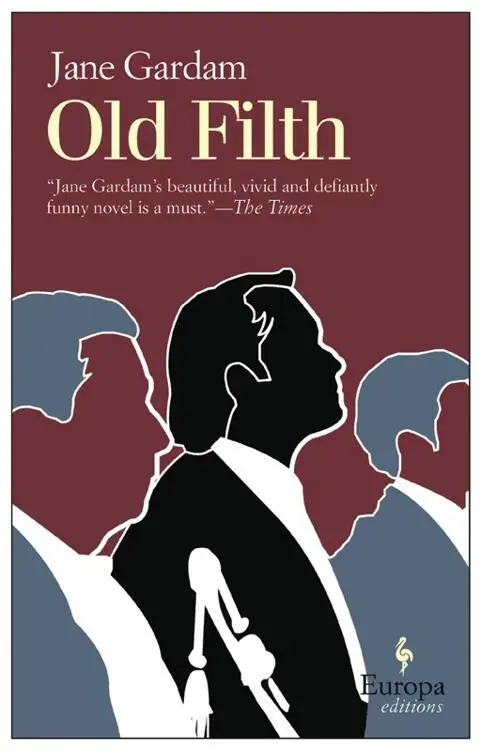
- Название:Old Filth
- Автор:
- Издательство:Europa Editions
- Жанр:
- Год:2006
- ISBN:нет данных
- Рейтинг книги:3 / 5. Голосов: 1
-
Избранное:Добавить в избранное
- Отзывы:
-
Ваша оценка:
Old Filth: краткое содержание, описание и аннотация
Предлагаем к чтению аннотацию, описание, краткое содержание или предисловие (зависит от того, что написал сам автор книги «Old Filth»). Если вы не нашли необходимую информацию о книге — напишите в комментариях, мы постараемся отыскать её.
Borrowing from biography and history, Jane Gardam has written a literary masterpiece reminiscent of Rudyard Kipling's
that retraces much of the twentieth century's torrid and momentous history. Feathers' childhood in Malaya during the British Empire's heyday, his schooling in pre-war England, his professional success in Southeast Asia and his return to England toward the end of the millennium, are vantage points from which the reader can observe the march forward of an eventful era and the steady progress of that man, Sir Edward Feathers, Old Filth himself, who embodies the century's fate.
Old Filth — читать онлайн бесплатно полную книгу (весь текст) целиком
Ниже представлен текст книги, разбитый по страницам. Система сохранения места последней прочитанной страницы, позволяет с удобством читать онлайн бесплатно книгу «Old Filth», без необходимости каждый раз заново искать на чём Вы остановились. Поставьте закладку, и сможете в любой момент перейти на страницу, на которой закончили чтение.
Интервал:
Закладка:
An old-time tar spat over the rail of his own ship.
“Is this the Breath o’Dunoon ?”
“It is, so. Step aboard.”
“Am I the only one? — the only evacuee?”
“Not at all, there’s one other. He’s below.”
Eddie clambered with his case down three metal ladders into smelly darkness and walked along a narrow passage that dipped towards the middle. It was way below the water line. Les Girls had not been interested in classes of cabin on the Breath o’Dunoon .
Nobody was to be seen. The sound of the sea slopped about. There was a dry, clicking noise coming from behind a cabin door.
He opened the door and found two bunks at right angles to each other, so narrow that they looked like shelves, each covered with a grey blanket. On the better bunk, seated cross-legged, was a boy, busy with a pack of cards. One of his very small hands he held high in the air above his head, the other cupped in his lap, and between the two, arrested in mid-air, hung an arc of coloured playing cards, held beautifully in space. As Eddie watched, the arc collapsed with lovely precision and became a solid pack again in the cupped hand.
“OK, how’s that?” said the boy. “Find the lady.”
He was an Oriental and appeared to be about ten-years old. His body, however, seemed to have been borrowed to fit the cabin and was that of a child of six. The crossed legs looked very short, the feet dainty. The features, when you looked carefully, were interesting for they were not Chinese though the eyes were narrow and tilted. He was not Indian and certainly not Malay. After thirteen years, Eddie still knew a Malay. The boy’s skin was not ivory or the so-called “yellow” but robust and ruddy red.
“OK then,” said the boy, “don’t find the lady. Just pick a card. Any card. OK?”
“I have to settle in.”
“You’ll have months for that. We’re in this rat hole for twelve weeks.”
“ What ! I hope not. I’m only going to Singapore.”
“Me too. Via Sierra Leone. Didn’t you know? We change ship at Freetown, if one turns up. Choose a card.”
Eddie sat on the other end of the bunk.
“Go on. Pick a card. No, don’t show me. Very good. Nine of diamonds. Right?”
It was the nine of diamonds.
“Are you some sort of professional?”
“Professional what?”
“Card-sharp.”
“Yes,” said the boy. “You could look at it that way. I’m Albert Loss. I’d be Albert Ross — I have Scottish blood — but I can’t say my Rs, being also Hakka Chinese. Right?”
“Why can’t other people call you Albert Ross?”
“You can, if you want. They did at school. And they called me Coleridge. ‘Albat Ross.’ Right? Ancient Mariner . They like having me on board ships, sailors. Albatrosses bring them luck.”
“Are you a professional sailor, too?”
“I’ve been around,” said Loss. “D’you play Crib?”
“No.”
“I’ll teach you Crib.”
“Are there going to be some more of us on the ship?”
“More what?”
“Well—” (with shame) “—evacuees.”
“No idea. I think it’s just the pair of us. OK? Pick another card.”
“I’m going back on deck,” said Eddie.
“OK. I’ll come with you. Watch them loading. It’s corned beef. We unload at Freetown and she’ll sail full of bananas.”
“Bananas? To the Far East?”
“Don’t be stupid. We change ship at Freetown, hang about. The bananas get taken Home by the Breath o’Dunoon for the Black Market and the Commandos.”
“I’ve not seen any bananas in three years.”
“Well, you’re not in the know. You can eat plenty in Freetown. Flat on your back. Nothing moves in Freetown. There’s RAF there, and they’ve all gone mad. Talking to monkeys. Mating with monkeys.”
“How do you know all this?”
“Common knowledge. I’ve done this trip before. Often.”
“How old are you?”
The boy looked outraged. Eddie saw the long eyes go cold. Then soft and sad. “That’s a question I don’t often answer, but I’ll tell you. I’m fourteen,” and he took from his pocket a black cigarette with a gold tip, and lit it.
Thirty-six hours later there were signs that the huge herd of ships might be thinking of sailing. Eddie asked again if they were the only passengers.
“Four months. Just you and I.”
“I suppose so.” Loss spat black shag at the seagulls. “Shag to shags,” he said. “I am also rather witty. I’m a master of languages as well. I could teach you Malay.”
“I speak Malay,” said Eddie. “I was born there.”
“Mandarin, then? Hindi. All one. Nice watch.”
“It was my father’s.”
Days, it seemed, later they saw the last of Ireland sink into the sea. The prow of the ship seemed to be seeking the sunset, such as it was, rainy and pale. Great grey sea-coloured ships like lead pencils stood about the ocean and smaller brisker ships nosed about them. The Breath o’Dunoon looked like a tramp at a ball. The Atlantic lay still beneath its skin.
“We’re in a convoy.”
“Well, of course, we’re in a convoy,” said Loss. “We can’t go sailing off to Africa alone. We’re not a fishing boat. It’s a widespread War.
“Mind you,” he added, “we’d probably get there faster if we were a fishing boat. The convoy always goes the speed of the slowest ship. And we’re headed out to the West for days on end, to get clear of the U-Boats. Nearly to America, zig-zagging all the way.
“Am I right?” he condescendingly enquired of the Captain at whose none too clean table they were dining. The Captain ignored him and spooned up treacle pudding.
“Is that all we’re going to do all the time? I’ve brought no books. I thought it would be just a few days.”
“You can do the cooking if you like,” said the Engineer Officer. “You couldn’t do worse than this duff. It’s made of lead shot. Can you cook, Mr. Feathers?”
“No, not at all.”
“I can cook,” said Loss, “but only French cuisine.”
“You can both peel spuds,” said the Captain, “but remember to take that watch off, Feathers.”
“And keep it away from him ,” said the Engineer Officer, pointing at Loss. “Ask me, he’s escaped from a reformatory school for delinquents.”
“It was Eton,” said Loss. “I was about to go to Eton. Do you play Crib?”
“Not now,” said the Sparks, “but I’ll thrash you when I do.”
They left the rickety Breath o’Dunoon at Freetown for a blazing beach where the air throbbed like petrol fumes. The jungle hung black. Black people were immobile under palm trees. Nobody seemed to know what should happen next. After a shabby attempt at examination by the customs, where interest was taken in the watch, the two of them stood about, waiting for instructions. There were none. The crew of the Breath o’Dunoon were taking their ease before the unloading of the cans of meat, and the Captain had disappeared. There was a suggestion that they should give up their passports which they ignored.
Heat such as Eddie had never known blasted land and sea. The smell of Africa was like chloroform. Inland from the port were dancing-hot tin sheds, one with a red cross on it, asphalt, some apologies for shops, and RAF personnel in vests and shorts. More black people stood about in the shadows beneath the trees.
Beyond the white strip of beach the mango forests began and Albert Loss sat down neatly under a palm tree and ate one, first peeling off the skin with a little knife from his pocket, then sucking. He took out a notebook and began to make calculations. Eddie ate bananas and thought about the buttermilk girl, with some satisfaction.
Читать дальшеИнтервал:
Закладка:
Похожие книги на «Old Filth»
Представляем Вашему вниманию похожие книги на «Old Filth» списком для выбора. Мы отобрали схожую по названию и смыслу литературу в надежде предоставить читателям больше вариантов отыскать новые, интересные, ещё непрочитанные произведения.









Обсуждение, отзывы о книге «Old Filth» и просто собственные мнения читателей. Оставьте ваши комментарии, напишите, что Вы думаете о произведении, его смысле или главных героях. Укажите что конкретно понравилось, а что нет, и почему Вы так считаете.