Jane Gardam - Old Filth
Здесь есть возможность читать онлайн «Jane Gardam - Old Filth» весь текст электронной книги совершенно бесплатно (целиком полную версию без сокращений). В некоторых случаях можно слушать аудио, скачать через торрент в формате fb2 и присутствует краткое содержание. Год выпуска: 2006, Издательство: Europa Editions, Жанр: Современная проза, на английском языке. Описание произведения, (предисловие) а так же отзывы посетителей доступны на портале библиотеки ЛибКат.
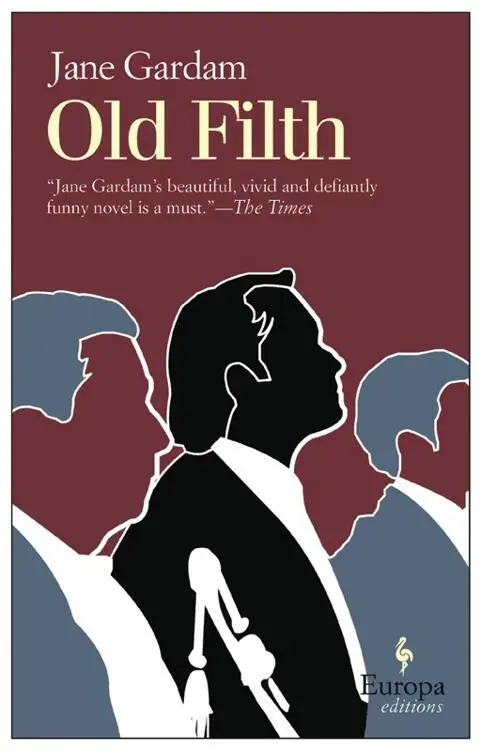
- Название:Old Filth
- Автор:
- Издательство:Europa Editions
- Жанр:
- Год:2006
- ISBN:нет данных
- Рейтинг книги:3 / 5. Голосов: 1
-
Избранное:Добавить в избранное
- Отзывы:
-
Ваша оценка:
Old Filth: краткое содержание, описание и аннотация
Предлагаем к чтению аннотацию, описание, краткое содержание или предисловие (зависит от того, что написал сам автор книги «Old Filth»). Если вы не нашли необходимую информацию о книге — напишите в комментариях, мы постараемся отыскать её.
Borrowing from biography and history, Jane Gardam has written a literary masterpiece reminiscent of Rudyard Kipling's
that retraces much of the twentieth century's torrid and momentous history. Feathers' childhood in Malaya during the British Empire's heyday, his schooling in pre-war England, his professional success in Southeast Asia and his return to England toward the end of the millennium, are vantage points from which the reader can observe the march forward of an eventful era and the steady progress of that man, Sir Edward Feathers, Old Filth himself, who embodies the century's fate.
Old Filth — читать онлайн бесплатно полную книгу (весь текст) целиком
Ниже представлен текст книги, разбитый по страницам. Система сохранения места последней прочитанной страницы, позволяет с удобством читать онлайн бесплатно книгу «Old Filth», без необходимости каждый раз заново искать на чём Вы остановились. Поставьте закладку, и сможете в любой момент перейти на страницу, на которой закончили чтение.
Интервал:
Закладка:
They stood for the Nunc Dimittis , and Oliver wondered what havoc Vanessa was wreaking on poor old Uncle Eddie.
“Have you always practised in Dorset?” asked Vanessa from her canvas chair.
“No, no. I returned there. Travelled a lot.”
“That was rather good luck.”
“Very good luck.”
“You found some ex-pat clients? Over the years?”
“Not exactly ex-pats,” he said. “The locals.”
“I often think,” she said (Vanessa was magnanimous to people who were no threat), “that to be a family solicitor, in any country, is to be the most useful person in the world. You have to be so subtle. And cleverer than any Barrister. Anyone can be a Barrister. The Bar finals are a joke, you know. Solicitors’ finals,” she said, “are a marathon by comparison.”
“I believe so. So they always said. But it is so long ago.”
She thought: He is quite unaware of me. He is Methuselah. Why do I care? He is so mysterious. I hadn’t expected to be drawn to someone as old as this. Sad silence. He’s so old he’s almost gone, yet he’s sharp — sharper than Oliver. I like his eyes. I wish he’d open them again.
The striped canvas hammock had come from Harrods — a present from Oliver to his mother, last birthday, like the huge, navy-blue sun-umbrella worked by rope pulleys, as for a yacht, supposed to be supported by a dollop of concrete that the window-cleaner and the gardener and the Vicar together had not been able to budge from where the van-man had dropped it by the gate. Claire had begun to grow trailing plants over this base and the umbrella, unwrapped but in cobwebs, was still propped in a corner of the car-less garage. Today Oliver had made an effort and had fixed up the hammock, just before lunch. It hung inside an outer wooden cradle, rather like a horse-jump at a gymkhana. There were no trees in Claire’s garden and the hammock stood out in high display. Passers by along the avenue looked curiously at the old long person stretched out in it, fine nose pointed at the winter sky.
A rope hung beside the hammock ending in a baroque blue tassel.
“I could swing you if you like,” Vanessa suggested, wondering at herself. She had refused Filth’s offer of the hammock for herself as firmly as she always refused a seat from a man on the Underground. She often offered her own seat on the Underground to an older woman. Sometimes these older women refused, too, not feeling older. Great games are played on the Underground, she thought, the premier sport being that everyone avoids everyone else’s eyes. Oh, how happy I am to have enough to think about. Work to do. How pleased I am to have mastered the pleasure — never acknowledged — when scanned, leaned against, breathed upon in the Underground by a man. I’ve got rid of that.
“Do you mind being stuck up here in the hammock in full view of Saffron Walden, Eddie?”
They had called him Eddie. And sometimes Teddy. They had not properly introduced him. They behaved as if she must know him. “Shall I give you a swing with the rope?”
“You sound like Mr. Pierrepoint,” he said, without opening his eyes. “I don’t feel exposed. No, not at all, thank you. No, I don’t need to be rocked.”
“Who is Mr. Pierrepoint?”
“I’m glad you can’t remember. He was the hangman. His last hanging was of a woman, Ruth Ellis, who shot her unfaithful lover a few weeks after losing his baby and whilst her mind was disturbed.”
“Oh yes, well, of course, I know about that. They buried her in quick-lime at Wormwood Scrubs prison, didn’t they?”
“They did. Before you were born, but not long before, I think.”
“I think,” she said, pouring tea through Claire’s Edwardian tea-strainer, “we have to forgive history a very great deal.”
“I think,” he said, “that we should forgive history almost nothing.
“I met the government hangman of Hong Kong,” he said soon, a breeze over the dahlias, a breeze over the lake, the hammock gently moving. Hot, hot November. “Had a long talk with him. An Englishman. Not a bad man. Not at all sadistic. Just unimaginative and conformist. Common, ugly English man. A good husband, I believe.”
“Hadn’t two wives left Pierrepoint though?”
“Yes. Yes, there was that. I am glad of that.”
“And he resigned after Ruth Ellis didn’t he?”
“Yes. That was interesting.”
“You’ve had a varied practice then, down in Dorset?”
“I told you, young woman, I retired to Dorset long ago. Away from the cut and thrust. The heat and dust.”
At heat and dust something flickered in Vanessa’s head. A novel? A film? Something to do with lawyers abroad? “Have you Oriental blood?” Filth asked.
“Certainly not, I come from Bournemouth.”
“You remind me of someone with kind hands. You are very beautiful. How old are you?”
“I’m thirty-two.”
“Did you have children? When you were young? You must have Oriental blood. Your age is not obvious.”
“Well thanks, I’m sure. You’ll be saying ‘younger than she are married mothers made’ next.”
“Oh, I’m not interested in your past life.”
“Well, I’m glad of that. You’re not like my parents.”
“What about Oliver?”
“Oh, he doesn’t think about it. Never has. Marriage, kids. Good God, no!”
“Then he’ll leave you,” said Filth, closing his eyes.
“Let him. He’d miss me.”
Filth said nothing.
“It’s the way of the world now,” she said. “It must be incomprehensible to your generation.”
“Not entirely.”
“It won’t change back, you know. We meet, we part. Life is pretty long nowadays to be satisfied by a single sexual partner.”
“And my lot will soon all be dead?” said Filth.
“Oh, of course I don’t mean that — that your generation is without influence. No. Personally , I respect your generation. I respect your attachment to duty and the Law, your lifetime dedication. But we live so long now that there’s time for three or four professions and partnerships. And we all have aides—” “Yes, you have Aids,” said Filth. “I don’t know much of the technicalities of ‘Aids’ with small or upper case ‘A.’”
“You see us, though — don’t you — as negative?” she said. “Selfish? Everyone under, say, forty?”
“At the moment I feel it about everyone under a century but I dare say this will pass. My wife would have no patience with me.”
“I’m sorry you’ve lost your wife. Was it long ago? I’d have enjoyed meeting her,” said Vanessa kindly to the imagined Betty: the marmalade-maker, Bridge-player, no doubt churchflower arranger, and the grandchildren in the holidays. “Did you have many children?”
“We had no children.”
Should she say she was sorry? Then she knew she was sorry. Sorry for him. The wife was probably—
“Sorry,” she said.
“It was deliberate. Think carefully before you bring children into the world. Betty and I were what is called ‘Empire orphans.’ We were handed over to foster parents at four or five and didn’t see our parents for at least four years. We had bad luck. Betty’s foster parents didn’t like her and mine — my father hadn’t taken advice — were chosen because they were cheap. If you’ve not been loved as a child, you don’t know how to love a child. You need prior knowledge. You can inflict pain through ignorance. I was not loved after the age of four and a half. Think of being a parent like that.”
“Yes. I suppose.”
“A parent like you, for instance, young woman. What child would want a parent like you?”
She was furious. “ I was loved,” she said. “I’m still loved by my parents, thank you very much. And I love them. We have difficulties, but it’s normal family life.”
Читать дальшеИнтервал:
Закладка:
Похожие книги на «Old Filth»
Представляем Вашему вниманию похожие книги на «Old Filth» списком для выбора. Мы отобрали схожую по названию и смыслу литературу в надежде предоставить читателям больше вариантов отыскать новые, интересные, ещё непрочитанные произведения.









Обсуждение, отзывы о книге «Old Filth» и просто собственные мнения читателей. Оставьте ваши комментарии, напишите, что Вы думаете о произведении, его смысле или главных героях. Укажите что конкретно понравилось, а что нет, и почему Вы так считаете.