John Wray - The Lost Time Accidents
Здесь есть возможность читать онлайн «John Wray - The Lost Time Accidents» весь текст электронной книги совершенно бесплатно (целиком полную версию без сокращений). В некоторых случаях можно слушать аудио, скачать через торрент в формате fb2 и присутствует краткое содержание. Год выпуска: 2016, ISBN: 2016, Издательство: Farrar, Straus and Giroux, Жанр: Современная проза, Фантастика и фэнтези, на английском языке. Описание произведения, (предисловие) а так же отзывы посетителей доступны на портале библиотеки ЛибКат.
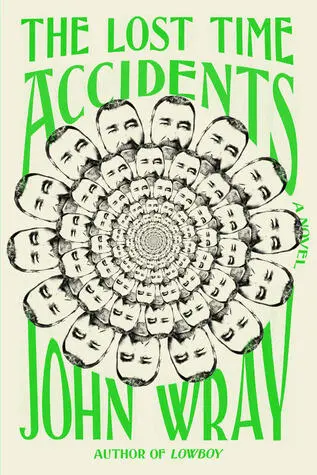
- Название:The Lost Time Accidents
- Автор:
- Издательство:Farrar, Straus and Giroux
- Жанр:
- Год:2016
- ISBN:9781429944526
- Рейтинг книги:4 / 5. Голосов: 1
-
Избранное:Добавить в избранное
- Отзывы:
-
Ваша оценка:
The Lost Time Accidents: краткое содержание, описание и аннотация
Предлагаем к чтению аннотацию, описание, краткое содержание или предисловие (зависит от того, что написал сам автор книги «The Lost Time Accidents»). Если вы не нашли необходимую информацию о книге — напишите в комментариях, мы постараемся отыскать её.
, John Wray takes us from turn-of-the-century Viennese salons buzzing with rumors about Einstein's radical new theory to the death camps of World War Two, from the golden age of postwar pulp science fiction to a startling discovery in a Manhattan apartment packed to the ceiling with artifacts of modern life.
Haunted by a failed love affair and the darkest of family secrets, Waldemar 'Waldy' Tolliver wakes one morning to discover that he has been exiled from the flow of time. The world continues to turn, and Waldy is desperate to find his way back-a journey that forces him to reckon not only with the betrayal at the heart of his doomed romance but also the legacy of his great-grandfather's fatal pursuit of the hidden nature of time itself.
Part madcap adventure, part harrowing family drama, part scientific mystery-and never less than wildly entertaining-
is a bold and epic saga set against the greatest upheavals of the twentieth century.
The Lost Time Accidents — читать онлайн бесплатно полную книгу (весь текст) целиком
Ниже представлен текст книги, разбитый по страницам. Система сохранения места последней прочитанной страницы, позволяет с удобством читать онлайн бесплатно книгу «The Lost Time Accidents», без необходимости каждый раз заново искать на чём Вы остановились. Поставьте закладку, и сможете в любой момент перейти на страницу, на которой закончили чтение.
Интервал:
Закладка:
“What is all this stuff?”
“I thought you’d never ask! It’s an archive.”
I was old enough to know that people were supposed to collect expensive things, or rare things, or things that fit together in some way; these looked as though they’d been scavenged at the Cheektowaga landfill. A fencing mask, a Dixie Cup, a credit card, an upside-down jar with the shell of a bug underneath it: any object takes on authority, of a kind, when singled out and given pride of place. But the sheer quantity of items on display, and the contrast of their battered condition to the customized perfection of the shelves, repelled interpretation like an antimagnet. It was my first physical encounter with paradox, Mrs. Haven, and it made me feel hollow and weak. My aunts’ apartment was now a museum of sorts — I understood that much — but a museum whose only curator, as far as I could see, was chance.
“What kind of an archive?” I asked her at last.
“The Archive of Accidents. That’s what my sister calls it. It’s beautiful, wouldn’t you say?”
I frowned at her. “Accidents? What do you mean?”
“I have to keep myself amused ,” she said, lowering her voice. “My sister has her work, you know, and I have mine.”
No one had ever spoken to me as an adult before, and it thrilled me almost as much as it confused me. I had no idea what to say next.
“I find things, Waldy,” she went on. “I notice things, and occasionally I take them.” She giggled. “Every man-made thing can be thought of as a work of art, you know. You’re familiar with The Shape of Time , by Kubler?”
I opened my mouth to speak. No sound emerged.
“No? Then let me read a bit to you.” She reached blindly behind her and plucked the book down from a shelf, like a conjuror producing a bouquet.
“I’ll begin, as the mock turtle advises, at the beginning.
“‘Let us suppose that the idea of Art can be expanded to embrace the whole range of man-made things, including all tools and writing in addition to the useless, beautiful, and poetic things of the world. By this view the universe of man-made things simply coincides with the history of Art. In effect, the only tokens of history continually available to our senses are the desirable things made by men.’”
As she read I looked past her, past the ceiling-high matrix of shelves, past a personal computer and a dressmaker’s mannequin and a stuffed kinkajou, toward the shadows at the turning of the hallway. The hallway had refused to conform to my expectations as my aunt led me inward, rushing toward us when my attention was diverted, then holding unnaturally still — resisting any and all acknowledgment of our forward motion — as though we’d stepped into the forced perspective of a painting. I was seven years old, an age at which the world still changes shape and hue according to one’s mood; but there was something unnatural, irresolvable, about the boundaries of that space. I sensed this right away, Mrs. Haven, as clearly as I sensed the anxiety behind my aunt’s coquettishness.
“‘Such things mark the passage of Time with far greater accuracy than we know, and they fill Time with shapes of a limited variety. Like crustaceans, we depend for survival upon an outer skeleton, upon a shell of historic houses and apartments filled with things belonging to definable portions of the past.’”
“That’s what I’m after with this little collection,” my aunt said, closing the book with a snap. “To approach every man-made thing as if it ought to be in a museum. Everything I see out there”—here she waved a hand vaguely (and with a bit of a shudder, I thought)—“could potentially have a place in here. Isn’t that terribly exciting, Waldemar?”
I struggled to come up with some worldly-sounding comment, as I did when watching football with my father. “How do you decide what to take?”
“Excellent question!” She looked proudly about her. “In theory, of course, this collection should be infinite. I suppose that we’ll have to expand.”
“What’s back there?” I asked, pointing toward the hallway’s turning.
“Where?”
“Back there. Where it starts to get dark.”
“You must be hungry ,” my aunt said, returning the book to its shelf. “I baked a peach cobbler this morning. It’s not easy to find peaches, you know, at this time of—”
“I have to go to the bathroom.”
“Of course, dear! The WC’s right behind you. Don’t trouble yourself about that dressmaker’s dummy — just waltz it right out of the way.”
Aside from its arched ceiling and acid-green walls, the only point of interest in the WC was the toilet seat, which was upholstered in chocolate pile. My aunt said something through the door that I didn’t quite catch, then tittered to herself and trundled off. Every so often I heard an odd noise, like the moving-about of heavy furniture. I made a game of trying to guess what it could be.
The hallway seemed darker when I came back out. I could hear my father’s voice not too far off, speaking more guardedly than I was used to, and a woman’s voice asking him questions. I stood still for a time, trying to make out what was being said, savoring the delectable thrill all children feel when spying on their elders. The voices were tantalizingly close, just shy of intelligibility; I crawled toward them on my hands and knees to keep the floor from creaking. My father was talking about someone they all seemed to know, someone who had to be handled with tact, even caution — a delicate case, not as simple as it might appear.
“I’m aggrieved to hear that,” came the voice of the woman. Not the one who’d led me down the hallway — the other one. Aunt Enzian.
“Let’s not get melodramatic here,” my father said. “He isn’t who you thought he was, that’s all.”
“He is ,” said Enzian. “He has to be.”
“Listen to me. He’s too suggestible, too fragile—”
“We’ll handle him gently, Orson. Like an egg.”
It took him a moment to answer. His voice had gone high and wheedling, the voice of the boy he’d once been. Whatever it was that my aunts wanted, it was clear his defenses were crumbling. It had never before occurred to me that there might be things, let alone human beings, of which or whom my father was afraid.
“Explain to me, one more time, what you need his help for.”
It was Gentian who answered. “We need him to believe in us, Peanut. To go where we can’t. As we’ve tried to explain—”
“We need him to jump,” came Enzian’s voice. “He has the best chance of any of us. It has to be him, Orson. There’s nobody else.”
“There’s you, isn’t there? What the hell have you been doing all these years?”
“My work,” Enzian answered, her voice hard as slate. “And I’ll say it again, little brother: I’ve done my work well. But I’m not the one to make the world take notice, and neither is Genny. We’d thought we could rely on you — but you decided otherwise. You decided to write smut instead.”
To my great surprise my father didn’t argue.
“There was no other option,” he murmured. “Not for me. I didn’t believe in the Accidents.” He was quiet a moment. “I still don’t, no matter what you say.”
“What is it that you do believe in, then?” said Gentian. “You must believe in something.”
“In my family,” my father spat out — then stopped short, as if surprised at his own answer. “I believe in this family.” He paused again, then mumbled, “God knows I wouldn’t be here if I didn’t.”
“ Give him to us,” said Enzian. “We had an understanding, Orson. We had a covenant.”
Читать дальшеИнтервал:
Закладка:
Похожие книги на «The Lost Time Accidents»
Представляем Вашему вниманию похожие книги на «The Lost Time Accidents» списком для выбора. Мы отобрали схожую по названию и смыслу литературу в надежде предоставить читателям больше вариантов отыскать новые, интересные, ещё непрочитанные произведения.


Обсуждение, отзывы о книге «The Lost Time Accidents» и просто собственные мнения читателей. Оставьте ваши комментарии, напишите, что Вы думаете о произведении, его смысле или главных героях. Укажите что конкретно понравилось, а что нет, и почему Вы так считаете.