John Wray - The Lost Time Accidents
Здесь есть возможность читать онлайн «John Wray - The Lost Time Accidents» весь текст электронной книги совершенно бесплатно (целиком полную версию без сокращений). В некоторых случаях можно слушать аудио, скачать через торрент в формате fb2 и присутствует краткое содержание. Год выпуска: 2016, ISBN: 2016, Издательство: Farrar, Straus and Giroux, Жанр: Современная проза, Фантастика и фэнтези, на английском языке. Описание произведения, (предисловие) а так же отзывы посетителей доступны на портале библиотеки ЛибКат.
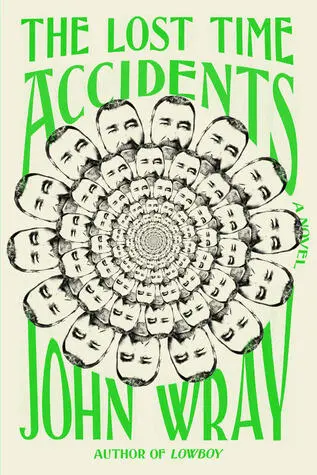
- Название:The Lost Time Accidents
- Автор:
- Издательство:Farrar, Straus and Giroux
- Жанр:
- Год:2016
- ISBN:9781429944526
- Рейтинг книги:4 / 5. Голосов: 1
-
Избранное:Добавить в избранное
- Отзывы:
-
Ваша оценка:
The Lost Time Accidents: краткое содержание, описание и аннотация
Предлагаем к чтению аннотацию, описание, краткое содержание или предисловие (зависит от того, что написал сам автор книги «The Lost Time Accidents»). Если вы не нашли необходимую информацию о книге — напишите в комментариях, мы постараемся отыскать её.
, John Wray takes us from turn-of-the-century Viennese salons buzzing with rumors about Einstein's radical new theory to the death camps of World War Two, from the golden age of postwar pulp science fiction to a startling discovery in a Manhattan apartment packed to the ceiling with artifacts of modern life.
Haunted by a failed love affair and the darkest of family secrets, Waldemar 'Waldy' Tolliver wakes one morning to discover that he has been exiled from the flow of time. The world continues to turn, and Waldy is desperate to find his way back-a journey that forces him to reckon not only with the betrayal at the heart of his doomed romance but also the legacy of his great-grandfather's fatal pursuit of the hidden nature of time itself.
Part madcap adventure, part harrowing family drama, part scientific mystery-and never less than wildly entertaining-
is a bold and epic saga set against the greatest upheavals of the twentieth century.
The Lost Time Accidents — читать онлайн бесплатно полную книгу (весь текст) целиком
Ниже представлен текст книги, разбитый по страницам. Система сохранения места последней прочитанной страницы, позволяет с удобством читать онлайн бесплатно книгу «The Lost Time Accidents», без необходимости каждый раз заново искать на чём Вы остановились. Поставьте закладку, и сможете в любой момент перейти на страницу, на которой закончили чтение.
Интервал:
Закладка:
A slew of anecdotal portraits were written about my aunts after their deaths: some affectionate, some lurid, a few of them nearly book-length. All the standard explanations were put forward. Often as not, the gossip rags viewed them as an old sapphic couple — incestuous, possibly, but more likely not sisters at all — which rumor neither of them seems to have discouraged. They were photographed often, and appear to have enjoyed striking poses: Carl Van Vechten took a snapshot (later much reproduced) showing Genny in a rumpled and corseted ball gown, and Enzie in a lab coat, playing the mad scientist to the hilt, resting her hands on her sister’s plump hips in what can only be described as a proprietary manner. Genny, for her part, is staring into the camera more frankly than I ever saw her do in life, secure in the knowledge that only a handful of people would see the result.
It’s not the least of the ironies in this history, Mrs. Haven, that this portrait would be reproduced in every newspaper in New York just a few decades later.
Van Vechten was far from the sisters’ only illustrious guest during their heyday, though their quota of Bowery bums and shop clerks never wavered. Harry Smith was a regular, entertaining all comers with his trick of tying human figures out of string; Eldridge Cleaver, by at least three accounts, showed up one night in ’69 with Sinatra’s stepdaughter — the one who couldn’t sing — but split when he saw William F. Buckley stagger drunkenly out of the loo. The dinners had become huge productions by then, almost monstrous: one night Genny counted fifty-seven dirty champagne flutes. The Aga Khan graced the General Lee, as did Joe Dallesandro, Charles Mingus, Buckminster Fuller, and Joan Didion, who published an account of her visit when “The Tolliver Case” was the talk of the town. I include it here in its entirety.
ENZIAN AND GENTIAN TOLLIVER: A
THOUGHT EXPERIMENT.
It’s a pretty nice evening and not much is happening so someone suggests that we go see the Sisters. Not having any idea who the Sisters might be, I wonder aloud whether they won’t object — it’s past ten o’clock on a Wednesday — but LaMont waves my question aside. “They’re having one of their nights,” he says, as if that explains things.
Who are the Sisters? I ask.
“The Sisters,” LaMont says again, with feeling. “Those crazy shut-in birds in Spanish Harlem.”
I remind him, politely, that I’ve only just arrived from Sacramento.
“They’re hermits,” says Jessup, coming to my rescue. “At least the older one is. She’s a physicist or something, but she spends all her time in that crumbly flat in that crumbly building with the ridiculous name. It’s called the General Lee, if you can believe it. And it’s smack in the middle of Harlem.”
The General Lee, it turns out, is what one might expect — a poor man’s Dakota in soot-stained concrete — but the Sisters are another thing entirely. One is plump and wide-eyed and childlike, and the other reminds me, to a startling degree, of Joan Crawford in the role of Mildred Pierce. There is only a strangeness about the eyes, and a kind of desperate indifference to fashion, to hint at the kinship between them. They are named, apparently, after a species of Austrian herb. Their accents are unclassifiable. One doesn’t think of them paying electric bills, or using the telephone, or addressing one another by their Christian names.
“It’s time for a ‘Mischung!’” the more compact sister, the one named Gentian, announces at the top of her voice. “Everybody switches to the right!”
We all change seats as directed, with the exception of the Sisters themselves. The feeling is not so much of a dinner party as of teatime in some rarefied asylum. The table sags under the weight of a huge mass of china, nearly all of it filthy. The party seems to have been going on for as long as anybody can remember.
It’s always six o’clock, I say to the guest on my left, an eager young man from Montevideo. To my surprise he recognizes the quote, and completes it for me, as if we’re exchanging a password.
“Yes, that’s it. It is always teatime, and we’ve no time to wash the things between the whiles.”
Time is a pet topic here at the Sisters’—in some curious sense, the only topic — though I haven’t fully realized that yet.
On this particular Wednesday — a slow night for the Sisters, I gather — only thirty-seven people have shown up for dinner, so there is plenty left over for us. When I praise the leek stew to the one who looks like Mildred Pierce, her head turns with a jerk, and I find myself in the considerable heat of her attention.
“We are discussing the ‘grandmother paradox,’ Miss Didion. Do you know what this paradox means?”
I believe it has to do with time travel of some kind, I reply.
“Time travel into the past,” says Enzian. “The grandmother paradox is the primary objection to such travel. Summarize, Gustavo, if you please.”
Gustavo, who turns out to be the nice young man from Uruguay, and who describes himself to me, later that same evening, as a “forensic physicist,” leans gracefully forward.
“A man chrononavigates into the past, to a time before his parents were conceived. This man, by chance or design, sets a chain of events in motion that results in the death of his grandmother. Does our chrononaut himself cease to exist?”
“Gracías, Geraldo.”
“De nada, maestra.”
The table grows quiet. It’s clear that I’m expected to respond. I’ve had a number of gin-and-hot-waters by this point in the evening, so I ask why the poor little grandmother has been singled out for destruction. Why not the time traveler’s mother, for example? Come to think of it, why not his father?
Gustavo considers my question. “Quién sabe,” he says. “Too sentimental?”
“That is not here or there,” Enzian cuts in. “The objection has always been that these two realities — the reality containing the chrononaut, and the reality in which he has been extinquished — cannot both exist, and yet they must both exist. The chrononaut has to exist in order to extinguish himself; but as soon as the deed is accomplished, he must therefore vanish.”
I acknowledge that this would seem to pose a problem.
“But there is a solution,” she says, laying her mannish hands flat on the table. “Paradoxes ought not to exist — but they continue to do so, despite our objections. Some even exist physically: for example, the Möbius strip.” She pauses briefly here, assessing me. “The Möbius strip, Miss Didion, shows us how effortlessly the universe can accommodate incompatible realities. We can stare at a Möbius strip, hold it in our hands and examine it, and still refuse to understand what we are seeing.”
The conversation is tending toward the metaphysical, someone observes.
“Allow me to quote from Ouspensky,” a bespectacled negro says suavely. “‘What does “metaphysics” mean, ultimately, but physics considered from a place above?’”
At this point things start to get lively.
“You must bring your ideas to the world,” my Montevidean acquaintance urges. “Take them to Princeton — to the Institute for Advanced Study. Oppenheimer is there. He may listen.”
“I have no interest in the opinions of that death fetishist,” Enzian snaps. “My father had no dealings with Dr. Oppenheimer, and neither shall I.”
For a while no one speaks. At the far end of the table a man with a grizzled gray beard is slurping Chablis out of what appears to be a soup tureen. He is later identified for me, by my husband, as an editor of the “Partisan Review.”
Читать дальшеИнтервал:
Закладка:
Похожие книги на «The Lost Time Accidents»
Представляем Вашему вниманию похожие книги на «The Lost Time Accidents» списком для выбора. Мы отобрали схожую по названию и смыслу литературу в надежде предоставить читателям больше вариантов отыскать новые, интересные, ещё непрочитанные произведения.



Обсуждение, отзывы о книге «The Lost Time Accidents» и просто собственные мнения читателей. Оставьте ваши комментарии, напишите, что Вы думаете о произведении, его смысле или главных героях. Укажите что конкретно понравилось, а что нет, и почему Вы так считаете.